
Neither approach is necessarily good inventory planning.
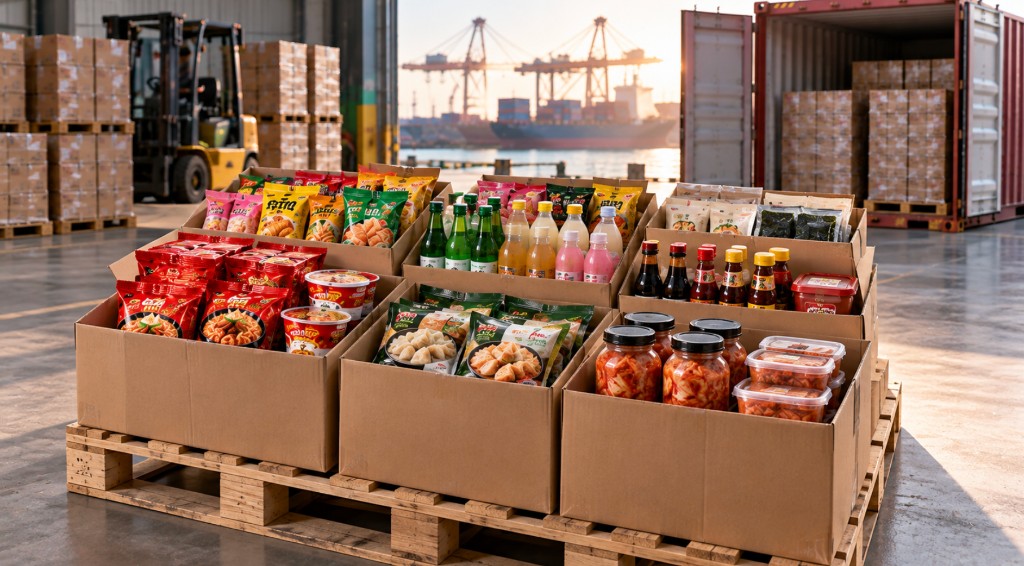
A first mixed order should give the importer enough variety to discover what the market wants without putting too much capital behind products that have not yet proved themselves. That means deciding which products deserve meaningful stock, which products should enter as tests, how much container space each category should receive and whether the resulting order can still be imported compliantly and sold at a workable landed cost.
The purpose of the first shipment is therefore different from the purpose of the tenth shipment. A mature importer already has sales history. A new importer is paying partly for inventory and partly for information.
The order should reflect that uncertainty.
Start with the market before opening the Korean catalogue
An importer can spend days selecting products from a Korean wholesale catalogue and still build the wrong order if it has not looked carefully at the destination market.
The first work should happen locally.
Look at the Korean and Asian food already being sold. Check the retail price of ramen, beverages, seaweed, snacks and sauces. Look at package sizes. Note which products occupy significant shelf space and which categories appear limited. Speak to the retailers that will actually buy the products.
If a supermarket customer says it wants Korean drinks between a particular retail price range, that information should affect the sourcing process before products are selected.
Suppose a Korean beverage looks attractive at USD 0.90 from the supplier. After freight, duty and other applicable import costs, the estimated landed cost becomes USD 1.20. Once importer, distributor and retailer economics are added, the product may need to retail at USD 2.50.
If comparable drinks in the destination market sell around USD 1.50, the product may be commercially difficult regardless of how attractive it looked in the Korean catalogue.
That problem should be discovered before the carton is purchased.
The first order needs core products and test products
The buyer should not treat every selected SKU with the same level of confidence.
Some products will have stronger evidence behind them. A retailer may already have requested them. Similar products may sell well in the market. They may belong to established categories such as noodles, beverages or seaweed where demand is already visible.
Those products can form the core of the shipment.
Other products are experiments. A new flavour, unfamiliar brand or unusual snack may look promising, but the importer does not yet know whether customers will purchase it twice.
Those products should receive smaller quantities wherever MOQ permits.
Suppose the buyer plans a 1,000-carton mixed shipment. Putting 800 cartons into completely untested SKUs would expose most of the order to assumptions. Putting nearly everything into three established products would teach the importer very little about what else the market might accept.
The correct balance depends on the buyer’s sales channel, but the principle is useful: certainty should earn quantity.
A product requested by ten existing retail customers should normally receive more inventory than a product somebody internally thinks will become popular.
The first container does not need to predict every future bestseller. It needs to keep mistakes affordable.
Do not confuse brand variety with useful assortment
A catalogue containing fifty Korean brands may look impressive. The customer may not need fifty brands.
Assortment should be built around different purchasing reasons rather than around the number of logos represented.
If the buyer selects ten ramen brands that all sit at the same price, pack size and consumer position, the products may simply compete with each other inside the importer’s own catalogue.
A healthier range may contain fewer brands but clearer differences. There may be an entry-price product, a premium product, a recognised brand, a spicy line, a milder line and a small number of experimental flavours.
The same thinking applies to beverages and snacks.
The importer should ask what role each SKU plays.
If Product B has essentially the same consumer, price and flavour as Product A, there should be a reason for carrying both.
This becomes important when working capital is limited. Every duplicate SKU divides sales and leaves less money available to keep the strongest lines in stock.
A large catalogue can therefore create the appearance of choice while weakening availability.
For a wholesale importer, being reliably in stock on the products customers repeatedly buy is usually more valuable than being able to show them hundreds of products that are available only occasionally.
Build quantities around the next order
A useful way to determine quantities is to decide when the importer expects to purchase again.
Suppose the buyer wants a new Korean shipment approximately every three months. For a product expected to sell forty cartons per month, three months of demand represents around 120 cartons before any safety stock is considered.
A test product expected to sell only five or ten cartons per month should not automatically receive the same 120-carton allocation.
This sounds basic, but mixed orders frequently become distorted because buyers focus on carton MOQs instead of months of inventory.
If a supplier requires sixty cartons of a product and expected sales are ten cartons per month, the importer is purchasing six months of inventory.
If the business intends to reorder every two months, that SKU is already carrying three purchasing cycles of stock.
That may still be acceptable if shelf life is long and the product is strategically important, but it should be a conscious decision.
The buyer should therefore convert MOQ into months of expected demand whenever possible.
A low MOQ is useful because it allows a buyer to test more products. A low MOQ does not automatically make a product worth importing.
Shelf life can decide how much of a product belongs in the order
A first shipment naturally contains more demand uncertainty than a repeat shipment. That makes remaining shelf life particularly important.
Imagine two new products that the buyer expects to sell at similar rates. One can leave Korea with eleven months remaining. The other will have only six months remaining.
The second product gives the importer far less time to discover whether its forecast was correct.
Shipping, customs clearance and domestic distribution consume part of those six months before the product even reaches the final retailer. Retailers may also require a minimum amount of shelf life when receiving stock.
This means a first-order quantity should be based on usable commercial shelf life, not simply the printed expiry period.
For ready stock, ask what dates are actually available.
For products requiring new production, understand the expected production schedule.
For a mixed shipment, check dates again before loading because different suppliers may deliver different batches.
A product with excellent pricing becomes expensive very quickly if the importer has to discount half of it because the commercial selling window was too short.
Compliance can remove products from the order before price does
A buyer may find the right product, the right MOQ and the right price and still need to remove the SKU.
The reason can be compliance.
Food-import requirements depend on the destination and product. Ingredient restrictions, labelling, allergen declarations, nutrition information, manufacturer documentation, product registration, Halal requirements and sanitary certificates can all affect whether a SKU is suitable for a market.
This needs to be checked before the final order is confirmed.
The Korean exporter can obtain product information and documentation from manufacturers and handle the Korean side of the export transaction. The importer still needs to establish what its destination market requires.
If a retailer requires Halal-certified products, for example, the buyer should verify the actual SKU and certificate scope rather than selecting products because a manufacturer uses a Halal logo somewhere in its catalogue.
If the destination requires particular label information, the buyer should confirm that the necessary product data is available before hundreds of cartons are purchased.
A mixed order makes this more important because forty products can mean forty separate compliance questions.
Products should therefore pass a commercial check and a compliance check before becoming final inventory.
Use landed cost to decide which products deserve container space
Supplier price is particularly misleading in a mixed shipment.
A lightweight but bulky snack may have a very low purchase price while consuming a large amount of CBM. A compact sauce may cost much more per carton but use shipping space efficiently.
The importer should estimate the landed cost of serious candidates before finalising the mix.
This does not require perfect numbers at the first stage. Estimated freight allocation, duty and destination costs are enough to identify products whose economics are obviously weak.
Suppose a snack costs USD 12 per carton but lands at USD 19 because of its carton volume.
Another product costs USD 16 and lands at USD 20.
The four-dollar supplier-price difference has become a one-dollar landed-cost difference.
If the second product has stronger demand and better retail pricing, it may deserve the space.
Container capacity should therefore be treated as a scarce resource.
The question is not simply whether another carton fits.
The question is whether that carton deserves the space more than the alternatives.
Do not fill the last part of the container with weak products
This is where otherwise sensible orders often become bad ones.
The buyer and exporter finish planning the shipment and discover that there is additional container capacity available.
The instinct is to use all of it.
If the buyer has established products that will need replenishment soon, increasing those quantities may be commercially sensible.
If the only way to fill the remaining space is adding large quantities of slow or untested products, leaving some capacity unused can be the cheaper decision.
The freight cost of unused space is visible immediately.
The cost of overstock appears slowly through warehouse occupancy, ageing stock, markdowns and cash tied up in products that are not moving.
This makes overbuying psychologically easy. The full container looks efficient on the day it ships.
Its real efficiency is determined several months later by how much of the inventory has turned back into cash.
Consolidating brands only works if product data is controlled
One of the advantages of buying through a multi-brand Korean exporter is that products from several manufacturers can be assembled into a single commercial programme.
The operational complexity moves to Korea.
The buyer still needs visibility.
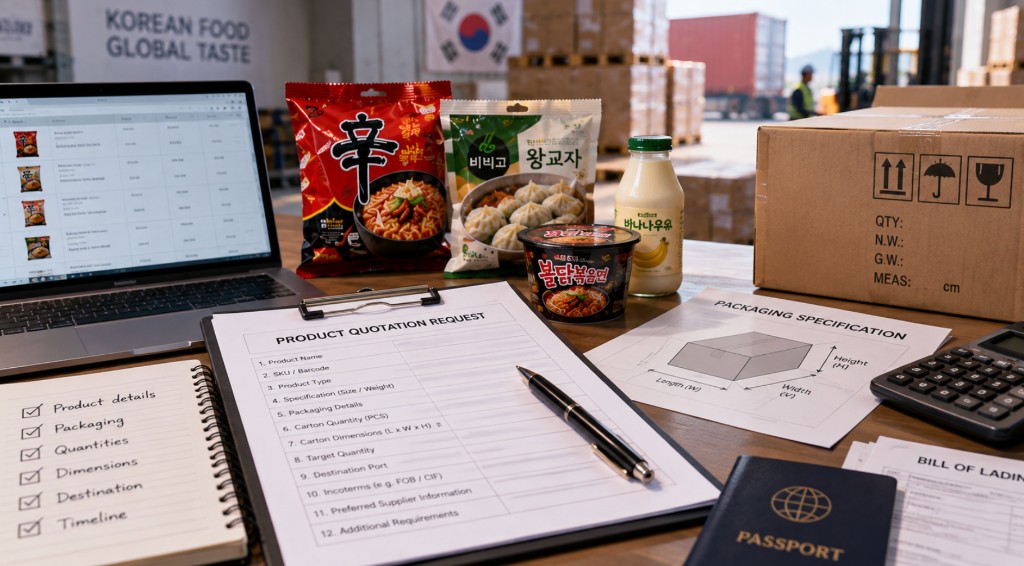
Every SKU should have a clear product identity. Carton configuration, dimensions, weight, MOQ, manufacturer and shelf-life information should be controlled. When applicable, relevant certificates and specifications should remain linked to the product.
Without this information, a mixed order becomes difficult to manage because the importer cannot compare products accurately.
It also becomes harder to repeat successful orders.
If the first shipment contains eighty SKUs and nobody maintains reliable product data, the second shipment begins almost from zero.
A proper product master turns the first order into reusable purchasing information.
This is particularly important when a business begins with dozens of brands and later discovers that a relatively small group of SKUs generates most of the repeat demand.
The importer should be able to identify those products quickly and reorder them without repeating the original sourcing exercise.
The first shipment should have an experiment budget
A practical way to control risk is to decide how much of the order can be experimental.
Suppose an importer has USD 100,000 available for its first Korean food programme.
Using the full USD 100,000 on products without proven demand creates a large market bet.
The buyer may instead decide that a substantial part of the capital will go toward products with retailer commitments or strong evidence, while a defined portion will be used for testing new products.
The exact percentage is a business decision. The important part is creating the limit before the catalogue is opened.
Otherwise every attractive product becomes “just another few cartons,” and the experimental portion of the order can quietly become most of the shipment.
The same rule can apply to container space.
New products can receive a controlled amount of CBM, while proven or strongly supported products receive the majority.
This gives the importer room to discover unexpected winners without allowing discovery to dominate the purchasing budget.
The second order tells you whether the first order worked
The first shipment proves that the importer can buy the products.
The second shipment begins to prove whether the business works.
After the stock reaches the market, the buyer should track retailer reorders rather than focusing only on the initial sell-in.
Which products were reordered?
How quickly?
Which products sold once and then stopped?
Which SKUs were unavailable when retailers wanted more?
Which products remain in the warehouse?
Which products required discounts?
Which categories produced the best gross contribution relative to the amount of capital invested?
These answers should shape the next mixed order.
A product that repeatedly sells deserves more cartons.
A test product that develops repeat demand can graduate into the core assortment.
A slow product should receive fewer cartons or disappear.
The importer can then introduce another controlled group of new products without allowing the catalogue to expand endlessly.
Over several shipments, the mix should become more concentrated around evidence.
That is how a mixed Korean food programme becomes commercially stronger.
The benefit of multi-brand sourcing is not the ability to buy the maximum number of Korean products.
It is the ability to buy different products at quantities appropriate to their demand, combine them into a workable shipment, and let actual market performance decide what deserves more space next time.