
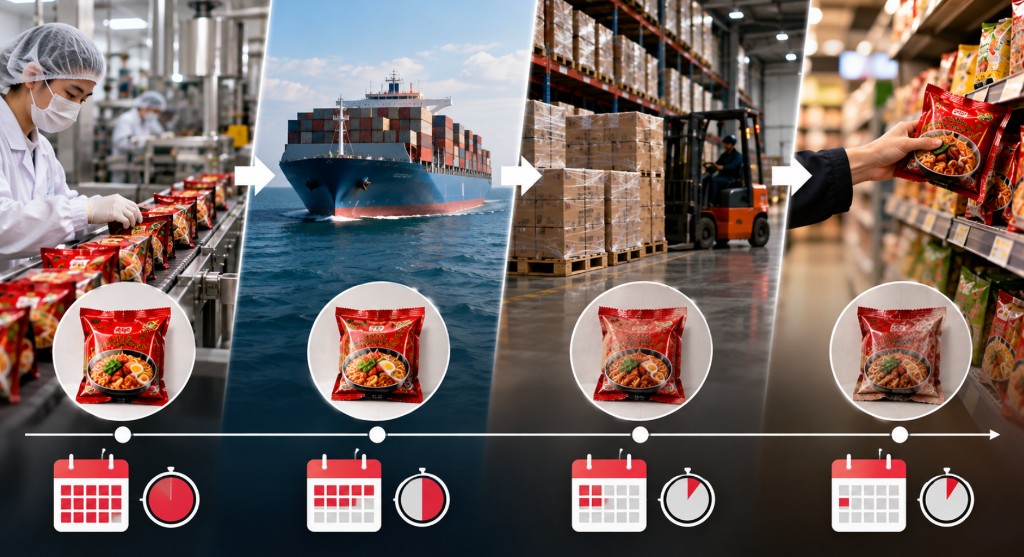
Take a simple example. A Korean snack is manufactured in January with a twelve-month shelf life. The importer places an order in April, when the stock is already three months old. If the shipment then takes another six to eight weeks to move through consolidation, ocean freight, clearance and domestic distribution, the product may reach retailers with only seven months remaining. If those retailers require a minimum of four months of remaining shelf life when they receive the stock, the importer does not really have seven months to work with. The commercially useful selling window may be closer to three months.
This is why experienced buyers tend to ask about remaining shelf life at dispatch, not only the total shelf life printed in the catalogue.
Shelf life should be treated as part of the supply chain
The shelf-life clock keeps running while the goods are moving. A product may spend several days waiting for other suppliers to deliver into a consolidation warehouse. There may be another delay before vessel departure. Ocean transit can take several weeks, followed by port handling, customs clearance and warehouse receiving. After that, the importer may still need another week or two to distribute the product across its customer network.
These periods are easy to ignore because none of them appears on the supplier’s price list. Together, however, they can consume a significant part of the product’s commercial life.
A useful way to think about this is to start with the shelf life remaining when the goods leave Korea and subtract all the time required before the product becomes available for sale. The retailer’s minimum acceptance requirement should then be deducted as well.
Suppose a product has 300 days remaining when it is dispatched. International freight, customs and local receiving consume 45 days. Domestic distribution takes another 15 days. If the retailer requires at least 120 days remaining when the product is delivered, the importer effectively has around 120 days of commercial flexibility. That is the period in which the stock has to move before retailer acceptance becomes an issue.
For purchasing decisions, that 120-day window is more informative than the original “12 months shelf life” statement.
Why the percentage of shelf life remaining matters
Some importers use a percentage requirement when buying products with different shelf lives. A buyer may specify, for example, that at least 75% of the original shelf life must remain at the time of dispatch.
This can be useful because it creates a consistent purchasing rule across a large catalogue. A product with 300 days remaining from a total shelf life of 365 days has around 82% remaining. Another product with 120 days remaining from a total life of 180 days has around 67% remaining.
Even so, percentages should always be viewed alongside actual calendar time. Eighty percent remaining on a three-month product is very different from sixty-five percent remaining on an eighteen-month product. The first product may still give the importer only a few weeks of practical flexibility after shipping and distribution.
For that reason, many buyers are better served by recording both the percentage remaining and the number of days or months remaining.
Shelf life should influence how much you buy
This is where shelf life becomes an inventory problem rather than a quality-control detail.
Imagine that a distributor expects to sell 100 cartons of a product every month. The supplier offers 600 cartons at an attractive price, and the stock has seven months remaining. At first glance, the order appears workable because six months of inventory is being purchased against seven months of remaining shelf life.
That calculation ignores the supply chain.
If two months disappear during shipping, customs and distribution, only five months remain. If the distributor’s customers stop accepting the product once less than two months remain, the importer has only about three months in which the stock can move normally. At an expected sales rate of 100 cartons per month, only around 300 cartons may sell within that commercial window.
The discount on the additional 300 cartons does not look attractive anymore.
This is one of the most common ways a good purchase price turns into poor inventory economics. The product itself may be fine. The problem is that the quantity purchased does not match the time available to sell it.
A simple calculation helps. Divide the order quantity by the expected monthly sales. If 240 cartons are being purchased and the product sells at roughly 60 cartons per month, the importer is buying four months of inventory. That figure should then be compared with the realistic selling window after freight, clearance and customer requirements are considered.
If the importer has six or seven months of usable commercial time, four months of stock may be comfortable. If the usable window is only three months, the order requires adjustment before the purchase order is issued.
Slow-moving products are often the real shelf-life problem
Long shelf life can create a false sense of safety.
Consider a fast-moving product with eight months remaining and 300 cartons in stock. If it sells at 200 cartons per month, the importer carries only one and a half months of inventory.
Now consider another product with twelve months remaining, 150 cartons in stock and monthly sales of only ten cartons. That importer is holding fifteen months of inventory against a product with twelve months remaining.
The second product has the longer shelf life, yet it carries far more expiry risk.
This is why shelf-life analysis should always be combined with sales velocity. The practical question is not whether the product has a long shelf life. It is whether the inventory can realistically be sold within the portion of shelf life that is commercially usable.
This becomes especially important when importers are building mixed containers. An FCL shipment may still have unused space, and filling that space can reduce the freight cost per unit. The temptation is to add more stock simply because the container has room.
That works only if the additional goods can sell.
Filling an empty portion of a container with 200 cartons of a slow product may improve freight utilisation while creating an expiry problem in the warehouse. Using the same space for proven fast-moving products, smaller quantities of several SKUs or controlled test products may produce better results even if the freight calculation looks similar.
A full container is not necessarily an efficient purchase.
Existing stock and fresh production should be treated differently
Importers should also understand whether the supplier is offering existing warehouse stock or arranging new production.
Existing stock can often ship faster, which is useful for urgent replenishment. Fresh production usually provides a longer remaining shelf life, which can be more valuable when the product is entering a new market or sales are still uncertain.
Neither option is automatically better.
What matters is knowing which one you are buying.
A quotation issued today does not mean the goods were produced recently. The stock may already have spent several months in a Korean warehouse. Before approving significant quantities, it is worth asking for expected production dates, expiry dates or the minimum remaining shelf life that will apply to the order.
For larger shipments, this information should ideally be reviewed at SKU level rather than as a general statement across the order.
A mixed shipment may contain products with very different expiry profiles. Most of the products could have ten or eleven months remaining while a handful have only three or four months. An “average remaining shelf life” figure can hide those weaker lines very easily.
The useful question is not what the average shelf life looks like. It is which products fall below the buyer’s agreed threshold.
Batch information matters once the stock reaches the warehouse
The same SKU can also arrive from different production batches. Fifty cartons may expire in March while another fifty cartons of the identical product expire in May. They share the same barcode and product name, but they should not necessarily be handled as one undifferentiated inventory line.
This is where FEFO, First Expired, First Out, becomes useful.
FIFO moves the stock that was received first. FEFO prioritises the stock with the earliest expiry or best-before date. For food products, the two systems can produce different results, especially when multiple production batches are received over time.
Maintaining batch and date visibility gives the warehouse team a better chance of moving older stock before newer stock and helps the importer see expiry pressure before it becomes a commercial problem.
Storage conditions also matter. The printed date assumes that the goods are handled correctly. Temperature-sensitive products are the obvious example, but ambient foods can also be affected by heat, humidity, sunlight or poor warehouse conditions. A product can remain within its printed date and still lose quality if it has been stored badly.
Shelf-life management therefore includes the conditions under which the goods are stored and moved, not only the date printed on the package.
Importers should plan for delays
A purchasing model that works only when everything runs exactly on schedule is too fragile.
If the normal shipment takes 35 days from dispatch to warehouse receipt, it is worth modelling what happens at 50 days and again at 60 or 65 days.
Vessels can be delayed. Containers can miss connections. Documents can require correction. Customs inspections can add time. Public holidays can slow down both origin and destination operations.
If a two-week delay turns a profitable order into an expiry problem, the buyer should know that before committing to the stock.
This becomes especially important for shorter-life products, where every week has a much larger effect on the commercial selling window.
Expiry risk should be measured in money
Expiry becomes much easier to understand when the discussion moves from cartons to cash.
Suppose the buyer expects that 100 cartons may remain unsold as the product approaches the end of its commercially usable period. The purchase price is USD 25 per carton, giving an exposed purchase value of USD 2,500.
Once freight, customs, local handling and warehousing are included, the landed value of that stock might be closer to USD 3,200.
Now suppose the supplier offered a USD 300 volume discount for accepting the larger quantity.
The importer has potentially exposed USD 3,200 of inventory to save USD 300.
Seen in those terms, the purchasing decision becomes much clearer.
The same logic applies when comparing suppliers.
Supplier A may offer a product at USD 24 per carton with six months remaining. Supplier B may ask USD 25.50 but offer stock with eleven months remaining. Across 500 cartons, Supplier B costs USD 750 more.
If the additional five months of shelf life reduces markdowns, rejected stock or expiry losses by more than USD 750, the higher purchase price can still produce the better commercial result.
Shelf life has economic value.
The best time to deal with ageing stock is before it becomes urgent
Importers should not wait until a product is close to expiry before taking action.
If the stock is ageing faster than expected, there may still be several options available. The distributor can increase promotion, move stock to another customer, reduce the next order, adjust pricing or transfer stock into a faster-moving channel.
Those options become narrower as the remaining shelf life falls.
Many importers therefore use internal ageing thresholds. The exact percentages vary, but the principle is straightforward. Healthy stock continues under normal sales conditions. Slower stock is reviewed earlier. Products approaching customer acceptance limits are escalated before they become difficult to sell.
This gives the business time to respond while the inventory still has commercial value.
A useful pre-shipment shelf-life check
For larger Korean food orders, a pre-shipment sheet can save a great deal of trouble.
The sheet can show the SKU, product name, quantity, production date, expiry or best-before date, total shelf life, shelf life remaining at dispatch and batch information where relevant.
The importer can review the sheet before loading and identify any exceptions.
If one product is below the agreed threshold, it may still be possible to replace the stock, reduce the quantity, wait for fresher production or remove the line from the shipment.
Once the container has sailed, those choices become considerably more expensive.
For important SKUs, five numbers are particularly useful to keep in the purchasing system: total shelf life, remaining shelf life at dispatch, expected shelf life when the importer receives the goods, the customer’s minimum acceptance requirement and average monthly sales.
Those figures are enough to expose most obvious shelf-life problems before money is committed.
The purchasing question that matters
Suppose a Korean snack has a total shelf life of 365 days and is already 50 days old when it is offered. That leaves 315 days.
Preparation and consolidation take 12 days. Waiting and international transport take another 31 days. Customs and warehouse receipt consume seven more. The product arrives with roughly 265 days remaining.
Another ten days pass while it moves through domestic distribution, leaving around 255 days when retailers begin receiving it.
If those retailers require at least 120 days remaining, the importer has around 135 days of commercial flexibility.
Now look at the order quantity.
If the product sells at around 40 cartons per month and the buyer orders 240 cartons, the importer is purchasing six months of inventory.
The realistic commercial window is only around four and a half months.
That gap is the issue.
The buyer can reduce the quantity, request fresher stock, change the shipment method, improve confirmed sales before ordering or adjust the product mix. The right response depends on the business.
The important thing is that the calculation has exposed the mismatch before the order is finalised.
Shelf life is often treated as a specification printed beside weight, ingredients and carton size. For an importer, it is much more useful to treat it as an inventory constraint.
The final question is very simple:
How much time do we have to sell this stock, and how much stock are we buying for that period?
When those two numbers match, shelf life becomes manageable. When they do not, the problem usually appears later in the warehouse.