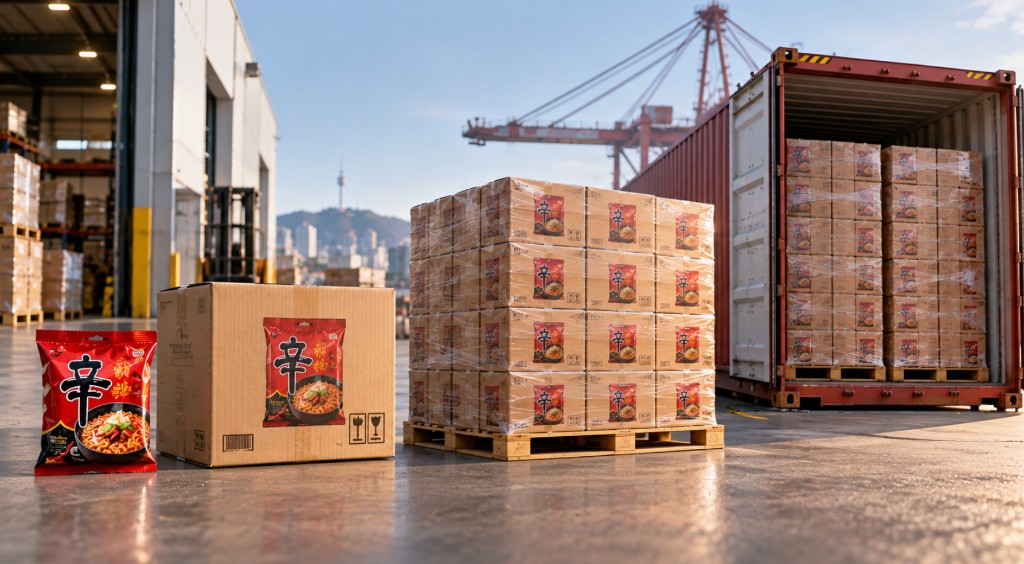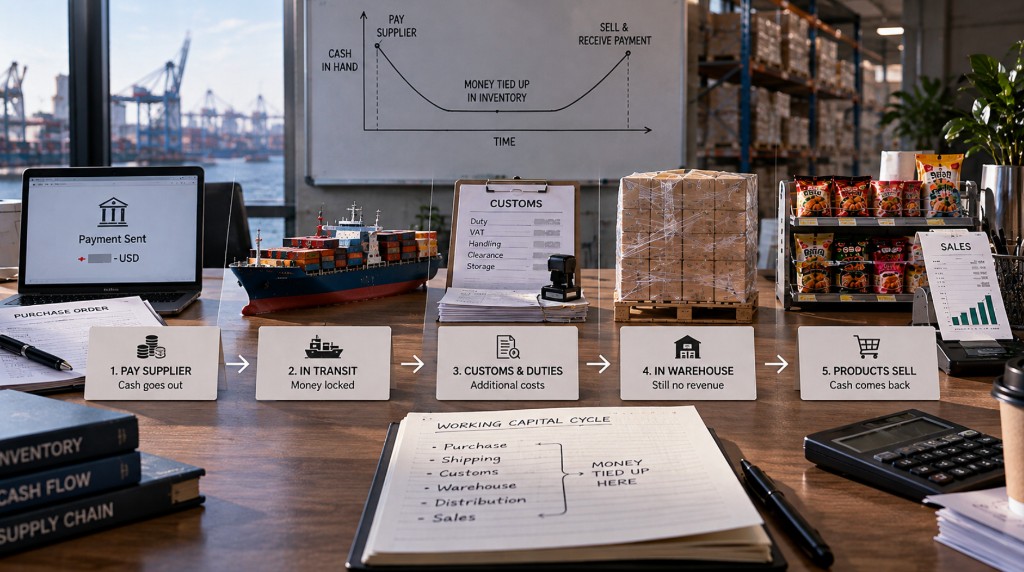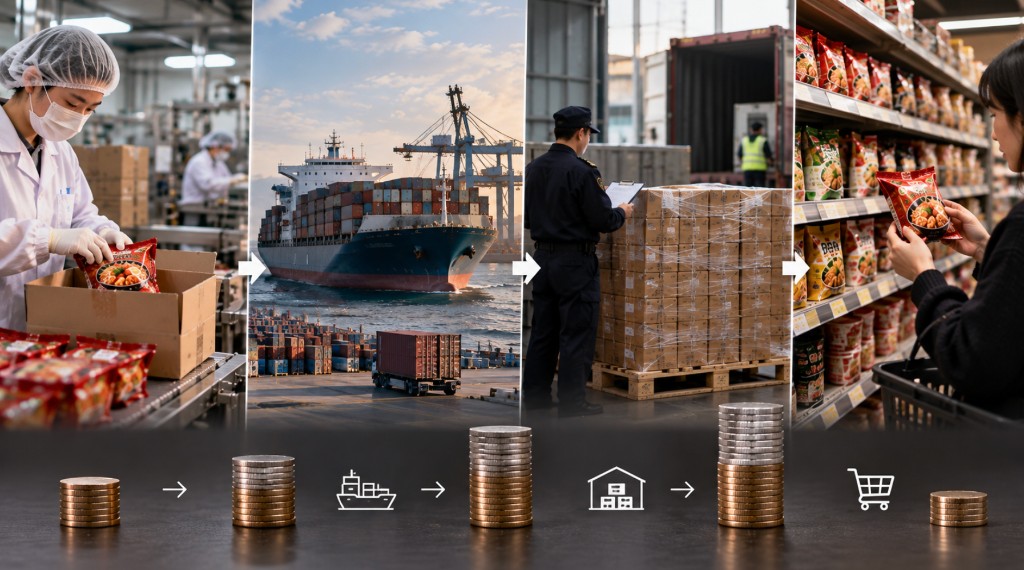

Between the Korean supplier and the destination warehouse, the shipment can accumulate inland transport, consolidation charges, export handling, international freight, insurance, port charges, customs clearance, duties, taxes, destination handling and local delivery. Some of those costs apply to the entire shipment rather than an individual product, which means they eventually have to be allocated back across every SKU in the container.
This is where landed cost becomes useful. For purchasing purposes, landed cost is the amount the importer has spent to get the product from the supplier to the point where the business considers it received and ready for sale. The exact components depend on how the company defines its landed cost and on the terms of the transaction, but the principle is straightforward: the supplier’s unit price is only one part of the cost of putting the product into inventory.
There is an important distinction here between commercial landed cost and customs value. Customs value is determined under the rules of the importing country and is used as the basis for customs duties and other purposes. The World Customs Organization explains that transaction value, broadly the price actually paid or payable for goods sold for export, is the primary basis under the WTO valuation system, subject to required adjustments. Whether items such as freight and insurance are included in the customs value also depends on the importing country’s valuation approach.
The internal landed-cost calculation used by an importer can go further. If the company wants to know what each carton genuinely costs when it reaches its warehouse, it may include destination handling, customs-broker charges, local trucking and other direct shipment expenses even when those items are treated differently for customs valuation.
Start by understanding exactly what the supplier’s price includes
A quotation of USD 20 per carton is meaningless without the commercial term attached to it. If one supplier quotes EXW and another quotes FCA, FOB or CIF, the two prices do not cover the same portion of the journey.
Under Incoterms 2020, FCA transfers delivery at the agreed place when the goods are handed over in the manner specified by the rule. FOB is a sea and inland-waterway rule where delivery occurs when the goods are on board the vessel at the named port. ICC specifically notes that FOB is not appropriate where goods are handed to a carrier before being placed on board the vessel, as commonly happens with containerised cargo, and recommends considering FCA in those situations.
This matters for Korean food shipments because the word “FOB” is still frequently used in commercial discussions. The buyer should understand what the supplier is actually agreeing to pay rather than relying on the three-letter term alone.
Imagine Supplier A quotes USD 18 per carton FCA at an agreed location in Korea, while Supplier B quotes USD 17.50 EXW from a factory several hundred kilometres from the consolidation warehouse. Supplier B looks USD 0.50 cheaper until Korean domestic collection is added. If transport, pickup and handling add another USD 1.20 per carton, Supplier A has become cheaper before the cargo has even left Korea.
The same issue appears with CIF quotations. A supplier may include freight to the destination port, but that does not mean every destination cost has disappeared. The importer can still face clearance charges, port or terminal expenses, customs duties, local transport and other costs after arrival. The Incoterm tells the parties where specified responsibilities, costs and risks sit. It does not tell the buyer the final cost of selling the product.
Build the cost from the shipment backwards
Suppose an importer purchases 1,000 cartons of Korean food at an average supplier price of USD 20 per carton. The purchase value is USD 20,000.
The shipment then generates USD 600 of Korean domestic transport and consolidation expenses, USD 350 of origin handling charges, USD 2,200 of international freight and USD 100 of cargo insurance. At destination there is another USD 800 of handling, USD 250 for customs-clearance services and USD 450 for delivery to the importer’s warehouse.
Before considering any import duty or tax, the importer has already spent USD 24,750.
The product that appeared to cost USD 20 per carton now averages USD 24.75 per carton before duties and taxes are considered.
That figure is still only an average. If the container contains twenty different products, allocating USD 4,750 of common logistics expenses equally across all cartons may produce a bad answer.
Suppose half the shipment consists of compact, high-value products and the other half consists of large lightweight snack cartons. The bulky cartons may be responsible for far more of the freight requirement even though the carton count is the same. Dividing international logistics cost equally by carton would make the compact product appear more expensive and the bulky product cheaper than they really are.
For a mixed Korean food shipment, the method used to allocate common costs matters almost as much as collecting the costs themselves.
Not every cost should be allocated in the same way
There are several reasonable ways to allocate shipment expenses. The correct method depends on what created the cost.
International freight for a volume-driven shipment may be allocated using CBM. If a product consumes 8% of the container’s relevant volume, approximately 8% of the applicable freight cost can be assigned to it.
Some weight-driven expenses may be allocated according to gross weight. Customs duty, where applicable, should normally be calculated using the legal tariff treatment and customs valuation applicable to that product rather than spread evenly across the shipment. Other fixed administrative costs may reasonably be allocated by value, quantity, shipment line or another consistent method used by the importer.
Consider two products in the same container. Product A consists of canned beverages. Each carton is relatively heavy and compact. Product B is a lightweight snack in large retail bags, making the shipping carton much larger relative to its value.
If freight is allocated only by purchase value, Product A might absorb most of the logistics cost because it is more expensive. But Product B could be consuming far more container space. If the constraint being paid for is primarily volume, allocating freight using CBM gives the buyer a better view of the actual economics.
This is why carton dimensions should be part of purchasing data. Length, width and height are not warehouse trivia. They affect freight economics.
Once the importer knows the carton CBM, gross weight, units per carton and purchase price, it becomes possible to calculate a realistic landed cost for each SKU rather than relying on a shipment-wide average.
Work down to the sellable unit
Carton-level landed cost is useful for procurement. Unit-level landed cost is more useful when pricing the product.
Suppose a carton contains 24 bottles. After allocating freight, handling, duty and local logistics, the landed cost of the carton is USD 28.80.
The landed cost per bottle is:
USD 28.80 ÷ 24 = USD 1.20
Now the importer can start testing whether the product works commercially.
If the importer sells to a distributor, there needs to be enough room above USD 1.20 for the importer’s margin. The distributor then needs its own margin. The retailer also needs room before arriving at the final shelf price.
If the market will support a retail price of only USD 1.80, the entire chain may be too compressed.
That can happen even when the original Korean supplier price looked attractive.
Another product may leave Korea at a higher purchase price but produce a lower landed cost because it packs more units into each carton, uses less volume per unit or qualifies for different tariff treatment.
This is why experienced purchasing teams compare products using the cost of a sellable unit rather than simply comparing carton quotations.
Import duty can completely change the comparison
Suppose two Korean products have almost identical supplier prices.
Product A lands at USD 1.00 per unit before duty. Product B lands at USD 1.04.
At first glance, Product A remains cheaper.
But if the products fall under different tariff classifications or qualify differently under an applicable trade arrangement, their final import costs can diverge.
The importer therefore needs to know the correct HS classification and whether any preferential origin treatment is available before making a serious landed-cost forecast.
This is especially important when a salesperson provides an estimated duty rate taken from another product that “looks similar.” Customs classification is based on the goods under the applicable tariff rules, not on how similar two products appear on a supermarket shelf.
A milk-based beverage, fruit drink, sauce, confectionery item and prepared food may all behave differently for tariff purposes. The appropriate classification should be checked before committing substantial quantities.
The same applies to origin preferences. The fact that goods are purchased from a Korean supplier does not automatically mean they qualify for preferential Korean origin under every trade agreement. The applicable origin rules still have to be satisfied.
For purchasing analysis, estimated duty should therefore be calculated SKU by SKU wherever the treatment differs materially.
Taxes require separate treatment in the internal calculation
Import taxes also need careful handling because some taxes may be recoverable or creditable for a registered business while others become part of the economic cost of the product.
The treatment differs by country and by the importer’s tax position.
For that reason, a landed-cost spreadsheet should make a distinction between amounts that permanently increase inventory cost and amounts that represent recoverable tax or temporary cash-flow requirements.
Otherwise, management can end up comparing products using numbers that overstate or understate the real margin.
The same principle applies to customs duties, anti-dumping duties where relevant, inspection charges, excise taxes and other destination-specific costs. A landed-cost model should be built around the rules of the actual importing country rather than copied from an example created for another market.
Currency can move the landed cost after the quotation is approved
A Korean supplier may quote in US dollars while the importer sells in another currency. Freight may also be invoiced in dollars, and some destination charges may be paid in local currency.
If exchange rates move between quotation, payment and customs clearance, the landed cost can change without the supplier changing the product price.
Suppose an importer approves an order when USD 1 converts to 83 units of its home currency. By the time the balance payment and freight are settled, the rate is 86.
A USD 20,000 purchase that originally represented 1,660,000 in local currency now represents 1,720,000. The difference is 60,000 before considering any change in freight or other expenses.
For low-margin products, that movement can matter.
Importers dealing with frequent shipments can therefore include a modest exchange-rate buffer in preliminary pricing or update the landed-cost calculation when the actual conversion rate becomes known.
The estimate used when approving the PO and the final landed cost recorded after receipt do not have to be identical. What matters is understanding why they changed.
Cheap products can be expensive to transport
Food importing produces some strange results when the value of the goods is compared with the space they occupy.
A carton of lightweight snacks may cost only USD 10 from the supplier but consume a relatively large amount of container space. A compact carton of sauce might cost USD 30 while occupying much less volume.
Suppose one CBM can hold 15 cartons of Product A at USD 10 each. The purchase value moved per CBM is USD 150.
The same CBM might hold 30 cartons of Product B worth USD 30 each. That is USD 900 of purchase value moving in the same space.
If the international freight cost associated with that cubic metre is broadly similar, freight represents a much larger percentage of Product A’s value.
This is why inexpensive bulky products sometimes become unattractive imports even when factory pricing is excellent.
The importer should look at freight per unit and freight as a percentage of product value. Products that consume a large amount of space while generating little gross margin deserve particular attention.
Landed cost should be estimated before the purchase order and corrected after arrival
A good landed-cost system usually contains at least two versions of the calculation.
The first is the estimated landed cost used before ordering. It uses the supplier quotation, estimated freight, expected duties, forecast handling charges and a working exchange rate. Its job is to answer whether the product is commercially viable before money is committed.
The second is the actual landed cost calculated after the shipment has been received and the final invoices are available.
The difference between the two contains useful information.
Perhaps ocean freight was USD 400 higher than expected. Maybe the shipment required an additional inspection. Perhaps the exchange rate moved. Destination handling may have been underestimated. The final CBM could also differ from the supplier’s original carton data.
If the importer records those differences, each shipment improves the next estimate.
After several containers, the company should become much better at predicting the cost of bringing Korean food into its market.
If estimated landed cost is consistently 8% lower than actual cost, that is not bad luck. Something is missing from the model.
A small change in landed cost can have a large effect on margin
Suppose a product has a landed cost of USD 1.00 and is sold by the importer for USD 1.30.
The gross difference is USD 0.30.
If freight and currency movements increase landed cost to USD 1.08, the gross difference falls to USD 0.22.
The landed cost increased by only eight cents.
The gross amount available to the importer fell by more than a quarter.
This is why seemingly small logistics changes matter so much in food distribution. Margins are calculated on the space between cost and selling price, not on the total selling price.
A buyer negotiating five cents off the factory price while ignoring ten cents of avoidable freight or handling cost is concentrating on the wrong part of the transaction.
Supplier negotiation still matters. It simply needs to be viewed alongside the rest of the supply chain.
Calculate the order before negotiating the last dollar
When several Korean suppliers are being compared, build a preliminary landed-cost model for each serious option.
Start with the commercial price under the quoted Incoterm. Add the costs required to bring the shipment through the Korean side of the journey that are not already covered. Add international freight and insurance where applicable. Estimate destination handling, clearance and delivery. Apply the appropriate customs and tax treatment. Then allocate common costs to each SKU using a method that reflects how those costs were created.
Finally, divide the result by the number of sellable units.
That gives the buyer a number that can actually be compared with wholesale and retail pricing.
A supplier that is USD 1 cheaper per carton may still lose once carton size, freight, shelf life and duty are included. Another supplier may appear expensive while producing the better landed cost because its packaging is more efficient or its terms reduce other expenses.
The quotation tells the importer what the supplier charges.
The landed-cost calculation tells the importer what the product costs the business.
Those two numbers should never be confused.