
This becomes more important when the buyer is sourcing a wide Korean food range rather than one product from one manufacturer. “I need Korean ramen, snacks and drinks” could describe ten cartons for a small retailer or several containers for a national distributor. Those two buyers require completely different purchasing structures. MOQ, freight method, payment arrangement, consolidation and even which suppliers are commercially sensible can change with the volume.
A useful quotation therefore begins with the buyer giving the supplier enough information to build the order correctly. The objective is not to write a long procurement document. It is to remove the uncertainties that would otherwise make the first price misleading.
A buyer should usually begin with the destination country and, where possible, the intended destination port. The destination matters because logistics, documentation, certification and import requirements are market-specific. A Korean exporter can provide information and supporting documents from Korea, but the importer still needs to confirm the destination country’s requirements before placing the commercial order.
The supplier should also know what kind of business is buying the products. A supermarket distributor, Asian grocery wholesaler, cash-and-carry operator, convenience-store supplier and e-commerce seller can all purchase Korean food, but the right assortment may be different for each one. Pack sizes, carton quantities and even the amount of variety that makes sense can depend on how the goods will ultimately be sold.
If the buyer is supplying major supermarkets, it may need complete product specifications, certification copies, label information and reliable replenishment. A smaller wholesaler may care more about flexible mixed quantities and broad variety. An online seller may prefer smaller quantities across more SKUs because it can test demand without filling physical retail shelves. The supplier can quote more intelligently when it understands the commercial context.
A product name is not enough
Korean food ranges contain many products that look almost identical in a catalogue but are commercially different.
A ramen brand may have several flavours, cup sizes and multipacks. A drink may come in cans, PET bottles and different volumes. One snack might be available in 60 g, 90 g and family-size packs. Even the same flavour can exist under different barcodes or carton configurations.
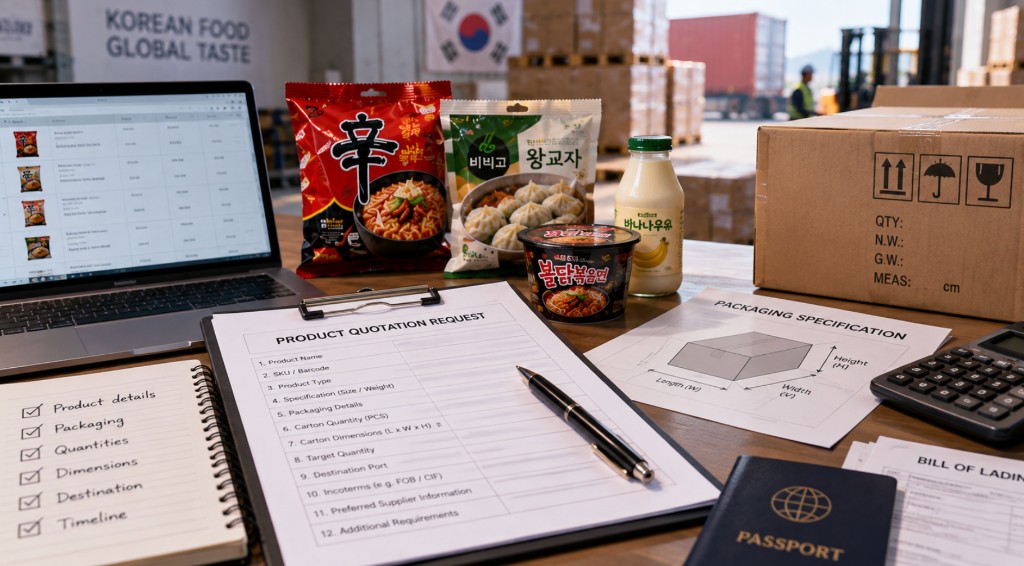
The buyer should therefore identify the exact product wherever possible. A product name, barcode, SKU, pack size or catalogue reference can remove a great deal of confusion.
Suppose a buyer asks for “Buldak ramen.” The supplier still does not know whether the request is for original, carbonara, cheese or another flavour, whether the buyer wants packet noodles or cups, or how much of each line is required.
A better request may say that the buyer wants three specific SKUs, approximately 100 cartons of each, for a mixed shipment to a particular destination.
Now the supplier can check the actual availability and commercial terms.
This also helps prevent quotation errors. If one supplier quotes a 5-pack retail configuration and another quotes individual packs, the prices can look dramatically different even though the underlying product is similar.
The buyer should compare the sellable unit, units per carton, net weight and carton quantity before assuming one supplier is cheaper.
The same discipline becomes more important when several hundred SKUs are being considered. A vague product list produces repeated questions later. A clean SKU list can move directly into quotation, consolidation and purchase-order planning.
Quantity should be realistic, even when it is only an estimate
Suppliers need volume because price and MOQ can depend on it.
A buyer does not always know the exact quantity during the first discussion, but an approximate level is still useful. “One pallet,” “around 10 pallets,” “one mixed 20-foot container” or “approximately 500 cartons” provides far more commercial information than saying “bulk.”
This is particularly important when comparing direct manufacturer sourcing with an exporter or consolidator.
A manufacturer may offer an attractive price at large volume but require more cartons of each SKU than the buyer needs. An exporter handling several Korean manufacturers may be able to provide smaller quantities across a broader range.
The appropriate sourcing structure changes with the size of the order.
A buyer asking for twenty cartons each of thirty different products needs something very different from a buyer ordering 5,000 cartons of one beverage.
The quantity estimate also helps determine whether LCL or FCL should even be considered. A small trial order may be suitable for palletised LCL. A larger recurring programme may make better use of FCL.
The final shipping decision should still be made after the actual CBM, weights, freight quotations and inventory requirements are known. The first volume estimate simply gives the supplier a realistic starting point.
Tell the supplier whether the shipment is mixed
This one detail changes a great deal.
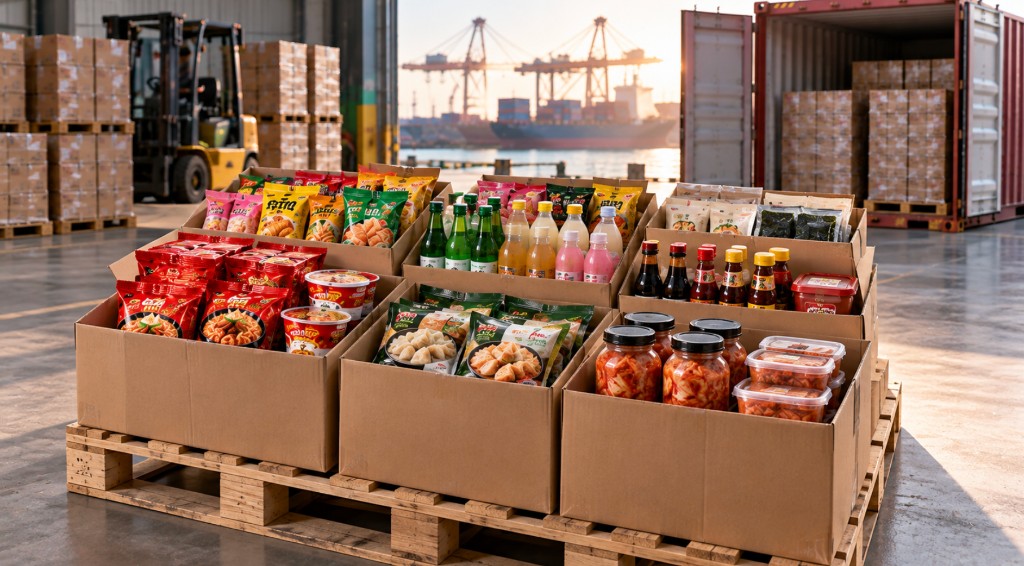
A buyer purchasing one product from one manufacturer is relatively straightforward. A buyer purchasing snacks, beverages, ramen, seaweed and sauces from several Korean manufacturers needs consolidation.
The supplier needs to know that before quoting because local Korean transport, warehouse receiving, consolidation timing and final shipment planning may become part of the transaction.
A mixed shipment may also require different MOQs by brand or SKU.
The buyer should not assume that because the total shipment is large, every manufacturer will accept very small quantities. A twenty-foot container containing thirty brands can still contain individual products that fall below the manufacturers’ minimums.
A useful quotation should therefore show minimum quantities at the line level where they apply.
This allows the importer to change the mix before placing the purchase order. If one product requires 100 cartons but expected sales justify only twenty, the buyer can remove it rather than discovering the problem after the rest of the shipment has already been planned.
The same principle applies to storage conditions. Ambient dry products can often be consolidated more easily with one another. Frozen, chilled or otherwise temperature-controlled products require different handling.
A buyer should therefore tell the exporter if the proposed order contains products with different storage requirements rather than assuming everything can move in one container.
Shelf life belongs in the quotation discussion
Food cannot be quoted properly using price alone.
Suppose one supplier offers a product for USD 18 per carton while another quotes USD 19. The first supplier appears cheaper until the buyer learns that the USD 18 stock has five months remaining while the second supplier expects to ship stock with ten months remaining.
The quotation has changed commercially even though the price did not.
Buyers should therefore ask about total shelf life and expected remaining shelf life at dispatch.
For ready stock, the supplier should ideally be able to confirm the available dates before the purchase order is finalised. For new production, the buyer should understand the expected production and dispatch timing.
The required shelf-life threshold should also be discussed before the supplier allocates stock.
If the buyer’s supermarket customers require a certain remaining shelf life when receiving the product, the supplier needs to know that requirement. Otherwise the goods may technically be within date while still being commercially difficult for the importer to distribute.
This becomes especially important in mixed shipments where one container may contain dozens of products from several batches.
A quotation that includes only “12 months shelf life” does not tell the buyer how old the stock will be when it actually leaves Korea.
Compliance questions should appear before the final price is accepted
The buyer should identify important compliance requirements as early as possible.
If Halal certification is required for the intended market or customer, say so in the initial request. If the retailer needs HACCP documentation, product specifications, ingredient files or other manufacturer documentation, tell the supplier before the SKU is approved.
The importer should also mention local-language or label requirements that could affect packaging or preparation.
The supplier can then check whether the relevant product and manufacturing facility can provide the required material.
This matters because certification is product- and scope-specific. A company producing some Halal-certified products should not automatically be treated as offering Halal certification across its entire catalogue. The same general principle applies to other certificates.
Destination compliance ultimately needs to be confirmed according to the rules of the importing market. A Korean exporter can provide Korean-side documents and product information, but it cannot replace the importer’s responsibility to determine what its market legally requires.
This should happen before the price becomes the centre of the negotiation.
There is little value in negotiating a product from USD 20 to USD 19.50 per carton if the product cannot be imported or sold in the intended market.
The buyer should state the commercial basis of the quotation
A useful quotation should show the Incoterm and named place.
“USD 20 per carton” is incomplete.
The buyer needs to know where the supplier’s responsibility and included costs end.
One supplier may quote EXW from its factory. Another may quote FCA at a Korean warehouse. Another may provide a sea-freight-inclusive price.
Comparing those figures without adjusting them to the same commercial point can make the wrong supplier look cheaper.
The buyer does not necessarily need to dictate the Incoterm during the first message. If unsure, it can ask the Korean supplier to state the basis of its quotation clearly.
For containerised goods, buyers should also avoid treating FOB as a generic word for every export price. Under Incoterms 2020, FOB is specifically a sea and inland-waterway rule, while FCA is often appropriate where containerised goods are handed over to the carrier before vessel loading.
The commercial term should describe what is actually happening.
Once the buyer has quotations on comparable terms, the real landed-cost analysis becomes much easier.
A usable quotation should become the basis of the purchase order
The quotation should eventually contain enough information that the buyer does not need to rebuild the order from scratch when it decides to proceed.
For each product, the importer should be able to identify exactly what it is buying, the quantity, carton configuration and agreed price. The buyer should also know the MOQ, expected availability, shelf-life position and any important certification requirements.
At shipment level, the commercial term, payment arrangement and expected cargo-ready timing should be understood.
The final values may still change before shipment. Actual carton quantities can be adjusted. Freight may move. A product can go temporarily out of stock.
The quotation nevertheless creates the commercial baseline.
This is especially useful for mixed Korean food orders. Once the buyer approves the proposed products and quantities, the exporter can begin converting the quotation into a consolidation plan.
That is why the best initial enquiry is not necessarily the longest one.
A Korean food supplier mainly needs the information that changes the commercial answer: what products, what quantity, where they are going, how the buyer expects to ship them and what product or compliance requirements have to be met.
When those points are clear, the supplier can give the buyer something much more useful than a price list.
It can give the buyer an order that can actually be evaluated, funded and shipped.