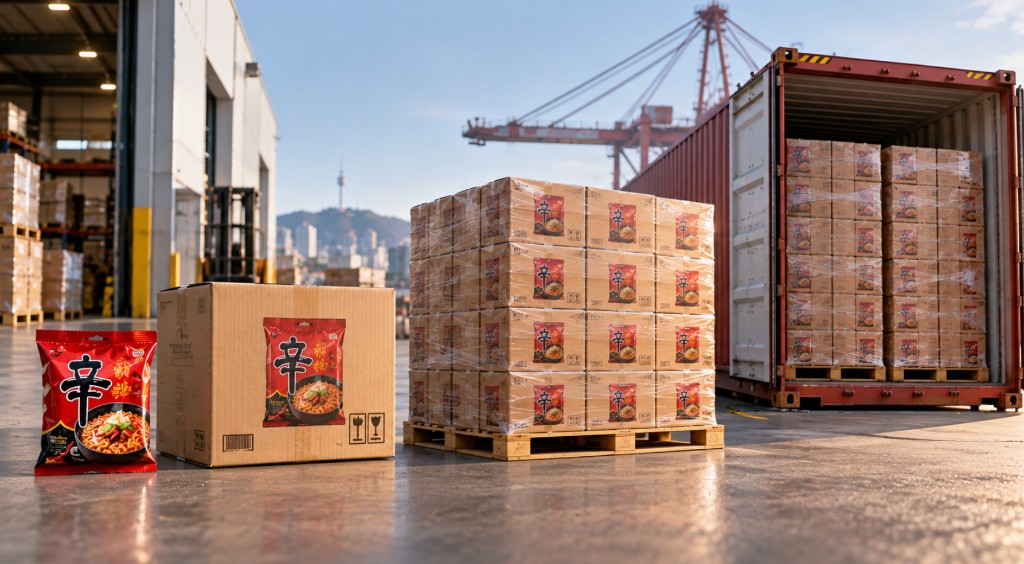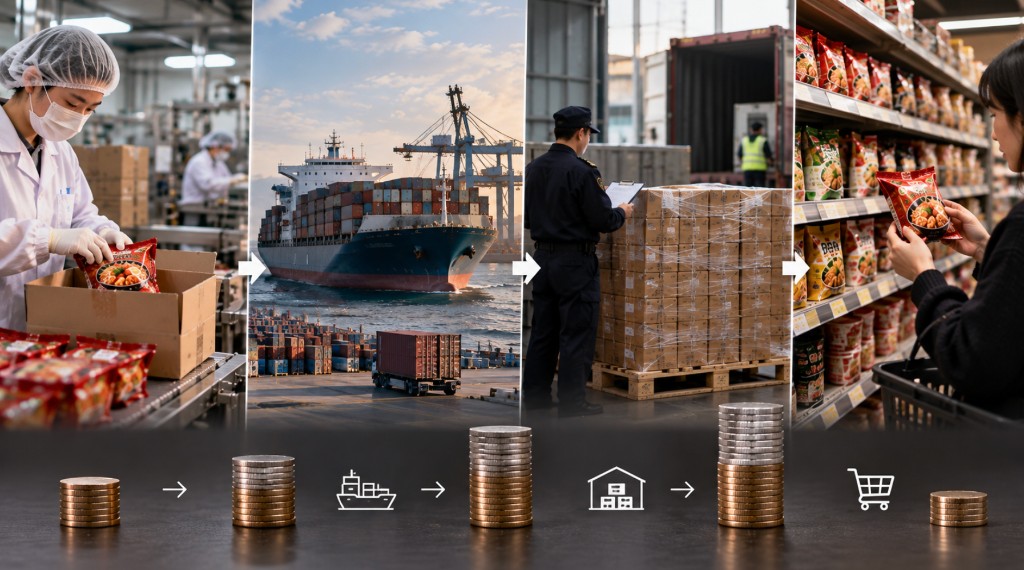

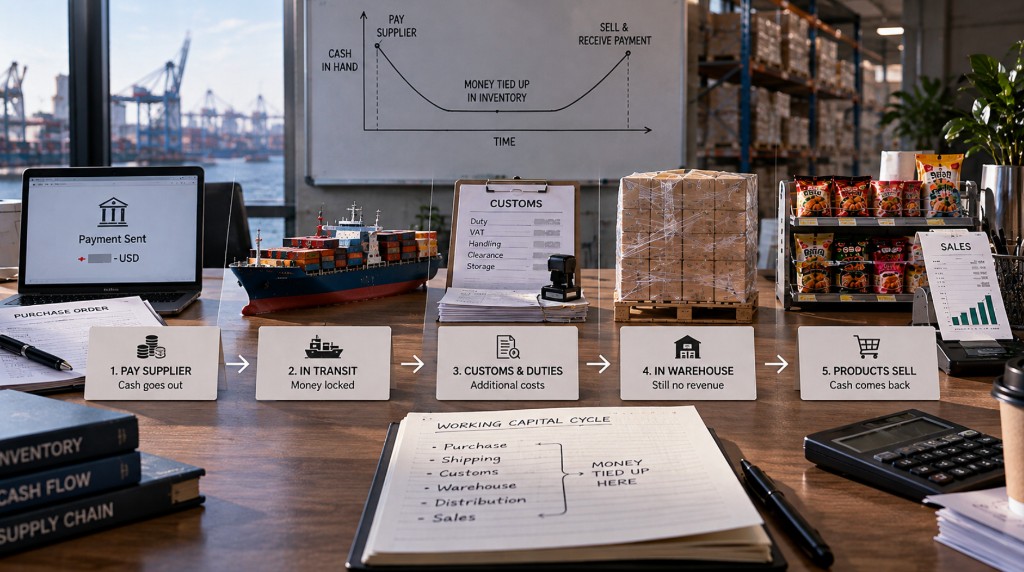
This is why revenue is a poor measure of how much cash an importing business needs. A company can show USD 1 million of annual sales and still struggle to finance the next container if too much money is tied up in stock and receivables.
Consider an importer placing a USD 40,000 Korean food order. The supplier requires 30% when the purchase order is confirmed and the remaining 70% before shipment. The importer pays USD 12,000 immediately and another USD 28,000 several weeks later. Freight, customs, handling and local delivery add another USD 8,000 before the stock becomes available for sale. The importer has now put USD 48,000 into the shipment.
Suppose the products take two months to sell and most retailers receive 30-day payment terms. A large part of that USD 48,000 may remain outside the company’s bank account for three months or longer. If the next container needs to be ordered after six weeks, the importer has to finance the new shipment before the cash from the first one has fully returned.
The business can therefore grow itself into a cash shortage.
Inventory turnover changes the economics of the same margin
Two products with the same gross margin can produce completely different financial results depending on how quickly they sell.
Suppose Product A costs the importer USD 10,000 and produces USD 3,000 of gross contribution when all the stock is sold. It takes six months to sell through.
Product B also requires USD 10,000 of capital but produces only USD 2,000 per cycle. Product B sells through every two months.
During the six months that Product A completes one cycle and produces USD 3,000, Product B may complete three cycles and generate USD 6,000 from approximately the same working-capital base.
The lower-margin product can therefore be the better business.
This is why importers should look at the relationship between margin and inventory turnover instead of chasing the highest percentage margin on every SKU. A 40% margin means very little if the product spends a year in the warehouse.
Food makes this even more important because the stock is deteriorating commercially while it waits. Shelf life is being consumed. Retailer acceptance windows are getting shorter. The probability of discounting increases. The product may still be technically saleable, but its commercial value declines as it gets older.
A fast-moving product with a moderate margin can therefore be much more valuable than a slow product with an impressive theoretical margin.
Suppose an importer holds 300 cartons of a beverage selling at 150 cartons per month. That represents approximately two months of inventory. Another product has 120 cartons in stock and sells only ten cartons per month. That represents twelve months of inventory.
If both products require the same amount of working capital per carton, the second one traps money six times longer.
That capital cannot be used to reorder the products that are actually selling.
This is how warehouses become full while the sales team complains that the best products are out of stock.
Reordering too late and reordering too early are both expensive
Reordering sounds simple until lead time and working capital are considered together.
If a Korean product sells 100 cartons every month and the complete replenishment cycle takes two months from purchase order to warehouse receipt, the importer cannot wait until inventory reaches zero before placing the next order. By then the business is already two months too late.
At the same time, placing the reorder too early creates excess inventory and ties up cash unnecessarily.
Suppose the importer has 300 cartons in stock and sells approximately 100 each month. A new shipment takes eight weeks to arrive. If the business waits until only 50 cartons remain before ordering, it will probably run out before replenishment reaches the warehouse.
If it orders another 500 cartons while 300 remain, it may soon be carrying seven or eight months of inventory.
The reorder decision should therefore be based on expected consumption during lead time, existing stock, confirmed incoming stock and an appropriate safety buffer.
If lead time is 60 days and sales average 100 cartons per month, the business expects to consume roughly 200 cartons while waiting for replenishment. The reorder point has to sit above that figure if the company wants protection against delays or stronger-than-expected demand.
The exact safety stock depends on the reliability of sales and supply. A stable product purchased from a reliable manufacturer may need a smaller buffer. A product with irregular production, long transit time or unpredictable demand may require more.
What matters is that the buffer is intentional.
Many businesses carry excessive inventory without actually having a stock policy. They simply reorder whatever the supplier offered last time. That is not safety stock. It is unmanaged inventory.
Credit terms to customers can consume more cash than inventory
Importers often focus heavily on negotiating supplier terms while giving customer credit too casually.
Suppose a distributor receives goods from the importer today but pays after 60 days. The importer effectively finances that distributor for two months.
If the goods themselves took two months to manufacture, ship and clear, the importer may have financed the product for four months or more before receiving cash.
Now imagine the business sells USD 100,000 every month and gives most customers 60-day terms. Approximately USD 200,000 can be sitting in receivables once the business reaches a stable run rate, even before considering overdue accounts.
That money is not theoretical profit. It is cash the business has already spent but has not yet collected.
This is why sales growth can produce a financing problem. If monthly sales rise from USD 100,000 to USD 200,000 while payment terms remain unchanged, receivables can roughly double as well.
The importer now needs more working capital simply to support the higher level of business.
Credit should therefore be treated as a commercial investment. A large retailer may justify 45 or 60 days because the volume is strong and payment reliability is high. A small customer buying irregular quantities may not justify the same treatment.
The sales team should understand that agreeing to longer payment terms is economically similar to reducing price. Both reduce the value of the transaction to the importer.
There is also a difference between negotiated credit and late payment. A customer with agreed 30-day terms who pays on day 45 is not simply using credit. The customer is consuming another 15 days of the importer’s working capital without necessarily paying for it.
If this behaviour is repeated across many accounts, the business can become dependent on overdrafts or short-term borrowing even while reporting good sales.
Supplier payment terms can be as valuable as price
Consider two Korean suppliers offering the same product.
Supplier A charges USD 20 per carton and requires 100% payment before production.
Supplier B charges USD 20.50 and requires 30% with the order and 70% before shipment.
Supplier A is fifty cents cheaper.
For a 1,000-carton order, the price difference is USD 500.
But Supplier B allows the importer to keep USD 14,350 of the purchase value for several additional weeks instead of paying everything on day one.
Depending on the importer’s cash position, financing cost and other purchasing needs, that flexibility may have significant value.
This does not mean a buyer should accept any price for better payment terms. It means payment timing should be compared alongside unit price.
The same principle becomes even more important if a supplier eventually offers partial credit after a successful trading history. A reliable supplier willing to support the buyer’s working-capital cycle can become commercially valuable even if another supplier occasionally quotes a lower carton price.
Terms should still be documented clearly, and payment should only be made to verified entities under the agreed transaction. Better credit should never become an excuse to weaken supplier due diligence.
Compliance delays are working-capital problems
Compliance failures are often described as regulatory problems. From the importer’s perspective, they are also cash-flow problems.
Imagine a USD 60,000 shipment arrives but cannot be released because a required document is missing or a product requires additional review. The importer has already paid the supplier. Freight has already been incurred. The goods are physically present, but the company cannot sell them.
Every day of delay extends the cash cycle.
Storage, demurrage or additional handling may also be added depending on the situation. If labels have to be corrected, that requires more money before any sales can begin.
The financial effect is similar when products clear customs but cannot be released into the market because the local labelling or registration process is incomplete.
The inventory exists, but it cannot generate cash.
This is why compliance should be completed as early as possible in the purchasing process. Product eligibility, required certificates, labelling, customs classification and destination-specific import requirements should not first become serious questions after the container is already moving.
There is also a cash-flow reason to avoid ordering large quantities of a new SKU before its compliance position is fully understood. A compliance issue on ten cartons is inconvenient. The same problem on 1,000 cartons can lock up a meaningful part of the company’s working capital.
The cost of compliance is therefore not limited to registration fees, laboratory work or labels. The amount of capital exposed while an issue is being resolved also matters.
Slow stock creates a second cash problem when fast stock needs reordering
The most frustrating position for an importer is having a warehouse full of inventory and not enough cash to reorder the products customers are asking for.
Suppose the company has USD 200,000 of inventory.
On paper, the business appears well stocked.
A closer look shows that USD 70,000 is tied up in slow products carrying eight to twelve months of stock. Another USD 40,000 sits in new products that have not developed repeat demand. Only the remaining USD 90,000 represents healthy core inventory.
Several fast-moving products now need another USD 50,000 purchase order.
The company may technically own enough inventory to fund the purchase, but inventory cannot pay the supplier unless it turns into cash.
The business either waits for slow products to sell, discounts them, injects more working capital or borrows money.
This is why inventory ageing needs to be reviewed financially rather than only operationally.
A product sitting for six months should trigger more than a warehouse report. Management should ask why the money is still there and whether continuing to hold the stock is better than converting it back into cash through a controlled discount.
Sometimes taking a smaller margin today is financially better than protecting a theoretical margin for another six months.
The decision depends on remaining shelf life, market demand and expected recovery, but the principle is important: inventory is supposed to circulate.
Purchasing budgets should be allocated by productivity
A simple annual purchasing budget is not enough for a growing importer. The business should also decide which products deserve that capital.
Suppose the importer has USD 300,000 available for purchasing.
Product Group A generates strong repeat orders and turns five times per year.
Product Group B generates reasonable margins but turns twice.
Product Group C contains experimental products with uncertain demand.
The business should not automatically divide the USD 300,000 equally between the three groups.
More capital should generally flow toward products with reliable demand and healthy economics, while uncertain products should receive controlled amounts until the market provides evidence.
This does not mean killing innovation. A catalogue needs new products.
The experiment simply needs a budget.
If management decides that 10% of purchasing capital can be used for new-product testing, the company knows how much it is willing to risk while learning. That prevents experimental inventory from quietly growing until it consumes the same amount of cash as established products.
The same approach can be used for categories.
If Korean beverages repeatedly turn four times per year while a particular confectionery range turns once, the buyer should investigate whether the confectionery category deserves the same capital allocation.
The answer might still be yes because it brings customers, supports a strategic retailer or produces high margins. At least the decision is being made consciously.
Growth should be measured by the cash cycle as well as sales
A useful way to think about an import business is to follow one dollar from the day it leaves the bank account until it returns.
The company pays the Korean supplier.
The dollar becomes inventory in production.
Then it becomes inventory in transit.
Then inventory in the destination warehouse.
Then a receivable after the product is sold.
Finally, it becomes cash again when the customer pays.
The faster and more reliably that cycle occurs, the more business the same amount of capital can support.
If the dollar takes five months to return, growth requires a lot of additional money.
If it returns every six weeks, the same capital can support much more annual sales.
Management should therefore understand how long the full cash cycle takes, not only how quickly the warehouse moves stock.
A product sold immediately to a retailer on 90-day terms still has a long cash cycle.
A product held for two months and then sold for cash may actually return money sooner.
This is why inventory days and receivable days belong in the same discussion.
Supplier credit can shorten the amount of time the importer’s own cash is committed. Customer credit lengthens it.
The business model sits between those two sides.
A healthy import business does not need to maximise stock
The objective of purchasing is not to keep the warehouse full.
The objective is to keep enough of the right inventory available so that profitable sales can continue without tying unnecessary cash into products that are not moving.
That balance is difficult because shortages are visible immediately. A salesperson complains when a fast-moving drink is unavailable. Excess inventory creates much less noise. Fifty slow SKUs can sit quietly in the warehouse while everybody focuses on the five products that are out of stock.
This makes businesses naturally biased toward over-purchasing.
Management has to correct that bias with data.
Look at months of inventory. Look at ageing. Look at repeat orders. Look at cash tied up by category. Compare supplier lead time with actual consumption. Review products that have not sold for 30, 60 or 90 days. Monitor receivables with the same attention given to sales.
Once those numbers are visible, purchasing improves.
The strongest Korean food import businesses are not necessarily the companies that can buy the largest containers. They are the companies that can move capital through the cycle repeatedly without losing control of shelf life, compliance or customer credit.
A container is only useful when the money inside it comes back.