
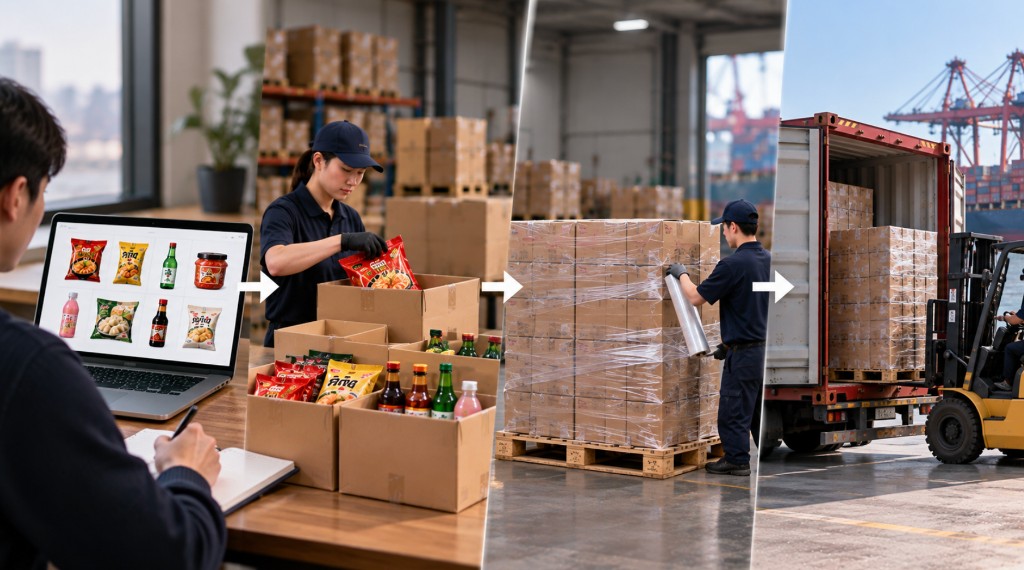
This is where the difference between browsing a catalogue and actually importing food becomes clear. A buyer may select fifty products in an afternoon, but not all fifty will necessarily survive the commercial review. Some may have an MOQ that is too high. Some may not have enough remaining shelf life. A product may be temporarily unavailable. Another may require documentation that the manufacturer cannot provide for the intended destination. A bulky carton may look attractive at supplier price but become expensive after freight is allocated.
A serious wholesale order is therefore built through several rounds of refinement. The final shipment is usually different from the first product list, and that is normal.
The first product list is usually too broad
Suppose an importer sends a Korean exporter a spreadsheet containing eighty products. The buyer may have selected them from a catalogue, website, trade fair or manufacturer list.
The exporter can begin by identifying the exact SKU, pack size, barcode, units per carton and available commercial information for each product.
At this point, obvious problems usually begin to appear.
One product may have a minimum order of 100 cartons when the buyer wants twenty. Another may only be available in a different package size. A beverage could be out of stock until the next production run. A product listed in an old catalogue may have been discontinued.
The purpose of the first review is therefore not to produce a final invoice immediately. It is to convert a broad shopping list into products that can actually be supplied.
For a mixed Korean food order, this often means removing some products, adjusting quantities and replacing unavailable SKUs before freight is even considered.
A buyer should expect this process.
The catalogue tells the buyer what exists. The commercial review tells the buyer what can be purchased now.
Every SKU needs enough data to make a decision
A product name and price are not enough to build a wholesale order.
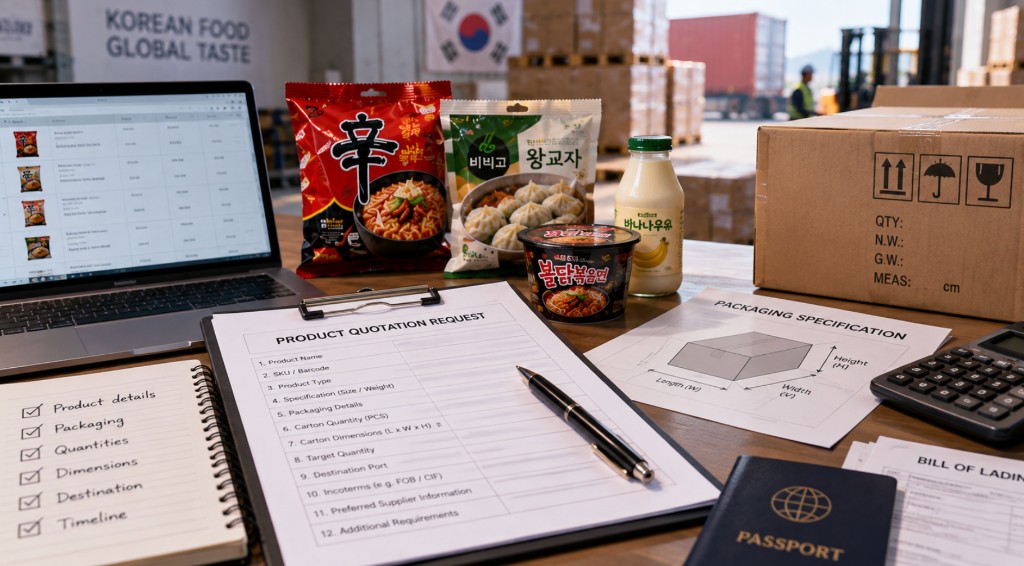
For each SKU, the buyer should ideally know the retail unit size, units per carton, carton price, MOQ, carton dimensions, gross weight, total shelf life and expected availability. Product specifications and certification information can then be added where required.
This data affects several different decisions at once.
Units per carton determine the real number of sellable units being purchased. Carton dimensions affect CBM and freight. Gross weight matters for logistics. MOQ determines how much inventory the buyer must accept. Shelf life affects how long the stock can realistically remain in the market.
Suppose two Korean snacks both cost USD 20 per carton.
Product A contains 20 retail units.
Product B contains 40.
The carton price looks identical, but the unit cost is completely different.
Now suppose Product B’s carton is twice the size. The freight difference may narrow the advantage again.
The buyer therefore needs enough information to evaluate the complete product rather than comparing one price column.
This is also why good product data becomes increasingly valuable as a wholesale catalogue grows. If every order requires the exporter to rediscover carton dimensions, weights and configurations, the purchasing process becomes slow and error-prone.
A structured product catalogue makes repeat business much easier.
The order should be tested against demand before quantities are finalised
Once the product data is available, the buyer can start deciding how much of each product to purchase.
This is where many orders become commercially healthier.
A buyer may initially request fifty cartons of every SKU because the quantities look balanced. That rarely reflects actual demand.
A proven beverage selling 100 cartons per month may justify a much larger quantity than a new snack being tested for the first time.
The shipment should therefore contain different levels of commitment.
Established products can receive deeper inventory.
New products should usually begin smaller.
Products with shorter shelf life should be purchased more carefully.
Products with unusually high MOQ should be checked against expected monthly sales before the buyer accepts the quantity.
Suppose the manufacturer requires sixty cartons and the buyer expects to sell ten cartons per month. The MOQ represents six months of inventory before shipping time is considered.
That may still be acceptable for a long-life product.
If the product arrives with only seven months remaining and the retailer requires several months of remaining shelf life, the same quantity becomes much harder to justify.
MOQ, sales velocity and shelf life belong in the same decision.
Compliance should be reviewed before the PI is treated as final
A product can make commercial sense and still be unsuitable for the destination market.
Before the final order is confirmed, the buyer should identify the destination-specific documentation and product requirements that matter.
These vary by country and product. They can include labelling rules, ingredient restrictions, certificates, product registration, sanitary documentation, manufacturer information or other import requirements.
Korea’s Ministry of Food and Drug Safety currently maintains export-certificate resources that include different health and sanitary certificate formats depending on destination and product. That is a useful reminder that there is no single universal Korean food export certificate that works for every shipment.
The buyer therefore needs to know what its destination requires.
The Korean supplier or exporter can provide manufacturer information and Korean-side documents, but the importer should confirm whether those documents are sufficient for the destination market.
This is especially important when the order includes Halal products, animal-origin products, dairy, meat, specialised health claims or products subject to additional local controls.
If the buyer needs a specific certificate, that should be checked while the product list is still being finalised.
There is little value in discovering after payment that an important SKU cannot provide the documentation needed by the destination authority or customer.
The proforma invoice should represent a real order
Once the products, quantities and commercial conditions have been reviewed, the exporter can prepare the proforma invoice.
The PI should not be treated as a prettier version of the catalogue.
It should represent the commercial transaction the buyer is actually preparing to place.
The exact products should be identifiable. Quantities should be stated clearly. Prices should use the agreed currency and commercial basis. Payment terms, Incoterm and named place should be understood. Where applicable, the buyer should also understand the expected lead time and any conditions attached to stock allocation.
For mixed shipments, the PI may still change before the order is finally paid.
Perhaps a manufacturer cannot supply one product. Another SKU may fail the shelf-life requirement. The buyer may decide that the total order value is too high and reduce slower lines.
Those adjustments are much easier before payment and supplier commitments are finalised.
Once the buyer approves the commercial order, the exporter can begin securing the products from the different manufacturers.
At that point, the spreadsheet has become real inventory.
The order now becomes a Korean-side coordination problem
A mixed Korean food order might involve products from ten or twenty manufacturers.
Those products do not all become ready at the same time.
One supplier may have ready stock and deliver within three days. Another may need two weeks. A third may require fresh production and take a month.
The exporter or consolidator therefore needs a cargo-ready plan.
Each supplier has to know where and when to deliver. The consolidation warehouse needs to know what is expected. The buyer needs visibility when an important product is delayed.
The final shipment date can be controlled by the slowest supplier.
Suppose 90% of the order is ready on September 1, but one manufacturer will not finish until September 20.
The buyer has to decide whether that product is important enough to delay the entire shipment.
If the missing product represents only twenty cartons of a new SKU, waiting three weeks may not make sense.
If it represents 300 cartons of one of the buyer’s strongest products, waiting may be reasonable.
This is not simply a logistics decision. The importer has to consider inventory shortages at destination, shelf life of the goods already waiting in Korea and the cost of delaying the rest of the shipment.
A good consolidation process makes this decision visible before the vessel booking is missed.
Received quantities should be checked against ordered quantities
When goods begin arriving at the consolidation warehouse, the physical cargo should be compared with the purchase order.
The importer ordered forty cartons.
Did forty arrive?
Did the correct SKU arrive?
Are the outer cartons in reasonable condition?
Does the product carry the expected date?
These checks sound basic, but a mixed shipment containing hundreds or thousands of cartons creates plenty of room for small discrepancies.
A manufacturer may deliver thirty-eight cartons instead of forty.
A flavour can be substituted incorrectly.
Two production batches may arrive with very different expiry dates.
The final shipment should be based on what physically exists at the warehouse.
This is one reason the commercial invoice and packing list may differ from an early draft quotation.
The quotation represents the intended order.
The final shipping documents should represent the cargo actually shipped.
Korea Customs Service states that exporters are responsible for providing accurate information when making export declarations, and export clearance involves filing the declaration and receiving customs acceptance before goods are loaded and depart.
That makes accurate final shipment data more than an internal warehouse issue.
Shelf life should be checked again before loading
Shelf life was discussed when the products were selected. It should be checked again when the goods are actually available.
The reason is simple: the dates originally discussed may not be the dates delivered.
A manufacturer may have sold through one batch and supplied another. Production may have been delayed. Ready stock may have aged while the buyer was finalising the order.
For important mixed shipments, the buyer should be able to see the expected remaining shelf life of the final products before loading.
Suppose an order contains sixty SKUs.
Fifty-eight meet the buyer’s agreed shelf-life requirement.
Two do not.
The importer now has a commercial decision to make.
If the products are fast-moving and the quantity is small, the buyer may still accept them.
If the products are new and the remaining shelf life is poor, the better decision may be to remove them.
The important part is making that decision before the goods are inside a container on the water.
Shelf-life management is much cheaper in Korea than after arrival.
The shipping method should follow the final cargo
The buyer may begin the order believing it will use FCL.
The final shipment may turn out smaller.
Or the opposite may happen.
The initial product list could look like an LCL shipment, but after quantities are finalised the buyer may be close enough to container volume that FCL becomes more attractive.
Shipping should therefore be confirmed using the final or near-final CBM and weight.
A buyer should not add weak products simply to justify a container.
If the commercial order naturally supports FCL, use the container.
If not, compare the cost and inventory implications of LCL.
A half-empty warehouse at destination is less expensive than a warehouse full of products purchased only because somebody wanted to fill the remaining container space.
The shipment is supposed to serve the inventory plan.
The inventory plan should not be distorted to serve the container.
The buyer should know what changes after the order ships
Once the shipment leaves Korea, the nature of the work changes.
The buyer now needs the final commercial invoice, packing list, transport documents and whatever additional certificates or documents apply to the shipment.
The importer and its broker use those documents for destination clearance according to local requirements.
The Korean exporter still has responsibilities on the Korean side, but the destination import procedure belongs to the importing market.
This is another reason commercial data should remain consistent through the process.
Product descriptions, carton quantities, values, origin information and supporting certificates should make sense together.
A buyer that maintains a proper product file from the beginning will find this much easier than a buyer trying to reconstruct product information while the vessel is already approaching the destination port.
The first order should make the second order easier
The process does not end when the container arrives.
The first shipment now produces information the buyer did not have before.
Which products sold quickly?
Which retailers reordered them?
Which SKUs were over-purchased?
Which manufacturer consistently supplied fresh stock?
Which product consumed too much container space?
Which MOQ caused too much inventory?
Which documents took too long to obtain?
Those answers should change the next order.
The second shipment should not simply be a copy of the first.
Fast products deserve more allocation.
Slow products deserve less.
Products with weak economics may disappear.
New products can be introduced in controlled quantities.
The order becomes more accurate because the importer is no longer buying only from expectations. It has actual sales and supply-chain data.
This is how a wholesale Korean food programme matures.
The first order is largely about selecting and testing products.
Later orders become more about maintaining availability, improving turnover and using container space and working capital more efficiently.
A good Korean food exporter should support that process rather than treating every transaction as an isolated price list.
The real value is not sending a buyer hundreds of products.
It is helping turn the right products into a shipment that can actually be imported, sold and reordered.