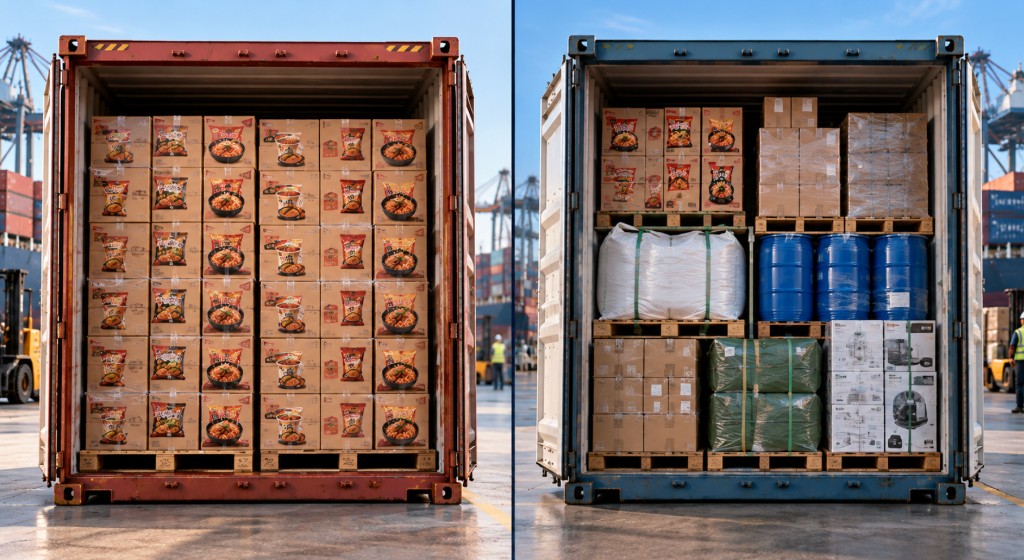

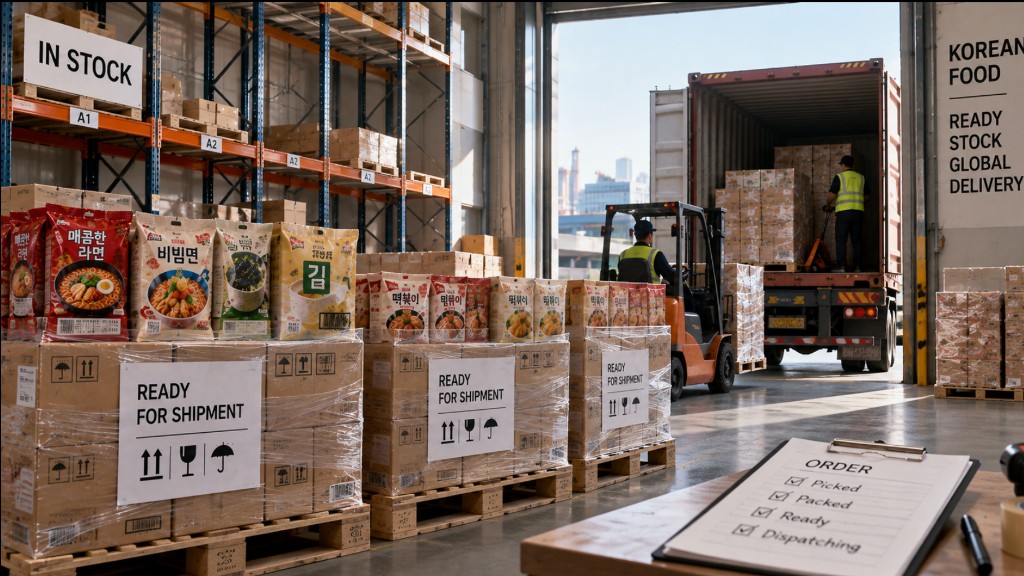
Ready stock means that inventory exists somewhere in the supply chain and may be available for purchase. The exact quantity still has to be confirmed. The batch and remaining shelf life still matter. The stock can be sold to another customer before the buyer confirms the order. Several products marked as available may also be sitting with different manufacturers or warehouses and still need to be collected and consolidated before export.
For an importer, ready stock should therefore be viewed as an availability advantage rather than a guarantee. The useful questions are straightforward: how many cartons are currently available, what dates apply to those cartons, how quickly can the stock be secured, and when can the complete order realistically become cargo-ready?
Ready stock is a snapshot, not permanent availability
A wholesale product catalogue may contain thousands of Korean products, but that does not mean thousands of products are physically sitting in unlimited quantities waiting for export. Manufacturers produce according to their own schedules, domestic customers purchase inventory, other exporters place orders and popular products can move quickly.
A Korean exporter may check a product on Monday and find 300 cartons available. By Friday, another buyer may have purchased part of that inventory. The product itself has not been discontinued and the manufacturer can still supply it, but the immediate quantity has changed.
This is why serious buyers should reconfirm availability when they are actually preparing the purchase order. A stock indication received several weeks earlier is useful for planning but should not automatically be treated as a reservation.
The same issue appears in mixed orders. A buyer may select seventy Korean products from a catalogue and find that fifty-five are immediately available, ten require a short wait and five are temporarily unavailable. The commercial order then needs to be adjusted around what can actually be supplied within the buyer’s shipment schedule.
That is a normal part of multi-brand wholesale purchasing.
Available quantity matters as much as availability itself
A product being “in stock” does not tell the buyer whether ten cartons or ten thousand cartons are available.
Suppose an importer needs 150 cartons of a Korean beverage and the exporter confirms that the product is currently in stock. A more useful confirmation is whether the full 150 cartons can be supplied from the available inventory.
Perhaps only forty cartons remain.
The importer then has a decision. It can accept forty cartons, wait for the next production, replace the SKU, or combine the available stock with new production if the dates and timing remain commercially acceptable.
This becomes particularly useful for buyers building mixed pallets or mixed containers because small quantities of ready stock can allow a broader product range without forcing large manufacturing MOQs on every SKU.
At the same time, a buyer should not assume that because an exporter is consolidating a large shipment, every manufacturer will release very small quantities. Minimum-order rules can still exist even where stock is physically available.
Ready stock can improve flexibility, but it does not eliminate the commercial conditions attached to every product.
Shelf life should be checked before celebrating faster availability
Ready stock has already been produced.
That sounds obvious, but commercially it creates the biggest difference between ready stock and fresh production.
A newly produced product may leave Korea with most of its original shelf life remaining. Ready stock may already have spent weeks or months in the manufacturer’s or distributor’s inventory.
That does not make the stock poor. A product with twelve months of total shelf life and ten months remaining can be excellent ready stock. Even a shorter-dated product may work perfectly for a fast-moving importer.
The buyer simply needs to know the dates before deciding.
Suppose Supplier A can provide a Korean snack immediately at USD 20 per carton with six months remaining shelf life. Supplier B can provide newly produced stock in three weeks at USD 21 with eleven months remaining.
The first offer saves one dollar and several weeks. The second gives substantially more selling time.
Neither answer is automatically correct. A distributor that already has confirmed supermarket orders may prefer the immediate stock. A new importer testing demand may value the additional shelf-life window more than speed.
Ready-stock purchasing works best when availability and remaining shelf life are considered together rather than separately.
Different batches can exist inside the same ready-stock order
A manufacturer or wholesaler may have inventory from more than one production batch.
If the buyer requires a large quantity, the order can therefore contain cartons carrying different manufacturing or expiry dates even though the SKU is identical.
This should not automatically be treated as a problem.
If the date difference is small and all stock comfortably meets the buyer’s shelf-life requirements, using more than one batch can be commercially insignificant.
The issue becomes important when the difference is large.
Suppose sixty cartons have ten months remaining while another sixty have six months remaining. The buyer may want to know that before accepting the full 120-carton quantity, particularly if the stock is going into organised retail.
This is one reason batch and date visibility becomes more important as order sizes increase. The importer does not need a forensic report on every carton. It needs enough information to avoid believing that all available inventory has exactly the same commercial life when it does not.
Ready stock can reduce lead time without eliminating lead time
Another common misunderstanding is that stock availability and shipment readiness are the same thing.
They are not.
The products may be ready at the manufacturer while the export order itself still requires work. Goods may have to move from several Korean suppliers to a consolidation warehouse. Quantities must be checked. The final packing list needs to reflect the actual cargo. Export documentation has to be prepared. The freight booking needs to align with the cargo-ready date.
For a single product from one supplier, the process can be relatively quick.
For a mixed Korean food shipment containing products from fifteen manufacturers, “ready stock” may mean fifteen separate Korean domestic movements before the complete export order is assembled.
A buyer should therefore distinguish between product availability and complete shipment readiness.
The first tells the importer whether the goods exist.
The second tells the importer when the actual shipment can leave.
Fresh production has advantages too
Ready stock is useful, but importers should not treat fresh production as the inferior option.
For large repeat orders, fresh production can provide better date consistency and stronger remaining shelf life. A buyer purchasing substantial volume may also prefer to coordinate the production schedule rather than depend on whatever quantity happens to be available.
Some manufacturers may require production because the requested quantity exceeds existing inventory. Others may manufacture certain export products only after receiving confirmed demand.
Fresh production usually involves waiting.
That waiting can be commercially worthwhile when the buyer is building long-term inventory for a market where distribution itself takes several months.
The right choice therefore depends on why the buyer is ordering.
If a retailer urgently needs replenishment, ready stock may be extremely valuable.
If a new market launch is six weeks away and the buyer expects slower initial sell-through, fresher production may be more useful.
A good wholesale order can contain both.
Mixed shipments often combine ready stock and new production
A large Korean food programme does not have to choose one model for the entire shipment.
Some products may already exist in acceptable quantities and dates.
Others may need production.
A mixed order can therefore develop in stages.
The ready-stock products are secured first while slower products move through their production schedules. The exporter then coordinates the timing so the complete shipment can be consolidated.
This creates an important decision when one product becomes significantly delayed.
Suppose fifty-nine SKUs are ready but one product requires another three weeks.
The buyer should decide whether that product deserves to delay the remaining order.
If it represents a major share of the shipment or an important retail commitment, waiting may make sense. If it is ten cartons of an experimental snack, removing it and shipping the other products may be commercially better.
The buyer does not need to understand every coordination detail behind this process. It should have enough visibility to make decisions when a delay affects the shipment.
Ready stock can be especially useful for trial orders
New importers frequently face a difficult combination of requirements. They want many different Korean products, but they do not yet have enough sales history to justify large quantities of each SKU.
Ready stock can sometimes help because existing inventory may allow the exporter to supply commercially workable quantities without waiting for a dedicated production run.
This is particularly useful for mixed-pallet and mixed-container orders where the buyer wants to test several products in the destination market.
The buyer should still resist the temptation to add products simply because they are available.
A product that does not suit the destination market remains a poor purchase even when the carton can leave Korea tomorrow.
Availability should help execute a good assortment.
It should not decide the assortment.
An urgent buyer should communicate what is genuinely urgent
Buyers often tell a supplier that the entire order is urgent when only part of it actually is.
That makes planning harder.
If twenty core SKUs are needed immediately because customers are already waiting while another forty are being purchased for general inventory, the exporter should know the difference.
There may be an opportunity to ship the urgent stock separately, prioritise certain products during consolidation or avoid delaying the entire commercial programme because of secondary lines.
The economics still need to make sense. Splitting shipments can create additional freight and handling costs.
The point is that urgency should be attached to a commercial requirement rather than used as a general instruction.
The clearer the buyer is about which products actually matter to its customers, the more useful availability information becomes.
Ready stock should still be reconfirmed before payment
There can be a gap between the first quotation and the buyer approving the purchase.
During that time, stock can move.
For important ready-stock orders, current availability and dates should therefore be reconfirmed when the commercial order becomes final.
The buyer should know whether the quoted quantity remains available, whether the expected batch or shelf-life position has materially changed and whether the estimated cargo-ready timing still makes sense.
This final check protects both parties.
The exporter avoids promising inventory that has already moved.
The importer avoids making payment based on an availability position that is several weeks old.
Once the order is confirmed and the relevant stock is secured under the agreed commercial arrangement, the transaction can move into consolidation and shipment preparation.
Ready stock is valuable because it gives the buyer options
The real advantage of ready-stock Korean food is flexibility.
It can help a distributor replenish a fast-selling SKU, build a mixed trial order, replace an unavailable product or reduce the time required to assemble a shipment.
Its value is highest when the buyer understands what “ready” actually means.
The product exists, but the quantity still needs confirmation. The stock has a batch and date. It may still need domestic movement and consolidation. Availability can change until the commercial order is secured. The fastest product is not automatically the best product if the remaining shelf life does not suit the buyer’s market.
For KCN, this is where a broad multi-brand Korean food network becomes useful to international buyers. The buyer does not need to contact dozens of manufacturers simply to determine what is currently available. It can build the requirement around the products, quantities, destination and timing it needs, then work from the stock position available in Korea.
A buyer looking for ready stock should therefore avoid asking only, “Is this available?”
The more useful question is whether the required quantity, dates and shipment timing are available for the order the buyer actually intends to place.