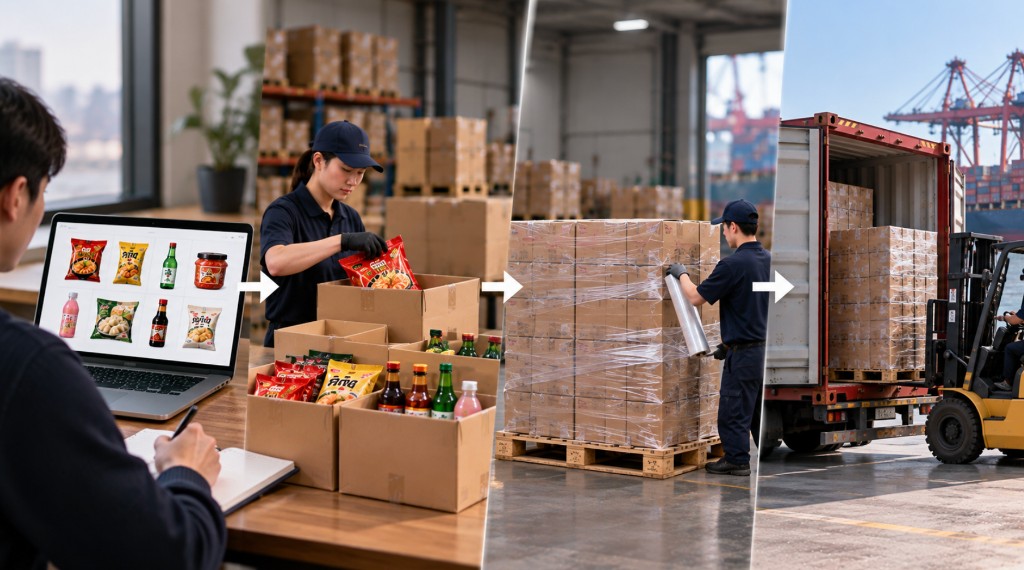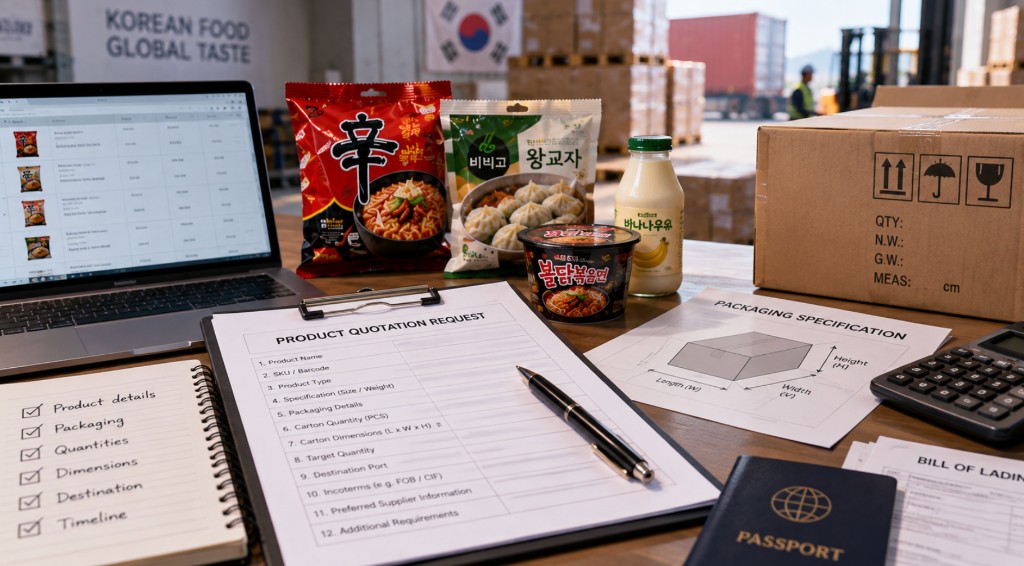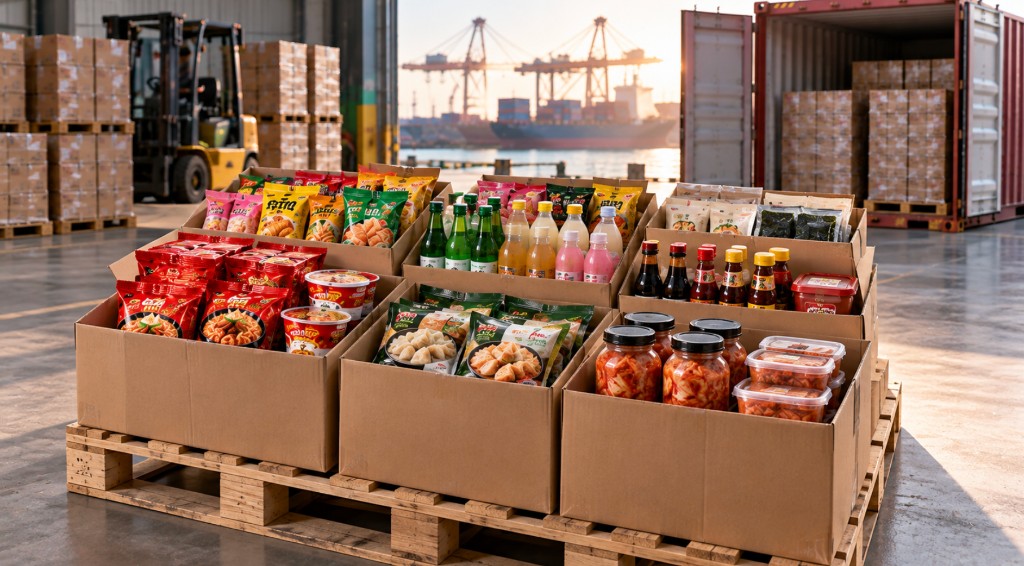

Product name.Carton quantity.Price.MOQ.
It looks as though the next step is to compare prices and place an order.
That is usually where the real work starts.
Food importing is a chain of commercial decisions. A product has to survive that chain financially and physically before it becomes a sensible import.
The factory price has to survive freight.
The shelf life has to survive transit and distribution.
The packaging has to survive handling.
The product has to satisfy the rules of the destination market.
And after all of that, there still has to be enough margin for the importer, distributor and retailer.
So if you are planning to import Korean food from South Korea, start with the economics of the shipment rather than the excitement of the catalogue.
Before looking for suppliers, work backwards from the shelf
Suppose a Korean beverage is offered at USD 0.80 per bottle.
That number tells you very little.
What matters is what that bottle costs when it reaches your warehouse and what price the market will accept when it reaches a retail shelf.
An importer can work backwards:
Expected retail price
minus retailer margin
minus distributor margin, where applicable
minus importer margin
minus local logistics and warehousing
minus duties, taxes and clearance costs
minus international freight
equals the approximate amount available for purchasing the product.
This calculation does not need to be perfect at the beginning. Its purpose is to prevent an importer from spending weeks sourcing a product that could never work commercially.
A USD 0.80 product can become expensive after freight and import costs.
A USD 1.00 product may work better if it ships efficiently, has stronger margins, has a longer usable shelf life or sells faster.
The cheapest FOB or FCA quotation is therefore not automatically the cheapest product to distribute.
What kind of Korean supplier are you dealing with?
“Korean food supplier” can describe several different businesses.
A manufacturer makes the product.
A brand owner owns the brand but may outsource production.
A trading company or exporter can purchase from several Korean manufacturers and prepare the products for export.
A domestic distributor may have access to a brand inside Korea without necessarily being the manufacturer or export-right holder.
There is no universal rule that one model is better.
A supermarket group trying to import thirty Korean brands has a different procurement problem from a distributor looking for one private-label seaweed manufacturer.
Buying from several manufacturers can give the importer direct access to factories, but it also means dealing with several order schedules, minimum quantities, invoices and pickup locations.
Working through an exporter can make mixed-brand purchasing easier because products can be collected and consolidated before shipment.
The right structure depends on what you are buying.
A supplier quotation needs more than a price
When comparing Korean food suppliers, request enough information to calculate the shipment properly.
For each product, you will normally want to know:
- product and brand name
- barcode or SKU
- net weight
- pieces per carton
- carton dimensions
- carton gross weight
- minimum order quantity
- stated shelf life
- expected remaining shelf life at dispatch
- storage requirements
- production or dispatch lead time
- country of origin
- available certificates
- quoted Incoterm
- payment terms
Carton dimensions are easy to overlook.
They matter because freight is partly a space problem.
Two products with the same purchase value can have very different shipping economics if one occupies twice the volume.
For a large catalogue, carton data becomes part of purchasing strategy.
Do not confuse total shelf life with usable shelf life
This is one of the easiest mistakes to make with imported food.
Imagine a snack with a twelve-month shelf life.
The importer does not necessarily receive twelve months.
Some time may already have passed between production and dispatch. Then the product moves through export preparation, international transport, customs clearance and local distribution.
A retailer may also refuse stock below its own minimum remaining shelf-life requirement.
The more useful number is therefore:
Usable selling period = remaining shelf life at dispatch − transport time − clearance time − local distribution time − retailer acceptance requirement
Consider a simplified example.
A product leaves Korea with nine months remaining.
Ocean transport and destination handling take five weeks.
Customs and warehouse receiving consume another week.
The distributor needs two weeks to place the goods across its retail network.
A retail customer requires at least four months remaining when stock is delivered.
On paper, the product had nine months.
Commercially, the importer has considerably less room.
This becomes dangerous when purchasing slow-moving SKUs.
A product can have healthy gross margins and still lose money through expiry.
MOQ has several meanings
Importers often ask:
“What is the MOQ?”
The answer can be more complicated than one number.
A manufacturer may require a minimum production quantity.
The exporter may require a minimum number of cartons per SKU.
A pallet configuration may create another practical minimum.
The shipment itself has an economic minimum because transporting tiny quantities internationally can make the cost per unit unreasonable.
This creates an interesting problem for first-time importers.
They want variety because retailers want a broad Korean range.
But every additional SKU divides purchasing volume.
An order containing forty products with five cartons each behaves very differently from an order containing eight products with twenty-five cartons each.
The first gives more assortment.
The second concentrates inventory into fewer products and may produce better purchasing and freight economics.
Neither approach is automatically correct.
The answer depends on expected sales.
Build the first order around sales velocity
A common beginner’s approach is to divide the order equally.
Twenty SKUs.
Twenty cartons each.
Neat spreadsheet.
Poor inventory logic.
Products rarely sell at exactly the same speed.
A better order might contain a group of products expected to generate regular sales, another group bought in moderate quantities, and a smaller number of experimental items.
For example:
A familiar ramen line may justify forty cartons.
A proven Korean snack may justify thirty.
A niche beverage flavour may start with eight.
A new confectionery item might start with five.
The carton allocation should reflect the confidence level behind each SKU.
This also makes the second order easier.
After several weeks of actual sales data, the importer can increase fast-moving products, remove weak performers and test new items without rebuilding the entire assortment.
Mixed containers solve one problem and create another
Korean food importers often want products from several manufacturers in one shipment.
That can make commercial sense.
One container could include beverages from one supplier, snacks from another, seaweed from a third and sauces from another producer.
The difficulty is timing.
If three suppliers are ready and the fourth supplier is delayed by two weeks, the importer has a choice.
Wait and delay the shipment.
Ship without the missing products.
Or split the cargo and pay for another movement.
Consolidation therefore needs coordination before the purchase orders are placed.
The buyer should know:
when each supplier can deliver,
where the goods will be consolidated,
how long they can remain there,
whether there are warehouse charges,
how expiry dates compare across the shipment,
and when the container or LCL cargo is scheduled to leave Korea.
A mixed shipment is partly a purchasing exercise and partly a scheduling exercise.
FCL and LCL should be compared on total economics
LCL means the importer uses part of a container.
FCL means the importer books the container.
The obvious assumption is that small importers use LCL and large importers use FCL.
Reality is more nuanced.
LCL can allow an importer to enter the market with less inventory. It can also make it possible to test more products without funding a full container.
But LCL usually involves more cargo handling and its cost per cubic metre can become unattractive as shipment volume rises.
FCL gives the importer more container capacity and can improve freight economics at sufficient volume.
It also creates a larger inventory commitment.
The question is therefore not:
“Which shipping method is cheaper?”
Ask:
“Which shipping method gives the lowest total cost without forcing us to hold more inventory than we can sell?”
There is a second technical point here.
FOB, FCA, CIF and similar terms are Incoterms, and they determine the division of costs, tasks and risk between seller and buyer. Under Incoterms 2020, FOB and CIF are rules for sea and inland-waterway transport. FCA is commonly the more appropriate rule when containerised goods are handed to a carrier or terminal before being loaded onto the vessel.
That distinction matters when comparing quotations.
Two prices should ideally be compared on the same commercial basis.
Calculate landed cost SKU by SKU
An importer should know the approximate landed cost before approving a large purchase.
At a simple level:
Landed cost = purchase cost + origin logistics + export charges + freight + insurance + import costs + clearance + destination handling + local delivery
The exact components depend on the Incoterm and destination country.
For mixed shipments, the harder question is how the common costs should be allocated across individual products.
Allocating freight equally across every SKU can distort the numbers.
A light packet of seaweed and a heavy carton of canned beverages do not consume freight in the same way.
Depending on the shipment, the importer may allocate costs using:
- weight
- cubic volume
- product value
- a combination of these methods
The method should make commercial sense for the shipment.
After allocation, calculate landed cost per sellable unit.
That is the figure that belongs beside the expected wholesale and retail price.
Compare quotations per sellable unit, not per carton
Consider two quotations.
Product A
Carton price: USD 3232 consumer units per carton
Purchase cost per unit: USD 1.00
Product B
Carton price: USD 2920 consumer units per carton
Purchase cost per unit: USD 1.45
Product B has the cheaper carton.
Product A has the cheaper unit.
Now add freight.
If Product A also packs more efficiently into a carton, the difference may widen further.
This is why professional buyers tend to normalize quotations before comparing them.
Useful measures include:
cost per unit
cost per kilogram
cubic metres per carton
freight cost per unit
landed cost per unit
gross margin at expected selling price
The supplier’s price list is only the raw material for the purchasing decision.
Certifications need to be checked carefully
Korean food manufacturers may operate under HACCP or other food-safety systems, depending on the company and product.
Food Safety Korea maintains official food-safety information and HACCP-related data, and Korea’s HACCP standards continue to be administered and updated by the relevant authorities.
An importer should still inspect the actual certificate presented for the goods.
Check:
- the company named on the certificate
- factory or facility covered
- issuing organisation
- validity dates
- scope
- whether the relevant product or process falls within that scope
This becomes even more important when buyers need a particular certification for regulatory, religious or commercial reasons.
A certificate logo in a catalogue is not enough information for a purchase decision.
Request the document.
Export documentation depends on the destination
There is no single document pack that applies to every shipment from Korea to every country.
Typical commercial shipping documentation can include items such as the commercial invoice and packing list. Origin documentation may also be required when claiming preferential tariff treatment under a trade agreement.
Korea Customs shows that certificate-of-origin procedures vary between FTAs. Depending on the agreement, origin certification may follow different forms or issuance methods.
Food products can also trigger destination-specific documentation or approvals.
The importer therefore needs to verify requirements in the importing country before shipment.
Do this before the goods leave Korea.
A missing document discovered before loading is an administrative problem.
A missing document discovered while food is sitting at the destination port can become a financial problem.
Labelling should be reviewed before commercial quantities are packed
The Korean retail label may not satisfy the rules of the destination market.
Depending on the country and food category, imported products may need specific information covering ingredients, allergens, nutrition, importer details, origin, dates, storage or local-language requirements.
The exact rules come from the destination country’s authorities.
For the importer, the practical lesson is simple.
Obtain label artwork early.
Send it for compliance review.
Determine whether an additional label is required.
Agree on where and when that label will be applied.
Doing this after the shipment arrives creates unnecessary labour and can delay distribution.
Treat samples as part of commercial screening
Sampling every interesting product in a 2,000-item catalogue is rarely useful.
Shortlist first.
Start with commercial data.
Remove products that fail on price, MOQ, shelf life, storage or regulatory suitability.
Then sample the remaining candidates.
The sample can answer questions the spreadsheet cannot:
Does the packaging feel strong enough for distribution?
Does the serving size fit the target market?
How does the product compare with an existing competitor?
Does the physical product match the catalogue presentation?
Would a supermarket buyer understand the proposition immediately?
Sampling becomes much more useful after the commercial filters have already been applied.
Think about the second order before placing the first
An importer can sell out and still have a supply-chain problem.
Suppose a popular product takes:
three weeks to prepare,
one week to consolidate,
four weeks in transport,
and another week for clearance and receiving.
If the importer waits until only two weeks of inventory remain before reordering, a stock-out is almost guaranteed.
Replenishment planning should therefore start with lead time.
A simple model is:
Reorder point = expected demand during replenishment lead time + safety stock
The exact safety stock depends on demand volatility and how reliable the supply chain is.
The important point is that reordering decisions should be made while stock is still healthy.
This is particularly relevant for imported products because replenishment cannot usually happen overnight.
A useful way to review the order before paying
Before approving a Korean food shipment, take the final product sheet and ask these questions.
Can we explain who manufactures each product?
Do we know the actual units and weight inside every carton?
Do we know the remaining shelf life expected at dispatch?
Can we see the certificates we are relying on?
Do we understand the quotation’s Incoterm?
Have we estimated landed cost?
Have we checked destination-country import and labelling requirements?
Do we know why each SKU is in the order?
Can the expected selling price support the supply chain?
Do we know when we would need to reorder?
If several answers are still “we will check later,” the order is probably being approved too early.
The real job of a food importer
Finding Korean products has become relatively easy.
Building an assortment that can be imported repeatedly at workable economics is harder.
The difference appears in small decisions.
Buying ten cartons instead of fifty because demand is untested.
Rejecting a cheaper product because too much shelf life has already been consumed.
Choosing a different shipment structure because the freight allocation makes one category uneconomic.
Ordering a faster-moving SKU before the warehouse looks empty.
Checking a certificate instead of assuming a logo in a brochure applies to the product.
None of these decisions looks dramatic by itself.
Together, they determine whether the first Korean food shipment becomes the start of a repeatable distribution business or an expensive warehouse full of lessons.