
A manufacturer may require a certain production quantity before it starts a run. An exporter may impose a minimum number of cartons per SKU because handling very small lines is inefficient. A brand owner may require a minimum purchase value across the whole order. A pallet configuration may create another practical minimum, while a private-label product may have packaging quantities that are much larger than the quantity needed for the food itself.
This is why the question should not stop at “What is the MOQ?” The buyer should understand what creates that MOQ and whether it applies to the product, the flavour, the carton, the factory, the shipment or the entire commercial relationship.
A product MOQ is usually the most visible one. If a supplier says the minimum is twenty cartons of a particular ramen SKU, the importer knows the smallest quantity it can add to the order. That becomes more complicated when several flavours are involved. A manufacturer may allow twenty cartons per flavour, while another may require one hundred cartons across the entire range but permit the buyer to divide those cartons between several flavours. Those two arrangements can produce very different first orders.
Suppose an importer wants five flavours. Under a twenty-carton-per-flavour rule, the minimum order becomes one hundred cartons. Under a one-hundred-carton mixed rule, the importer might buy forty cartons of two stronger flavours and smaller quantities of the remaining three. The total quantity is identical, but the second structure gives the buyer far more control over inventory risk.
This is why buyers should ask whether the minimum applies per SKU, per flavour, per brand or across the total order.
The manufacturer may be creating the minimum
A supplier sometimes has very little freedom to reduce the MOQ because the minimum originates at the factory.
A manufacturer producing an existing branded product may run production in large batches. If the requested SKU is not already available in warehouse stock, the factory may require a certain quantity before scheduling another run. The exporter cannot necessarily break that requirement simply because the overseas buyer wants ten cartons.
Ready stock changes the situation. If a Korean exporter already has access to finished goods, the buyer may be able to purchase much smaller quantities because the production minimum has already been satisfied by someone else. This is one reason the same product can have different MOQs depending on the supplier and the timing of the order.
The buyer should therefore ask whether the quoted MOQ applies to existing inventory or new production.
That distinction also affects shelf life. Ready stock may allow a smaller order and faster shipment, but some of the product’s shelf life has already been consumed. Fresh production may provide better remaining shelf life while requiring a larger quantity and longer lead time. The cheapest or smallest MOQ is not automatically the better commercial option.
For established products with strong sales, accepting a production MOQ may be easy. For a product entering the market for the first time, the same quantity may represent several months of inventory. That should be calculated before the buyer agrees to the factory minimum.
Carton configuration can create hidden minimums
Imported food is generally purchased and shipped in cases or cartons rather than individual retail units. The number of consumer units packed inside each carton therefore matters.
Suppose Supplier A has an MOQ of ten cartons and each carton contains 48 units. The true minimum is 480 sellable units.
Supplier B has an MOQ of fifteen cartons, but each carton contains only 20 units. Its minimum is 300 units.
The supplier with the higher carton MOQ actually requires the smaller retail-unit commitment.
For this reason, buyers should compare both cartons and sellable units.
This becomes especially important when comparing products from different manufacturers. One beverage may be packed as 24 bottles per carton, another as 12. One snack may contain 20 retail packs per case while another contains 60. A ten-carton minimum therefore has almost no meaning until the carton configuration is known.
The carton dimensions also matter. Twenty cartons of a bulky snack can occupy more shipping space than fifty cartons of a compact sauce. MOQ should therefore be considered alongside the CBM created by the minimum order.
An importer managing a mixed container is not really asking whether twenty cartons are affordable. The buyer is asking how much cash, container space and warehouse capacity those twenty cartons consume.
Pallet minimums change the calculation again
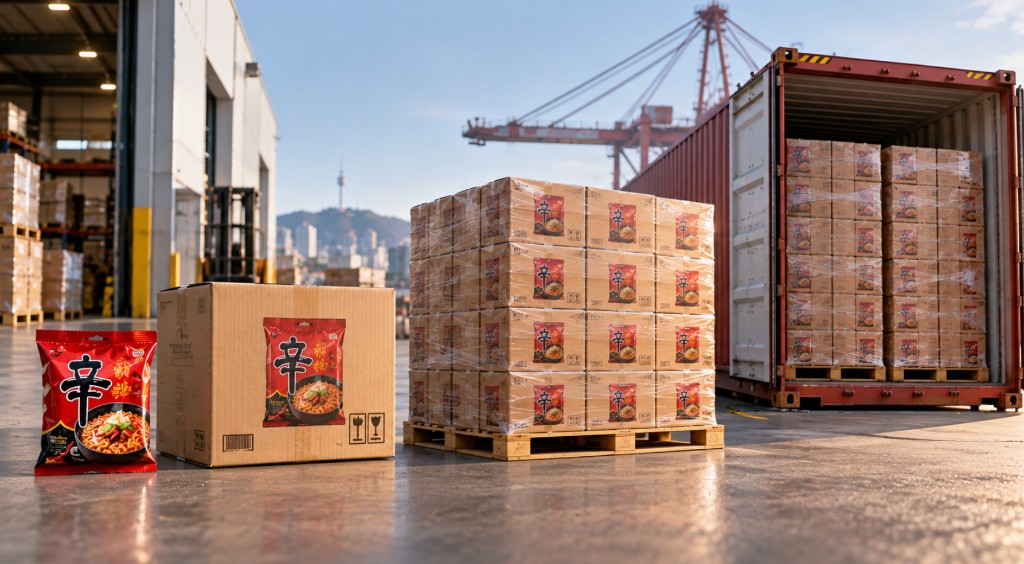
Some suppliers or logistics arrangements work more efficiently with full pallets. A supplier may therefore quote a pallet-level minimum even when the product itself could theoretically be sold in smaller carton quantities.
Suppose one pallet contains eighty cartons. The importer needs only thirty cartons based on expected sales. Buying the full pallet means the buyer is taking more than twice the quantity needed for the current sales cycle.
The purchasing team should calculate how long those eighty cartons will take to sell.
If the product moves at twenty cartons per month, the pallet represents four months of inventory. That may be perfectly acceptable if the product has strong shelf life and the importer normally reorders every three months.
If the product sells at five cartons per month, the same pallet represents sixteen months of stock. The pallet minimum has now become a much bigger issue.
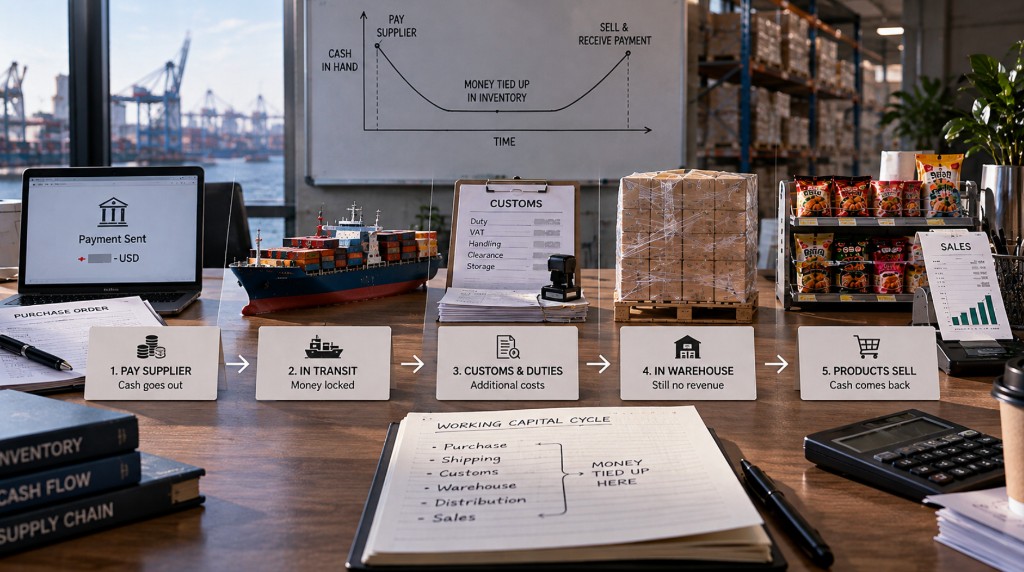
This is where minimum order quantities should be converted into months of inventory.
The calculation is simple:
Months of Inventory = MOQ Quantity ÷ Expected Monthly Sales
An MOQ of sixty cartons looks reasonable until the product is expected to sell only eight cartons per month. That minimum represents seven and a half months of inventory before shipping delays or safety stock are considered.
A buyer can then compare that number against the product’s usable shelf life.
If the minimum quantity requires seven months to sell but the product will have only five months of comfortable commercial shelf life after arrival, the MOQ does not fit the market yet.
Private label has a different MOQ problem
Private-label Korean food can introduce several minimums at the same time.
The food manufacturer may have a production minimum. The packaging printer may have a separate minimum for wrappers, labels, cartons or pouches. The ingredient supplier may require a certain production batch. The factory may also charge additional setup costs for smaller runs.
This can produce situations where the importer needs 5,000 units of the product but must purchase 20,000 printed packages because that is the packaging supplier’s minimum.
The unused packaging may be stored for future production, but this creates another risk. If the importer changes the design, nutrition panel, importer details, regulatory wording or barcode, the remaining packaging can become unusable.
For private-label products, the buyer should therefore ask separately about the MOQ for the food product, retail packaging and outer cartons.
It is also worth asking whether excess packaging will be stored by the manufacturer and under what conditions. The financial commitment may extend beyond the quantity of finished goods delivered in the first shipment.
This is one reason private label usually makes more sense once the importer has some confidence in product demand. A branded product purchased from ready stock allows a new market to be tested without committing to custom packaging quantities.
Mixed orders can reduce risk if the exporter allows them
An exporter handling several Korean manufacturers can sometimes make MOQ easier to manage because products can be combined into one larger shipment.
The importer might purchase twenty cartons from one manufacturer, thirty from another and ten from a third, then consolidate everything into one export shipment.
This does not remove each manufacturer’s product MOQ, but it can reduce the shipment-level commitment. Instead of filling a container with one brand, the buyer can spread purchasing capital across several categories and suppliers.
The commercial advantage is variety with controlled depth.
The danger is taking variety too far. A mixed order containing eighty SKUs with tiny quantities can become difficult to manage. Freight cost per product may rise, warehouse complexity increases and the importer may spend a large amount of time coordinating lines that contribute very little revenue.
A mixed-order strategy therefore needs a balance. The importer wants enough variety to build a useful catalogue, while maintaining enough quantity in the stronger products to make the shipment economical.
MOQ should help shape that balance, but it should not dictate it blindly.
A lower MOQ is not always better
Importers naturally prefer lower minimums because they reduce the amount of capital committed to an untested product. There are situations, however, where buying slightly more creates better economics.
Suppose a supplier allows an importer to purchase ten cartons, but international freight and destination handling make the landed cost extremely high at that quantity. Buying thirty cartons may reduce the freight allocation per unit enough to produce a much healthier margin.
If the product has strong sales and long shelf life, the larger purchase can make sense.
The important point is that the additional quantity should be justified by demand, not merely by the supplier’s discount.
A supplier may offer a lower price at fifty cartons, another reduction at one hundred and an even lower price at two hundred. The buyer should calculate the saving against the extra inventory created at each step.
Assume the price falls from USD 20 to USD 19 per carton when the order increases from fifty to one hundred cartons. The buyer saves USD 1 on all one hundred cartons, or USD 100 compared with paying the higher rate.
But the buyer has also purchased fifty additional cartons.
If those cartons sell quickly, the saving is useful. If they remain in the warehouse for six months, the USD 100 saving may be irrelevant compared with the cash tied up, storage requirement and expiry risk.
Volume discounts should therefore be compared with inventory turnover.
MOQ can sometimes be negotiated through product mix
When an MOQ appears too high, the buyer should first understand why it exists before asking for a reduction.
If the minimum comes from a production run, the supplier may have little flexibility. If it comes from warehouse handling or an internal exporter policy, there may be more room to adjust it.
One useful question is whether several related SKUs can be combined toward the minimum.
A manufacturer might require one hundred cartons in total but allow the buyer to split that quantity between several flavours. Another may allow a minimum purchase value across the brand rather than imposing the same carton requirement on every SKU.
For a buyer, that can make the difference between a sensible assortment and excessive inventory.
The discussion can also change after several successful orders. A supplier that initially requires larger quantities from a new overseas customer may become more flexible once the buyer has established regular purchasing patterns.
It is therefore useful to record the actual MOQ achieved in each order rather than treating the first quotation as a permanent rule.
Minimum order value matters too
Some exporters do not focus only on carton quantities. They may require a minimum total order value before accepting an export shipment.
This can be more flexible for a mixed Korean food buyer because expensive products and inexpensive products can contribute toward the same threshold.
Suppose the exporter requires a minimum order value of USD 10,000. The importer might spread that amount across fifty SKUs based on expected demand rather than meeting a large carton minimum for every product.
The difficulty is that minimum value can encourage the buyer to add products simply to reach the target.
If the draft order is USD 8,700 and the buyer adds USD 1,300 of slow products only to satisfy the exporter, those final products deserve the same scrutiny as the rest of the order.
A purchasing minimum should never become a reason to abandon the demand forecast.
If the business genuinely needs only USD 8,700 of stock, it may be better to negotiate, wait, combine the order with future demand or use another sourcing structure rather than purchasing USD 1,300 of inventory without a clear sales plan.
MOQ should be reviewed together with the reorder cycle
The best MOQ is one that fits reasonably into the importer’s normal replenishment pattern.
If the business brings Korean food every two months, a product MOQ representing approximately two or three months of demand may be comfortable. A minimum representing twelve months of demand is much harder to manage.
Suppose a product sells fifteen cartons per month and the supplier requires sixty cartons. That gives four months of inventory. If the product has long shelf life and the importer expects to reorder every three months, the difference may be manageable.
Now suppose the supplier requires 180 cartons. That is twelve months of demand.
The buyer should have a strong reason before accepting that quantity.
The same product may become suitable six months later if sales increase to fifty cartons per month. MOQ is therefore not only a supplier characteristic. It also depends on the size of the buyer’s market.
A minimum that is impossible for one importer may be routine for another.
The right question is whether the minimum fits the business
When reviewing a Korean food product, the importer should know the MOQ, units per carton, carton CBM, remaining shelf life and expected monthly sales. Those numbers together reveal far more than the MOQ alone.
If the supplier requires forty cartons and the importer expects to sell forty cartons in a month, the minimum is probably easy to manage. If the same forty cartons represent eight months of sales, the product needs closer examination.
The buyer should also understand whether the minimum comes from the manufacturer, exporter, packaging supplier or logistics arrangement. That tells the importer where flexibility may exist and where it probably does not.
MOQ is sometimes treated as a hurdle that has to be crossed before the supplier will accept the order. For an importer, it is more useful to treat it as an inventory decision.
The real question is not whether the supplier will allow the buyer to purchase that quantity.
It is whether the buyer can sell that quantity comfortably before it becomes expensive stock.