
This is why a serious importer should build the business model backwards from the market rather than forwards from a Korean quotation. Start with the price at which the product can realistically sell. Remove the margin required by the retailer. If a distributor sits between the importer and retailer, remove that margin as well. Account for promotions, rebates or other commercial deductions that are common in the intended sales channel. What remains is the maximum amount the importer can afford to spend while still earning an acceptable return.
Suppose a product can sell at retail for USD 2.50. The retailer needs enough room to operate, and the distributor may need its own margin. After those layers are removed, perhaps the importer can sell the unit for USD 1.35. If the true landed cost is USD 1.10, the importer’s gross spread is USD 0.25. That is a very different business from looking at a Korean supplier price of USD 0.70 and imagining USD 1.80 of profit.
The product can still be attractive. The point is to understand where the money actually goes.
Margin is only useful when the stock turns
Importers often spend too much time negotiating percentage margin and not enough time looking at inventory turnover. A product producing a 35% gross margin sounds better than one producing 22%. The picture changes if the first product takes nine months to sell while the second turns every six weeks.
Capital can be used repeatedly when stock moves.
Suppose Product A requires USD 10,000 of inventory and produces a USD 3,500 gross contribution when the entire quantity sells. It takes six months to clear. Product B also requires USD 10,000 but produces only USD 2,200 per cycle. If Product B sells through every two months, the importer may be able to complete three cycles during the time Product A completes one.
The lower-margin product can therefore generate more gross contribution from the same working capital.
This is one of the most important ideas in food distribution because food inventory has a clock attached to it. The buyer is not holding machinery or industrial equipment that may remain sellable for years. Shelf life is declining every day. A slow product consumes capital while becoming harder to sell.
This is why the best SKU is not necessarily the one with the highest percentage margin. A strong SKU combines reasonable margin with reliable turnover, predictable replenishment and enough shelf life to tolerate ordinary supply-chain delays.
An importer should know how many days or months of inventory it is carrying for each major line. If a product sells 100 cartons per month and the warehouse contains 300 cartons, there are roughly three months of stock. If another product sells ten cartons per month and the warehouse contains 150, there are fifteen months of stock.
The second line may show a beautiful theoretical margin in the spreadsheet while quietly destroying cash flow.
The business is usually financed before it earns anything
Importing also creates a timing problem that is easy to underestimate.
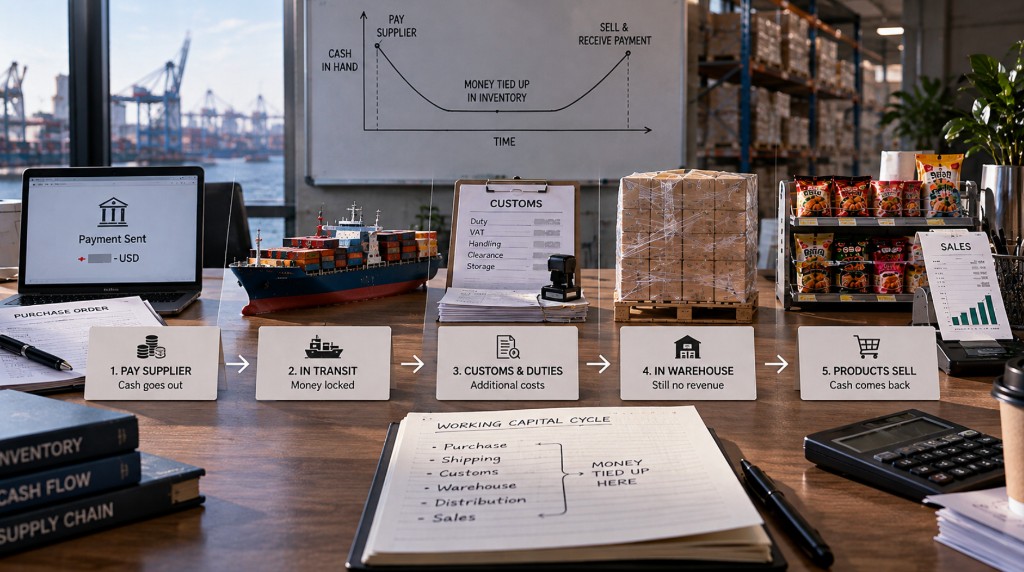
The supplier may require a deposit when the order is confirmed and the balance before shipment. The goods then spend time in production, consolidation and international transit. Customs and destination charges have to be paid before the importer can distribute the stock. Retail customers may then expect payment terms after receiving the goods.
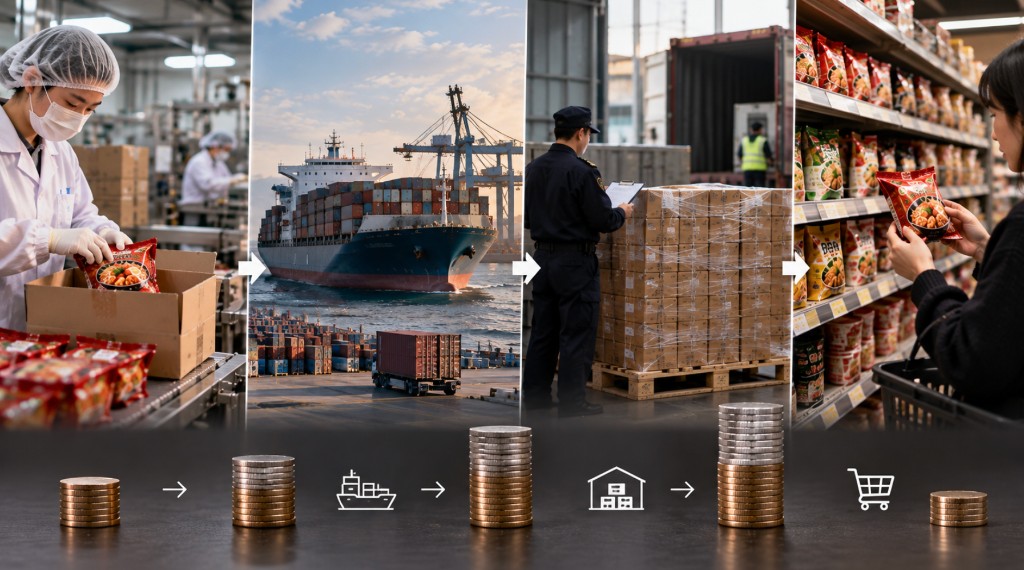
The importer can therefore spend most of the money several months before collecting the final receivable.
Imagine a USD 50,000 Korean food order. The importer pays USD 15,000 as a deposit, later pays the remaining USD 35,000, then another USD 8,000 across freight, duty, clearance and local logistics. The products reach the warehouse after six weeks. The importer sells them to retailers on 30-day credit and the stock takes another two months to move through the market.
The business may have more than USD 50,000 tied up for a substantial period before the full sales proceeds return.
If another container has to be ordered before the first one has been fully collected, the working-capital requirement increases again.
This is why fast growth can actually create cash pressure in an importing business. Sales can be rising while the bank balance is falling because each additional shipment requires more cash before the previous shipment has converted back into cash.
The purchasing schedule should therefore be connected to the cash-flow schedule.
A business that can profitably sell two containers per month still needs enough working capital to finance those containers. Otherwise it can become permanently short of stock, repeatedly delay supplier payments or depend on expensive short-term finance.
Supplier payment terms become important for the same reason. Ten cents of price reduction is valuable, but additional payment time can sometimes be worth more. If one supplier requires full payment before production while another allows a more favourable structure, the second supplier may place less pressure on working capital even at a slightly higher unit price.
Distribution structure decides how much margin is actually available
A Korean exporter may look at a destination retail price and assume there is enormous room in the market. The missing piece is the number of companies between the importer and the consumer.
Some importers sell directly to retailers. Others sell to regional distributors that then supply supermarkets, groceries, convenience stores or food-service customers. In some markets there may be several layers.
Every layer needs a commercial reason to handle the product.
If the importer wants a distributor to warehouse the product, sell it, deliver it and collect payment from hundreds of smaller customers, that distributor needs enough margin to make the activity worthwhile. The retailer then needs enough margin to allocate shelf space to the product.
A product with excellent factory economics can therefore fail simply because the final retail price cannot support the required distribution chain.
Suppose a Korean snack has an estimated landed cost of USD 0.95. The importer wants to earn USD 0.20 and sells it to a distributor at USD 1.15. The distributor needs another USD 0.20 and sells to the retailer at USD 1.35. The retailer requires enough room to cover its own costs and expected margin and places the product on shelf at USD 2.10.
If competing snacks in the category sell at USD 1.50, the product has a problem. Negotiating another three cents from the Korean supplier probably will not solve it.
The business needs a structural answer. The package size may need to change. The distribution chain may need to be shorter. The product may need premium positioning, or the buyer may simply need to choose another SKU.
This is why retail benchmarking should happen before the commercial order, not after the stock reaches the warehouse.
The importer should walk the market, look at actual shelf prices, understand the competitive pack sizes and estimate how much room exists between landed cost and realistic selling price.
Compliance belongs inside the business model
Compliance is sometimes treated as an administrative step that begins after the purchasing team has chosen the products. That is a dangerous way to build an import business.
The legal ability to import and sell the product needs to be part of product selection from the beginning.
Food-import requirements differ by destination. Depending on the jurisdiction and product, there may be rules relating to importer registration, product registration, foreign-manufacturer approval, ingredients, allergens, nutrition information, language, shelf-life marking, health certificates, Halal requirements, laboratory testing or other controls. There is no universal Korean document pack that guarantees entry into every market.
South Korea’s MFDS maintains different export-certificate materials for different products and destinations, including destination-specific sanitary certificates. Its current export-certificate resources illustrate why buyers need to establish destination requirements rather than asking suppliers for a generic “health certificate.”
That responsibility should be clear inside the business.
The Korean manufacturer understands the product and its production. The exporter may understand Korean export procedures. The freight forwarder understands transportation. A customs broker can assist with destination customs procedures. None of those parties automatically owns the importer’s entire compliance responsibility.
The importer needs somebody who understands what is required before the purchase order is issued.
This matters because compliance problems have direct financial consequences. If a label needs to be changed before sale, every unit may require relabelling. If a product cannot be cleared, storage and demurrage can accumulate while the problem is investigated. If an ingredient is not accepted in the destination market, the entire stock can become commercially unusable.
Those costs can wipe out the expected margin from many successful products.
Compliance should therefore be treated as part of cost and product viability rather than as paperwork.
Customs classification deserves the same attention. Duty rates and other import treatments can depend on the tariff classification of the product, and customs valuation is generally built around internationally recognised valuation rules. The World Customs Organization notes that transaction value, with applicable adjustments, remains the primary valuation basis used across most world trade.
The importer should confirm the applicable local customs treatment rather than building its margin using an HS code copied from another supplier’s invoice.
Working capital should determine how wide the catalogue becomes
A broad Korean food catalogue can be commercially attractive. Retailers like choice, and a distributor carrying many categories can become a more useful supplier.
The danger is spreading working capital too thinly.
Suppose an importer has USD 100,000 available for inventory. It can use that capital to hold 50 strong SKUs with meaningful stock depth, or 300 products in very small quantities.
The 300-SKU catalogue looks much larger. Operationally it can be weaker.
Some products will sell out immediately because there is too little stock. Others will sit for months. Reordering becomes fragmented. The warehouse carries many low-value inventory lines. Salespeople spend time managing products that barely contribute to revenue.
A smaller range with strong availability can sometimes produce a healthier business than a giant range that is permanently half out of stock and half overstocked.
The importer should therefore think in terms of capital allocation.
If one SKU needs USD 10,000 of working capital but contributes only USD 1,000 of annual gross profit, the capital may be more productive elsewhere. If another SKU requires USD 5,000 and produces USD 6,000 of annual contribution through repeated turns, it deserves more purchasing capacity.
This logic should gradually reshape the assortment.
New products begin with limited capital. Products that demonstrate repeat demand receive more. Products that repeatedly sit in the warehouse lose allocation.
The catalogue becomes the result of capital productivity rather than the result of how many products the Korean exporter can offer.
Growth should come from repeat orders, not first orders
A new importer can create impressive sales numbers by continuously launching new products. Every launch produces initial orders from retailers that want to test the line.
That can hide weak underlying demand.
The business becomes healthier when revenue increasingly comes from products that have already been ordered before.
Suppose a distributor sells USD 100,000 in one month. If USD 80,000 came from first-time placements of products into new retailers, the company still has a lot to prove. If USD 80,000 came from retailers replenishing products they previously sold, the quality of the revenue is very different.
Repeat orders demonstrate that products are moving through the retailer rather than merely moving from the importer into the retailer’s warehouse.
This is why a Korean food importer should measure more than sales.
It should know which products are being reordered, how long each reorder takes, which retailers repeatedly purchase them and whether reorder quantities are increasing or declining.
A product that consistently generates repeat orders deserves stock.
A product that produces one attractive launch and then disappears from retailer orders should not receive the same purchasing priority.
The business model becomes stronger when each shipment teaches the next one
The first Korean food shipment will contain assumptions. Sales velocity is estimated. Freight is estimated. Some products perform better than expected and others disappoint.
The second shipment should contain fewer assumptions.
By the fifth or tenth shipment, the importer should know far more about its market than it did at the beginning. It should know which categories turn quickly, which carton configurations create poor freight economics, which suppliers deliver reliable shelf life and which products generate retailer reorders.
If the company keeps purchasing the same way despite that information, it is wasting the value of its own trading history.
Good import businesses gradually become more selective.
They stop buying products simply because the supplier offers them. They buy products because they understand how those products behave after arrival.
They negotiate more aggressively on the lines where volume is meaningful. They purchase smaller quantities where demand remains uncertain. They remove weak inventory instead of allowing the catalogue to grow forever.
Compliance also becomes more systematic. Product files improve. Classification and documentation are resolved earlier. Labels are reviewed before shipment. Supplier certificates are stored against the actual products they cover.
The business starts becoming predictable.
That predictability is far more valuable than finding one unusually cheap shipment.
A sustainable Korean food import business is built when the importer understands four things at the same time: what the product really costs, how quickly it turns back into cash, whether the distribution chain can make money from it, and whether the product can be legally imported and sold in the destination market.
If one of those four fails, a good product can still become a bad business.