
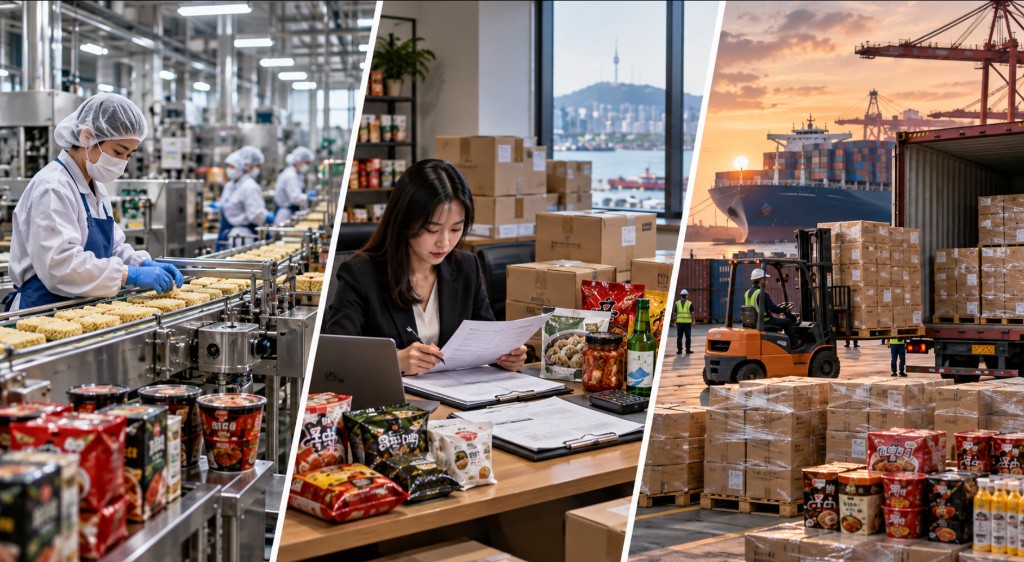
A Korean manufacturer, an exporter and a trading company can all sell legitimate products, but they solve different problems. The manufacturer makes the food. An exporter may handle overseas sales for one or several manufacturers. A trading company can source products from multiple Korean suppliers, consolidate them and manage the export transaction. In real business these roles can overlap, which is why the buyer should understand what the company actually does rather than relying only on the word used in its company profile.
This matters particularly in Korean food because importers often want mixed assortments rather than one product from one factory. A buyer may need ramen from one manufacturer, beverages from another, snacks from three more companies and seaweed from a specialist producer. Buying every line directly can produce excellent product-level pricing while creating a much more complicated shipment.
Buying directly from the manufacturer
Direct sourcing works best when the importer has meaningful volume in a relatively small number of products. If a distributor already sells several thousand cartons of a beverage every quarter, dealing directly with the manufacturer can make sense. The buyer may receive clearer production information, better visibility over fresh production and potentially better pricing because there is no separate exporter margin added to the transaction.
The difficulty usually appears in MOQ and coordination.
A manufacturer designs its production around efficient factory runs. The quantity that makes sense for the factory may be much larger than the quantity a new importer wants to test. If the product is already sitting in ready stock, the manufacturer may be flexible. If new production is required, the minimum can increase considerably.
The manufacturer may also be excellent at making the product but less interested in managing a complicated mixed export shipment. A factory producing beverages may have no reason to coordinate snacks from another manufacturer or collect seaweed from a third supplier just because the overseas customer wants one mixed container.
For an importer concentrating on one brand or one category, that may not matter. For a buyer building a broad Korean food catalogue, it quickly does.
Direct sourcing also means the importer may have to manage several supplier relationships at the same time. Each factory can have its own quotation format, payment schedule, production lead time and delivery point. One factory may finish on the 10th of the month and another on the 25th. The importer or its logistics partner then has to bring those products together before export.
With five suppliers, this may still be straightforward. With twenty-five, the coordination work becomes part of the purchasing cost even though it does not appear on the unit price.
What an exporter adds
A Korean exporter can sit between the overseas buyer and the manufacturers and manage much of that complexity.
Instead of receiving fifteen separate invoices and arranging collections from fifteen factories, the importer may work with one Korean company that sources or receives the products, consolidates the shipment and handles the export side of the transaction. KOTRA’s buyKOREA platform exists specifically to connect overseas buyers with Korean sellers, and KOTRA also supports international buyers through sourcing inquiries and business matching.
The exporter earns a margin for providing that service, so the product price can be higher than a direct factory quotation. The useful comparison is whether that higher price is offset by smaller MOQs, easier consolidation, fewer local transport movements, simpler communication or better export handling.
Suppose an importer wants thirty Korean SKUs but needs only twenty cartons of each. Most factories may not consider those quantities attractive individually. An exporter already working with those manufacturers may be able to combine the buyer’s requirements with its existing supply relationships and build one shipment.
For a new importer, this can be more valuable than saving a few cents per unit.
The exporter can also become a single point of contact when one manufacturer is delayed or when an item needs to be replaced before loading. The buyer does not have to chase every factory personally.
That convenience should still be verified rather than assumed. Some exporters have strong operational teams and product data. Others simply pass messages between the buyer and factory. The importer should understand what the exporter actually handles before accepting the additional margin.
Trading companies become useful when the range is wide
A trading company can be particularly useful when the buyer wants products from many unrelated manufacturers.
Instead of specialising in one brand or one category, the trading company may source across beverages, snacks, noodles, sauces, confectionery and other food lines. For the overseas importer, the main attraction is flexibility.
A mixed container might contain forty SKUs from ten manufacturers while the buyer receives one commercial relationship on the Korean side.
That can make the first few shipments much easier.
The trade-off is that the trading company may be another step away from the actual factory. Product questions can sometimes take longer to answer because the information has to move from factory to trader to importer. The buyer may also have less visibility into the manufacturer’s original price.
This is why a trading company should not be judged simply by whether it adds margin. The buyer should judge what it adds operationally.
Can it provide accurate carton dimensions?
Can it confirm current stock and expiry dates?
Can it identify the actual manufacturer for every SKU?
Can it provide product specifications and certificates when required?
Can it consolidate products properly and keep the final packing list accurate?
If the company can do those things consistently, its margin may be buying the importer a useful service.
If it cannot, the buyer may simply be paying more for an additional communication layer.
The cheapest sourcing route changes with scale
The right structure often changes as the importer’s business grows.
A new distributor may begin with a Korean exporter because it wants fifty products in relatively small quantities. After a year, perhaps six of those products account for most of the sales.
At that point, the buyer may start purchasing the six core products directly from their manufacturers while continuing to use the exporter for smaller lines.
This hybrid approach is common-sense procurement.
There is no rule saying every product must be purchased through the same sourcing model.
Suppose the importer now needs 1,000 cartons of one Korean beverage every month. The volume may justify a direct relationship with the beverage manufacturer. At the same time, the business may still need only ten or twenty cartons of several niche snacks. Routing those through a trading company can remain more practical.
The sourcing model should follow the economics of each product.
As sales concentration becomes clearer, the importer can move high-volume products closer to the manufacturer while leaving fragmented, low-volume purchasing with a consolidator.
This also reduces dependence on one supplier structure.
Price should be compared after the Korean-side costs are included
The factory price can create a misleading comparison when the products have to be collected from several locations.
Imagine a direct manufacturer quotes a product at USD 19 per carton.
An exporter offers the same item at USD 20.
The direct quotation appears to save USD 1 per carton.
Now assume the factory requires the buyer to arrange local collection, while the exporter delivers the goods into the consolidation process as part of its quotation. Once Korean domestic transport, pickup charges, separate documentation and coordination are added, the difference may become much smaller.
If the order is large, the direct option can still win comfortably.
If the order is small, the exporter’s margin may be cheaper than managing a separate factory collection.
That is why supplier comparisons should use the same commercial endpoint.
Compare the cost of both options at the consolidation warehouse, port or final landed-cost stage rather than comparing one EXW quotation with another supplier’s more inclusive offer.
The buyer should also consider payment fragmentation. Sending several international payments can create additional bank charges and administrative work. One exporter invoice may simplify that. Again, the effect may be tiny on a large order and meaningful on a small one.
Documentation can expose weak sourcing structures
Documentation is one of the easiest ways to see whether the supplier understands the product.
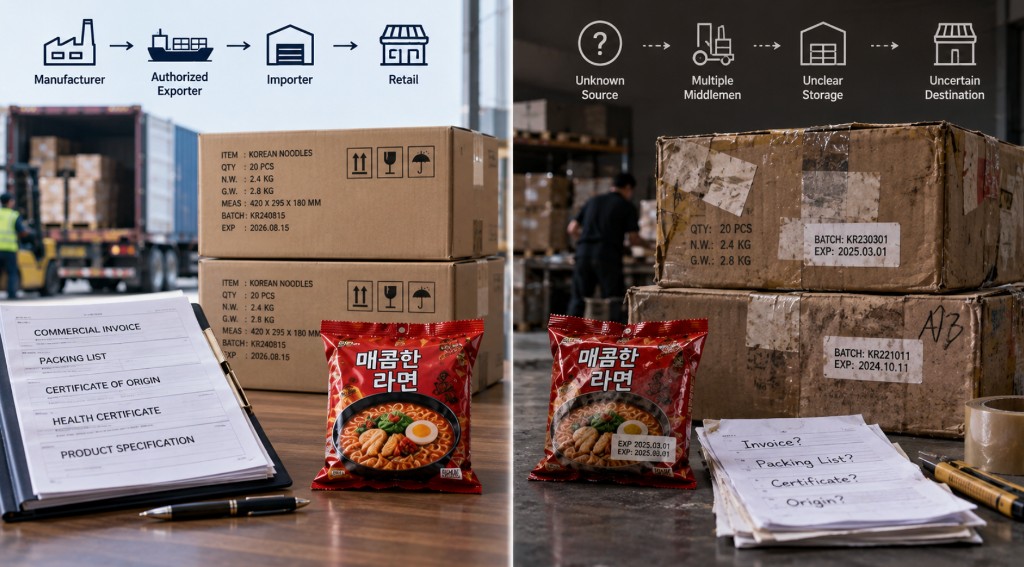
If a trading company is selling a Korean sauce, the importer should still be able to identify the actual manufacturer and obtain relevant product information. The same applies to certificates, ingredient data, carton specifications and shelf life.
A company should not become a black box simply because it is handling the export.
For origin claims, this becomes particularly important. Korea Customs Service maintains FTA resources covering certificates of origin and approved-exporter information, and exporters are required to make accurate export declarations.
If preferential origin treatment is important to the importing country, the buyer needs to understand who is providing the relevant origin information and whether the product actually qualifies. Buying through a trader does not automatically prevent preferential origin, but the documentation chain still needs to work.
The same logic applies to HACCP, Halal or other product-related certificates. The importer should check the certificate against the actual manufacturer and factory rather than relying only on the trading company’s own credentials.
The intermediary can handle the commercial transaction. It cannot change which factory manufactured the food.
Control and convenience usually sit on opposite sides of the decision
Direct manufacturer relationships normally provide greater access to production and potentially stronger pricing at scale. Exporters and trading companies usually provide more flexibility when the order is fragmented.
The importer has to decide which matters more for each part of the catalogue.
If the business is launching with eighty Korean products and uncertain demand, flexibility is valuable. Being able to reduce quantities, mix brands and replace unavailable products can matter more than getting the absolute lowest factory price.
If the business later discovers that ten products generate most of its revenue, direct sourcing becomes more attractive because the buyer can concentrate negotiation and purchasing volume around those products.
The mistake is assuming that direct sourcing is always more professional.
Professional sourcing is simply choosing the structure that produces the best overall result for the buyer’s volume, catalogue and market.
A distributor purchasing one container of the same ramen every month has a different requirement from a retailer launching sixty Korean products for the first time.
Both can be sourcing correctly.
Know who is actually responsible for the export
Whatever sourcing structure is used, the buyer should know which legal entity is invoicing the goods and acting as exporter for the shipment.
This becomes important when reviewing invoices, banking details, export documents and certificates.
Korea Customs states that exporters are responsible for making accurate export declarations in accordance with applicable customs and trade laws.
If the manufacturer produces the goods but another company invoices and exports them, the importer should understand that arrangement before payment.
The company name on the quotation, invoice, bank account and shipping documents should make commercial sense.
Differences are not automatically suspicious. A brand owner may use an affiliated export company, or a manufacturer may appoint a separate trading company for overseas transactions. The issue is whether the buyer understands the structure and can verify it.
Unexplained changes in the company receiving payment deserve attention.
The sourcing structure should make reordering easier
The real test usually comes after the first shipment.
Suppose one product sells three times faster than expected. If the importer bought through an exporter, can that exporter replenish it quickly without waiting for the entire mixed-container programme? If the importer bought directly from the factory, does the factory require another large production MOQ?
Now suppose five low-volume products need replenishment at the same time. Ordering each directly may be inefficient, while a trading company may be able to combine them easily.
This is why sourcing should be designed around reordering rather than only around the first purchase.
For core products with reliable volume, direct factory relationships can become extremely useful.
For a broad catalogue of smaller products, a strong exporter or trading company can keep the purchasing process manageable.
For many Korean food importers, the best answer eventually becomes a combination of both.
The buyer does not need the shortest possible supply chain. The buyer needs a supply chain that can keep the right products moving at quantities the market can actually absorb.