
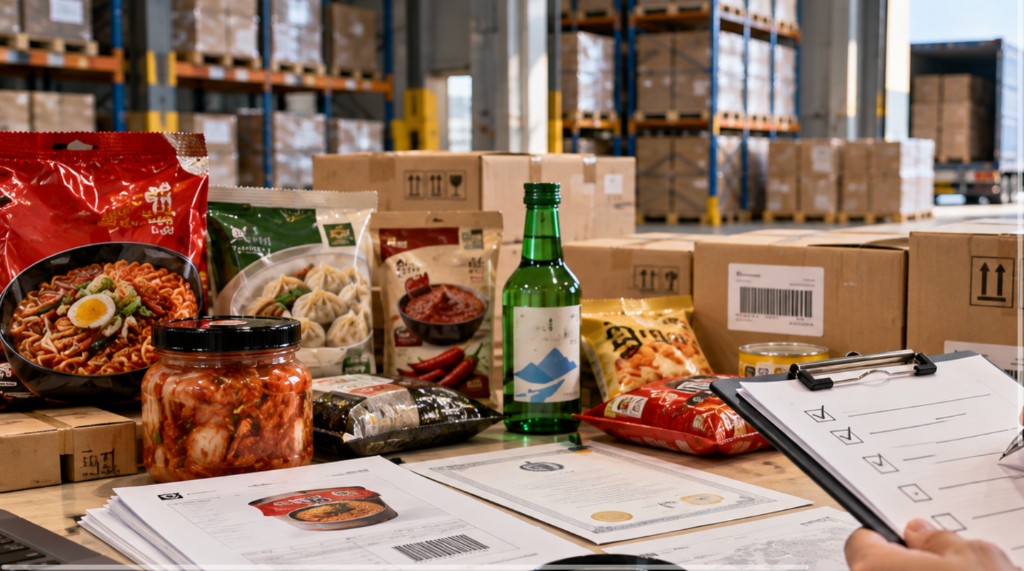
Evaluating them is harder.
A buyer can receive two quotations for apparently identical products and still be comparing two very different supply arrangements.
One supplier may be the manufacturer.
Another may be an exporter purchasing from that manufacturer.
A third may be a domestic distributor with access to the product but limited experience preparing it for export.
The lowest quotation does not tell you which one can deliver the right quantity, with acceptable remaining shelf life, correct documentation and predictable lead times.
For an importer, supplier evaluation should answer a more useful question:
Can this company repeatedly supply the product under conditions that work for our market?
That requires more than checking a website and asking for a price list.
First, establish who the supplier actually is
Ask a simple question early:
What is your relationship to this product?
The answer matters.
A supplier might be:
- the manufacturer
- the brand owner
- an authorised exporter
- a trading company
- a domestic wholesaler
- a distributor
- a sourcing company
There is nothing inherently wrong with buying through a Korean trading company.
In fact, an exporter capable of sourcing from several manufacturers can be useful when an importer wants a mixed shipment.
The problem starts when the buyer assumes the company is the manufacturer when it is not.
That misunderstanding affects discussions about production lead time, private labelling, product modifications, certifications, MOQ and pricing.
If the supplier is not the manufacturer, ask who manufactures the product.
For branded goods, also ask how the supplier obtains the goods and whether there are any territorial restrictions affecting export.
Verify that the business exists
Before discussing a substantial payment, establish the legal identity of the company you are dealing with.
The company name on the quotation should make sense against the name on its business documents, bank information and commercial correspondence.
KOTRA’s buyKOREA platform maintains a directory of Korean sellers, which can be one useful reference when researching a Korean company. It currently contains thousands of seller profiles. A directory listing alone, however, should not replace normal commercial due diligence.
For food businesses, South Korea’s Food Safety Korea system also provides manufacturer and food-business search functions. These official databases can help a buyer cross-check manufacturing information rather than relying entirely on a supplier’s sales presentation.
You are looking for consistency.
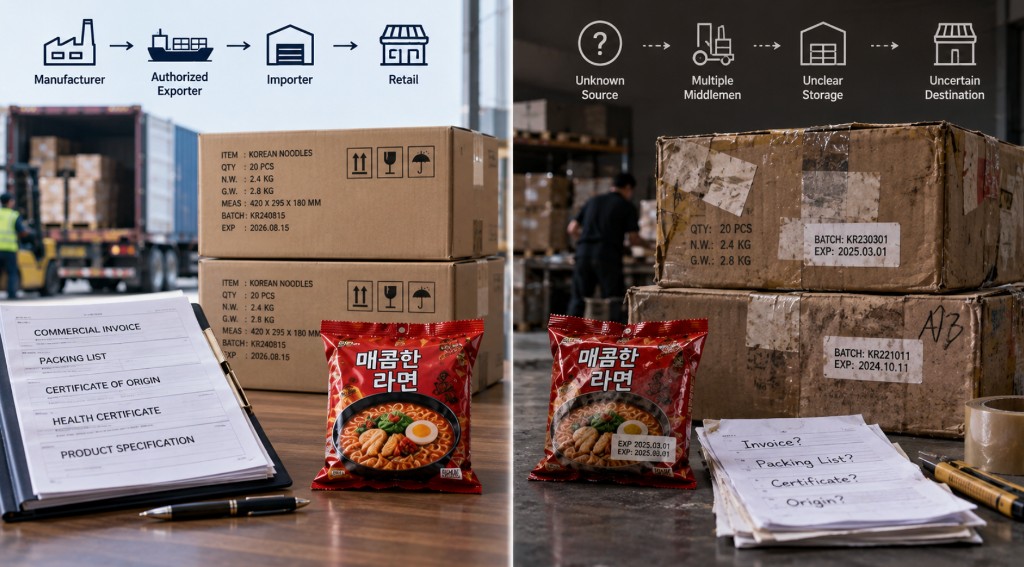
If the quotation comes from Company A, the invoice comes from Company B and payment is requested to an unrelated Company C, stop and understand the structure before sending money.
There may be a legitimate explanation.
Get that explanation first.
Manufacturer and exporter are two different capabilities
A good factory is not automatically a good exporter.
Manufacturing and export execution require different capabilities.
A factory may produce an excellent snack but have little experience coordinating multilingual labels, certificates, mixed orders, export packing or overseas documentation.
Conversely, an experienced Korean food exporter may not manufacture anything itself, but may be very good at coordinating several factories into one shipment.
This means buyers should evaluate two questions separately.
Can they supply the product?
and
Can they execute the export?
For a manufacturer, ask where the product is produced and what export markets it already serves.
For an exporter or trading company, ask how it controls purchasing, expiry dates, consolidation and documentation across the manufacturers it represents.
Ask for a proper product data sheet
A photograph and price are not enough to approve a food product.
For each serious SKU, request enough information to calculate the order.
That will normally include:
- exact product name
- brand
- barcode
- net weight
- pieces per carton
- carton dimensions
- carton gross weight
- shelf life
- expected remaining shelf life
- storage condition
- ingredients
- allergens
- country of origin
- MOQ
- lead time
- available certificates
The exact information required will depend on the destination country and product category.
The important point is that the information should exist.
If a supplier cannot clearly tell you what is inside a carton, how much it weighs and how long the product lasts, it will be difficult to build a reliable import calculation around that product.
Watch the difference between stated shelf life and stock age
Suppose the catalogue says:
Shelf life: 12 months
Ask another question:
How much shelf life will remain when this order leaves Korea?
Those are not the same thing.
A distributor may already be holding inventory manufactured several months ago.
That stock might be perfectly saleable in Korea but unsuitable for a destination involving several weeks of transit and distribution.
For imported food, remaining shelf life at dispatch is often more useful than total shelf life from manufacture.
Imagine two suppliers offering the same product.
Supplier A:
USD 20 per cartonSeven months remaining
Supplier B:
USD 21 per cartonEleven months remaining
The USD 1 difference may disappear quickly if Supplier A’s stock has to be discounted later because of expiry pressure.
The useful comparison is not simply:
Which carton is cheaper?
It is:
How much commercially usable life am I purchasing with that carton?
Ask how the supplier controls expiry across mixed orders
This becomes especially important when buying dozens of SKUs.
A mixed Korean food shipment may contain products manufactured on very different dates.
The beverage may have eleven months remaining.
The snack may have nine.
The bakery product may have five.
The sauce may have eighteen.
If the supplier simply loads available warehouse stock without managing remaining shelf life, the importer can receive an assortment with very uneven selling windows.
Before confirming the order, agree on the minimum acceptable remaining shelf life.
Do not leave this as an assumption.
For example:
Minimum 75% of total shelf life remaining at dispatch
or:
Minimum nine months remaining at shipment
The appropriate requirement depends on the product.
The useful part is that both sides know the rule before goods are selected.
MOQ should be explained, not merely stated
If a supplier says:
MOQ: 100 cartons
ask what creates that minimum.
Is it:
a production MOQ?
a product MOQ?
a flavour MOQ?
a packaging MOQ?
a supplier-wide order minimum?
a pallet requirement?
Understanding the reason behind the MOQ tells the importer how flexible it really is.
A manufacturer producing private-label packaging may have a genuinely high minimum because packaging has to be printed specifically for the buyer.
A trading company selling existing branded goods may have much more flexibility.
The same word, MOQ, can describe very different commercial constraints.
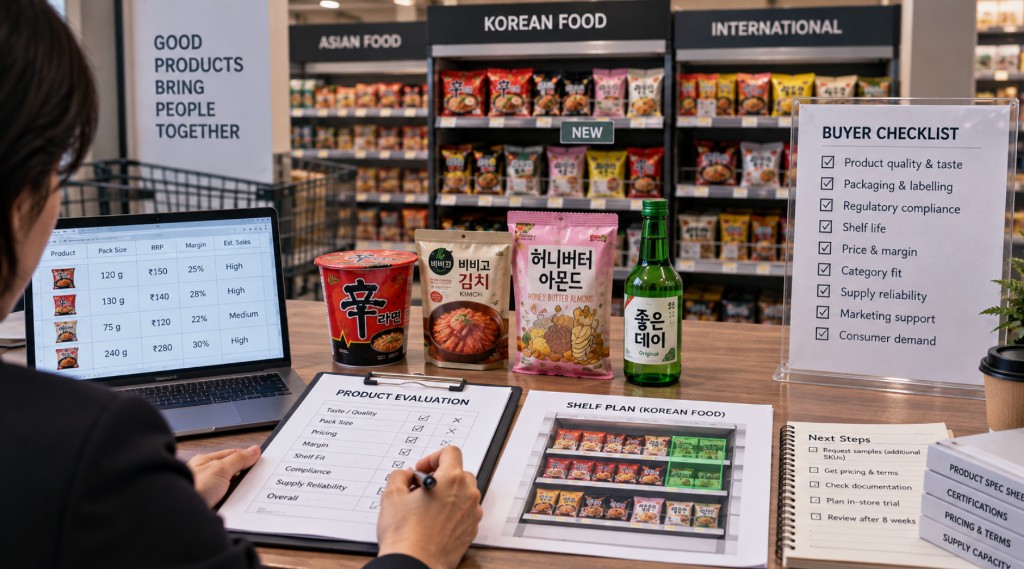
Test the supplier with a mixed quotation
One useful way to assess a Korean food exporter is to request a realistic mixed-product quotation.
Not two products.
Give them a commercial shortlist.
For example:
12 beverage SKUs8 snack SKUs5 sauces4 seaweed products
Then examine how the supplier responds.
Does the quotation clearly show carton quantities?
Are barcodes provided?
Are unit counts clear?
Are MOQ restrictions identified?
Are lead times separated where manufacturers differ?
Are shelf-life details provided?
Does the supplier identify products that cannot be consolidated on the requested schedule?
A serious quotation reveals a surprising amount about the supplier’s internal organisation.
Compare carton economics, not catalogue prices
Assume Supplier A quotes a Korean drink at:
USD 18 per carton
Supplier B quotes:
USD 19.50 per carton
Supplier A appears cheaper.
Then you discover:
Supplier A: 20 bottles per cartonSupplier B: 24 bottles per carton
Cost per bottle:
Supplier A: USD 0.90
Supplier B: USD 0.8125
The more expensive carton contains the cheaper product.
Now add carton dimensions.
If Supplier B also packs more bottles into less cubic volume, its freight economics may be better again.
This is why supplier quotations should eventually be normalised into comparable numbers:
price per sellable unit
weight per carton
volume per carton
freight allocation
landed cost per unit
Procurement becomes clearer when every supplier is measured using the same units.
Check certificates, not certificate logos
A catalogue may display:
HACCPISOHALALother certification marks
That tells you what to investigate.
It does not complete the investigation.
Ask for the certificate you need.
Then check:
Who owns it?
Which facility does it cover?
When does it expire?
What is its scope?
Does it apply to the relevant product or manufacturing process?
Food Safety Korea maintains official food-safety information and manufacturer records that can assist with Korean-side checks.
For requirements such as Halal certification, buyers should also verify the certificate against whatever standards and certification bodies are accepted in the destination market.
A certification question should finish with a document, not a logo copied into a PDF catalogue.
Do not ask only, “Do you export?”
Ask:
Where do you export?
A supplier experienced with Japan does not automatically understand the requirements of Saudi Arabia.
A company shipping regularly to the United States may still have little experience with the buyer’s market.
Previous export destinations can tell you something about the supplier’s operational experience.
You can follow with questions such as:
How are export labels handled?
Who prepares the commercial invoice and packing list?
Can certificate-of-origin documentation be provided where applicable?
Who coordinates pickup and consolidation?
Which Korean ports are normally used?
How are damaged cartons handled before loading?
How are lot numbers and expiry dates recorded?
You are testing process knowledge.
Check origin documentation properly
Certificates of origin can matter when an importer is claiming preferential tariff treatment under a trade agreement.
Korea Customs Service provides tools for checking the authenticity of certain Korean certificates of origin and approved-exporter information.
The requirements are not identical across every Korean FTA.
Korea Customs lists different verification procedures, certificate formats and validity periods depending on the applicable agreement.
Therefore, do not ask vaguely:
“Can you provide CO?”
Instead determine:
Which trade agreement applies?
What form of origin evidence is required?
Who is permitted to issue it?
Does the product satisfy the applicable rule of origin?
Can the importer actually claim the intended preference?
For a large shipment, a mistake in origin documentation can be worth considerably more than a small negotiation on the product price.
Ask who controls the export schedule
Lead time deserves more scrutiny than:
“Ready in 14 days.”
Ask what the fourteen days represent.
Fourteen days until production?
Until goods reach the consolidation warehouse?
Until container loading?
Until the vessel departs?
These dates are different.
For mixed shipments, request expected readiness by supplier or product group.
For example:
Supplier A goods ready: 4 OctoberSupplier B goods ready: 7 OctoberSupplier C goods ready: 18 October
Now the importer can see that Supplier C is controlling the shipment schedule.
That may affect the decision to wait, remove those SKUs or ship them separately.
Examine payment details with the same care as product details
Before transferring money, compare:
quotation company
invoice company
beneficiary name
bank country
supplier explanation
Unexpected differences deserve investigation.
A supplier changing bank accounts shortly before payment is particularly worth confirming through an independently verified communication channel.
The objective is not to make every international transaction suspicious.
It is to avoid treating payment instructions as an administrative detail.
For a new supplier, the payment stage is part of due diligence.
Samples are useful, but only after commercial screening
A sample can tell you whether a product tastes good.
It cannot tell you whether the shipment makes money.
Before requesting large numbers of samples, screen products using:
MOQ
price
remaining shelf life
carton configuration
storage requirement
certification needs
expected retail positioning
Then sample the products that survive.
This saves time on both sides and produces a more useful sample programme.
When samples arrive, inspect the physical packaging too.
Look at seals.
Check the outer carton.
Read the dates.
Confirm the barcode.
Compare net weight with the product sheet.
See how well the retail package survived international courier handling.
The sample is partly a product test and partly a miniature logistics test.
Run a “bad shipment” conversation before the good shipment
One of the most revealing supplier questions is:
What happens if something is wrong?
Ask about realistic situations.
What happens if several cartons arrive damaged?
What if the shipment quantity differs from the packing list?
What if a SKU arrives below the agreed remaining shelf life?
What if production is delayed after the deposit has been paid?
What if the wrong flavour is packed?
What evidence does the supplier require for a claim?
How are credits or replacements handled?
You are not expecting the shipment to fail.
You are learning how the supplier handles failure when it occurs.
Every supply chain eventually produces an exception.
The important question is whether the supplier has a process for dealing with it.
Do a small order when uncertainty is high
There is a temptation to maximize the first shipment because larger volumes often improve pricing and freight economics.
Sometimes that is sensible.
Sometimes the first order should be treated as a paid test of the supply chain.
A smaller initial shipment can reveal:
actual preparation time
document quality
communication speed
packing quality
shelf-life consistency
customs issues
consumer demand
damage rates
reorder behaviour
The first transaction produces information that no catalogue can provide.
An importer can then commit more capital with evidence from its own market.
Build a supplier scorecard that uses facts
You do not need a complicated procurement system.
A spreadsheet is enough.
For each supplier, record measurable information such as:
Company identityVerified / unresolved
Supplier roleManufacturer / exporter / distributor
Quotation completenessComplete / missing information
MOQ flexibilityActual quantities
Average remaining shelf lifeBy SKU or category
Lead timeQuoted days
Certificates receivedDocuments and expiry dates
Carton data availableYes / no
Export marketsCountries supplied
Payment termsActual terms
Sample evaluationRecorded observations
First shipment performanceDelay, shortages, damage, documentation issues
After several orders, this becomes much more useful than relying on memory.
The supplier who replies fastest may not be the supplier who performs best.
A useful final check before approving the PO
Before committing to a new Korean food supplier, you should be able to answer:
Who is the legal counterparty?
Are they the manufacturer, exporter or distributor?
Who actually manufactures each important product?
What quantities are required?
How much shelf life will remain at dispatch?
What will each carton contain?
What certificates have we actually received?
What Incoterm is being quoted?
When will the goods genuinely be ready for export?
What documents will accompany the shipment?
Where will products from different manufacturers be consolidated?
What happens if quantity, condition or shelf life does not match the agreement?
Who receives the payment?
If these answers exist only inside WhatsApp messages scattered across several weeks of conversation, collect them into the purchase order or an agreed commercial document before payment.
The purpose is simple.
Both buyer and supplier should know exactly what is being purchased and under what conditions.
Supplier evaluation does not end after approval
The strongest supplier data comes after the first shipment.
Record what actually happened.
If the supplier promised 21 days, how long did it take?
If nine months of remaining shelf life were agreed, what arrived?
Did carton quantities match the packing list?
Were certificates delivered when requested?
Were documents corrected quickly?
How much product was damaged?
How many SKUs required follow-up?
Did the second order become easier than the first?
A supplier who improves with every shipment can become more useful than one who produced the lowest initial quotation.
For an importer, the goal is not to collect the longest possible list of Korean food suppliers.
It is to develop a smaller group of suppliers whose products, documentation, timing and commercial terms can be relied on repeatedly.
That is what turns sourcing into a supply chain.