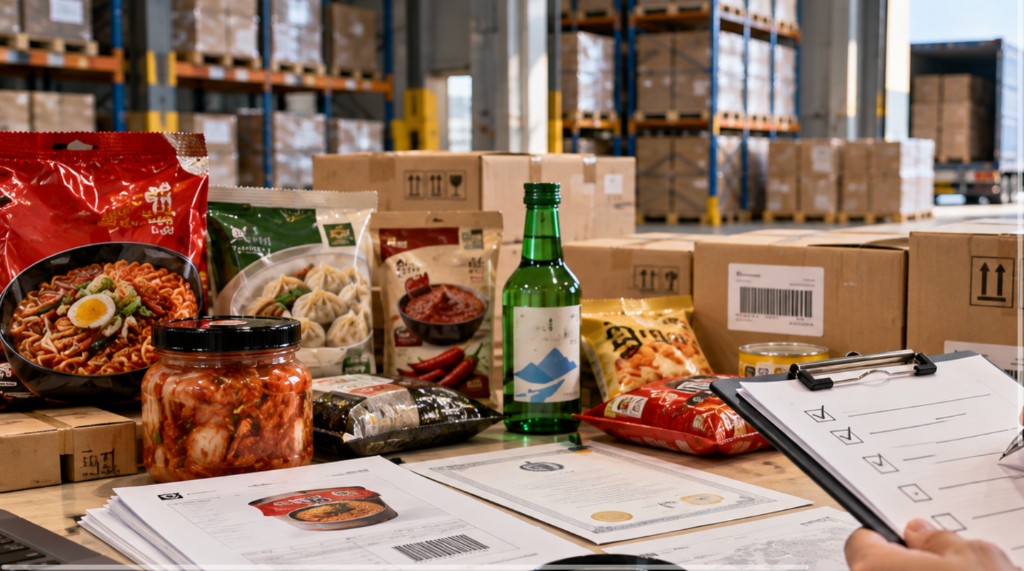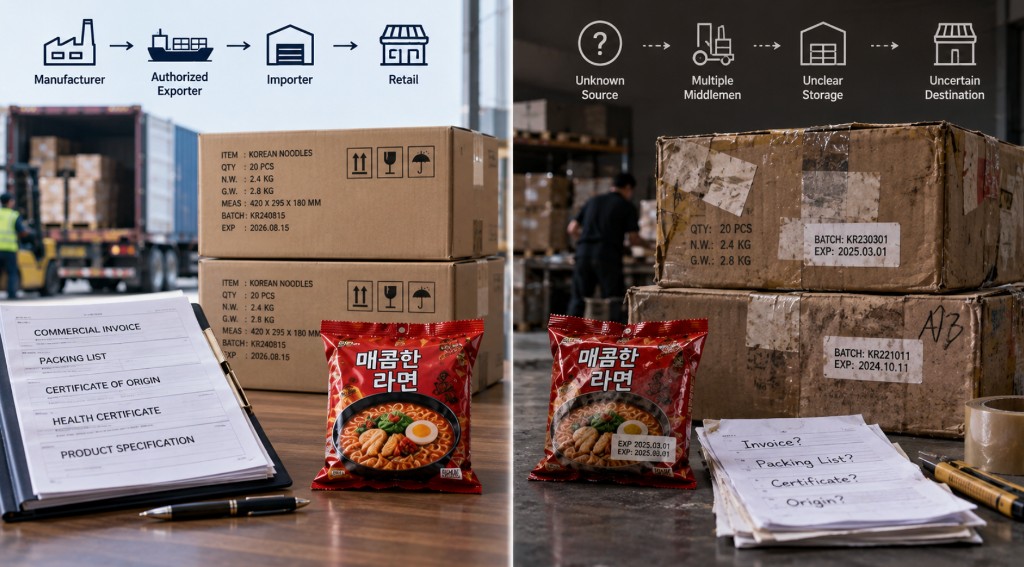

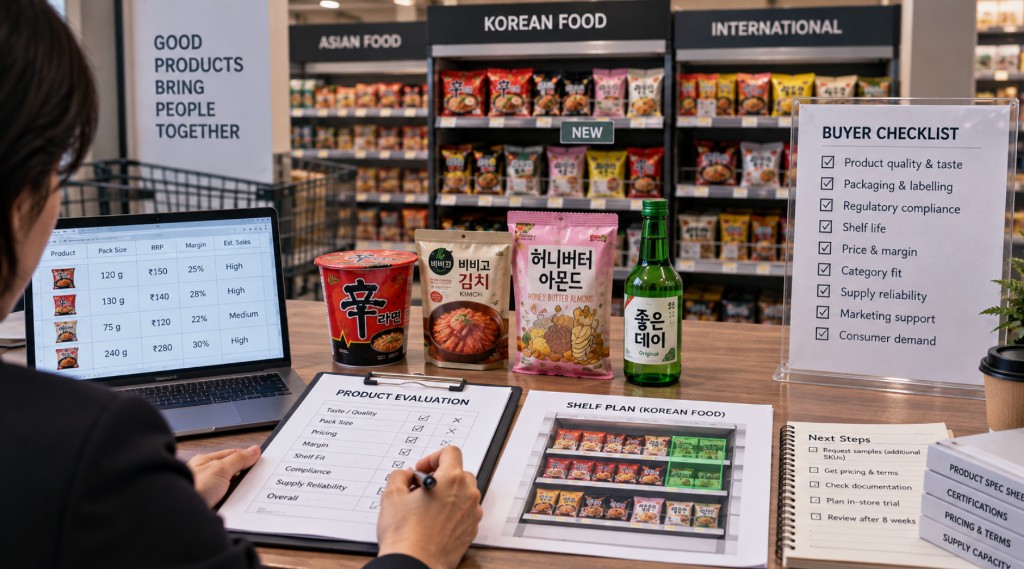
For a Korean exporter, this changes what “good supply” means. Having access to popular food products is useful. Being able to support those products with accurate commercial information is what makes them easier for an importer or distributor to present to organised retail.
A supermarket buyer does not necessarily want to understand the Korean sourcing chain in detail. The buyer wants confidence that when an SKU is approved, the same product can be ordered, received, scanned, distributed and replenished without repeatedly rebuilding the information around it.
That is why a Korean food supplier preparing products for wholesale export should think beyond the first quotation.
The product has to be identifiable before it can be listed
Retailers operate around exact products rather than approximate descriptions.
“Korean grape drink” is not enough.
The product needs an identifiable SKU, pack size and retail configuration. A barcode or GTIN may also be needed so the retailer can connect the physical product with its internal product record.
GS1 states that many retailers and marketplaces require the existing GS1 GTIN when a distributor or reseller wants to list a branded product. GS1 also notes that retail point-of-sale products commonly use barcode formats such as EAN-13 or UPC-A, while other barcode formats may be used on outer cartons and throughout the supply chain.
For an importer, this means the barcode should be treated as part of the product identity.
If the supplier quotes a 100 g package, the buyer should receive information for that 100 g product rather than a barcode belonging to an 80 g version or another flavour.
This becomes particularly important when Korean manufacturers redesign packaging or maintain several sizes of the same product.
A supermarket buyer may create the product record weeks before the physical stock arrives. If the item delivered later does not match the product information originally submitted, the importer may need to correct the listing before the product reaches the shelf.
Clean SKU information prevents that problem.
Supermarkets need more product data than a normal price list provides
A traditional wholesale price list may contain a product name, image, price and carton quantity.
Organised retail can require much more.
Depending on the retailer and market, the importer may need information covering ingredients, allergens, nutrition, net quantity, storage, manufacturer information, product dimensions, carton dimensions, weights and other product attributes.
GS1’s foodservice guidance specifically describes nutrition, allergen and ingredient data, together with supply-chain attributes such as product and case dimensions and weights, as information that can be exchanged between trading partners.
The importer may not need every field during the first conversation with the Korean supplier.
The important point is that the data should be obtainable when the product progresses toward listing.
This is one of the reasons a good B2B product catalogue is more useful than a collection of product photographs.
A buyer looking at fifty Korean snacks should be able to narrow the selection commercially. Once ten products become serious candidates, the importer should then be able to obtain the information needed to present those products properly to the retailer.
If basic product data has to be reconstructed every time a supermarket asks a question, the listing process becomes slower than necessary.
Shelf life is part of retailer acceptance
A supermarket is rarely interested only in the expiry date printed on the pack.
The retailer needs enough time to receive the product, move it through its own distribution system, place it on shelf and sell it to consumers with an acceptable remaining life.
This means a product can still be legally within its shelf life while becoming commercially unattractive to a retailer.
Suppose a Korean snack has twelve months of total shelf life.
The stock reaches the importer with five months remaining.
The importer needs time for customs clearance and warehouse receiving. The distributor may hold the product before delivering it to stores. The supermarket then needs enough time to sell through the stock.
Five months can disappear quickly.
Another batch of the same product leaving Korea with ten months remaining gives everybody in the chain much more room.
This is why supermarket-focused importers often care about the remaining shelf life at shipment rather than simply the manufacturer’s total shelf-life specification.
The Korean supplier should therefore be able to discuss actual or expected dates when the order becomes serious.
For mixed shipments, this matters even more because products from different manufacturers may arrive at the consolidation point with very different production dates.
The carton matters almost as much as the retail unit
Retail buyers see the product on shelf. Distribution centres and warehouse teams see the carton.
Units per carton affect ordering.
Carton dimensions affect storage and logistics.
Gross weight affects handling.
The outer case may need its own identification depending on the retailer’s logistics process.
GS1 distinguishes retail point-of-sale identification from case-level identification. Its guidance notes that outer cases can carry their own GTIN, and formats such as ITF-14 are specifically used on outer packaging that does not pass through retail point of sale.
The importer does not need to redesign the manufacturer’s carton for every retailer.
It does need accurate information about how the product is packed.
Suppose a retailer expects twenty-four units per carton based on the original product file, but the supplier later delivers twenty units per carton following a packaging change.
That affects the purchase order, warehouse receipt, per-unit cost and stock record.
Small packaging changes therefore matter much more in organised retail than they may in informal wholesale.
The importer should be notified when they happen.
Buyers care about continuity after the first shipment
A supermarket listing is less useful if the product disappears immediately after launch.
The retailer may spend time creating the item, allocating shelf space, arranging promotions and distributing it across stores. If the importer cannot replenish the product, the commercial value of the listing falls quickly.
This is why supply continuity matters.
A buyer may want to know whether the SKU is a regular production item, whether it is seasonal, whether it is normally available from ready stock and what the expected production lead time is when stock runs out.
Nobody can guarantee that every Korean product will always remain available.
Manufacturers discontinue products. Packaging changes. Production schedules move. Popular products can temporarily sell out.
A good supplier relationship gives the importer visibility when that happens.
If a product normally requires four weeks for replenishment, the buyer can plan around four weeks.
If the lead time is unknown until the warehouse becomes empty, the importer cannot plan properly.
For KCN’s type of multi-brand supply model, this is important because the supermarket importer may purchase products from many Korean manufacturers in one programme. The buyer wants access to the range, but also needs enough visibility to decide which products should become permanent lines and which should remain occasional or promotional products.
Product changes need to reach the importer before the next order
Food products are not static forever.
A manufacturer may change packaging, net weight, ingredients, carton configuration or barcode. A flavour may be renamed. A brand may replace the artwork while keeping the product largely unchanged.
Some of those changes are cosmetic. Others affect the retailer’s product record.
GS1 places responsibility for assigning GTINs primarily with the brand owner, and its standards distinguish different trade-item configurations because product identity needs to remain consistent throughout the supply chain.
For the importer, the practical requirement is simple.
If something material changes, it needs to know.
Imagine a supermarket has already listed a 120 g Korean snack. The next shipment arrives as 100 g with revised artwork.
The product may still be excellent.
The retailer may simply need the new information before receiving it.
The problem appears when the change is discovered only after the cartons arrive.
A Korean supplier serving organised retail buyers therefore adds value by keeping basic product information current rather than treating every SKU as permanently fixed once it enters the catalogue.
Traceability becomes more important when volume increases
A small independent shop may purchase several cartons and sell them quickly.
A supermarket distributor can have the same product spread across warehouses and many retail locations.
If a quality issue affects one production batch, the business needs to know which inventory is affected.
GS1’s traceability guidance connects the GTIN identifying the product with batch or lot information that distinguishes specific groups of production. It also describes batch and expiry information as data that can move through the supply chain alongside the product identifier.
The supermarket buyer does not necessarily need all of this information during initial sourcing.
The supply chain needs to be capable of supporting it when required.
That distinction is important.
A supplier can keep the buying process simple while still maintaining enough product and batch visibility behind the transaction.
For an importer supplying organised retail, that is much more useful than receiving a large amount of paperwork with no clear connection to the actual stock.
The supermarket is ultimately buying reliability
Price matters.
So do brand strength, taste, packaging and consumer demand.
The supplier still has to make the operational side work.
The exact product should be identifiable. Product data should be available. Carton configuration should be clear. Shelf life should be commercially usable. Relevant documentation should be obtainable. Changes should be communicated. Replenishment should be understandable.
None of those things guarantees that a supermarket will list the product.
Retailers make their own commercial decisions based on their market, category and customers.
They do make a Korean food product considerably easier for an importer to present professionally.
For KCN, that is where a multi-brand export platform becomes more valuable than a simple catalogue.
The buyer may come to Korea looking for ramen, beverages, snacks, seaweed or confectionery.
What helps the buyer move those products into serious retail is the information surrounding them.
A supermarket importer does not need thousands of products with incomplete data.
It needs the right Korean products supported well enough that its own retail customer can say yes.