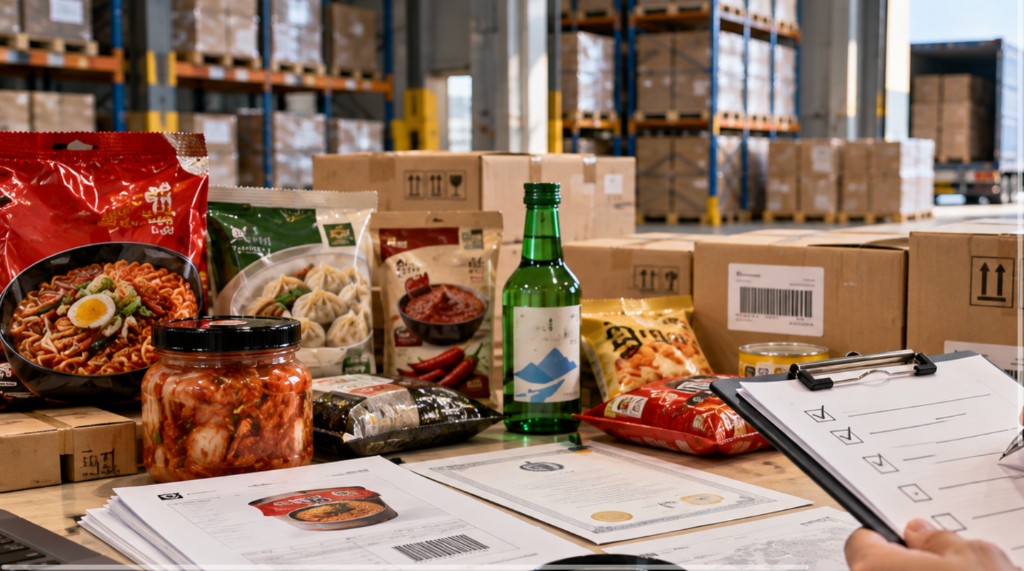

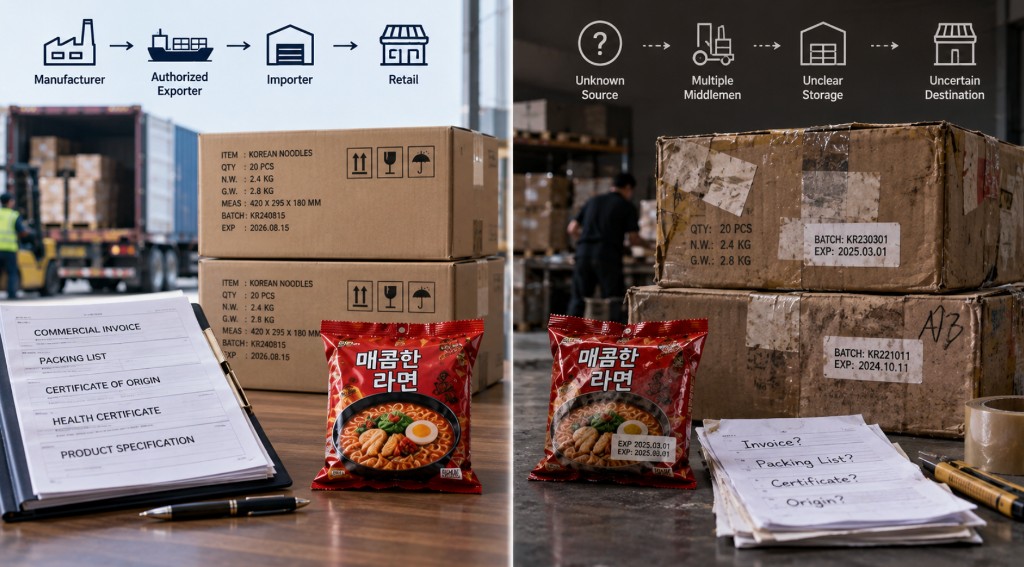
The more useful question is where the stock came from and whether the supplier can support the transaction properly.
International food distribution can involve manufacturers, appointed exporters, distributors, trading companies, wholesalers and other intermediaries. A genuine product does not become counterfeit simply because it moves through a reseller, and buyers should be careful with broad labels such as “gray market.” What matters commercially is whether the importer can identify the product, understand the supply chain relevant to its purchase and obtain the information and documents needed to import and sell that product in its market.
For a buyer supplying supermarkets, retail chains or established distributors, that distinction becomes important. The purchase is no longer only about obtaining cartons. The importer may later need manufacturer details, ingredient information, certificates, batch data, shelf-life information or evidence connecting the shipment to the products actually received.
A low price does not compensate for missing information when the stock is already sitting at the destination port.
Start with the exact product, not only the brand
A familiar Korean brand can contain dozens or hundreds of SKUs.
The importer should know the exact product it is purchasing, including the variant, net quantity, retail pack configuration and barcode where available.
This sounds obvious until quotations are compared.
One supplier may offer a 100 g package while another quotes 80 g. A multipack can be confused with an individual unit. Export packaging may differ from Korean domestic packaging. A brand may redesign the product while older packaging remains in circulation.
The buyer should therefore compare exact SKUs rather than comparing only brand names.
GTINs and barcodes are useful for product identification, but they should not be treated as complete proof of the history of an individual carton. GS1’s traceability framework distinguishes product-level identification from batch or lot-level identification. A GTIN can identify the type of trade item, while combining it with a batch or lot number allows stock from different production batches to be distinguished.
That difference matters when the importer later needs to identify affected stock, investigate a quality issue or manage a product recall.
Know who manufactured the food
An exporter and manufacturer do not have to be the same company.
A Korean trading company may legitimately sell products made by many manufacturers. An exporter may represent brands or obtain products through established Korean supply relationships. The importer does not necessarily need to buy directly from the factory for every product.
It should still be possible to identify the manufacturer where that information is relevant to the product and destination requirements.
This becomes particularly important when the importer is reviewing HACCP, Halal, ISO-related documentation or product specifications. A certificate should be evaluated in relation to the facility, company, product or scope it actually covers.
A certificate belonging to one manufacturer does not automatically describe another manufacturer’s food simply because both products were purchased from the same exporter.
The commercial intermediary can change.
The identity of the factory that manufactured the food does not.
Shelf life tells you something about the stock you are actually buying
A product catalogue might state that a Korean snack has a twelve-month shelf life.
That does not mean the stock being offered today has twelve months remaining.
It may have been produced recently. It may already have spent several months in a warehouse. Different cartons may even come from different batches.
The buyer should therefore ask about the remaining shelf-life window for the stock being supplied.
This becomes useful when comparing two offers that appear identical.
Supplier A may quote USD 18 per carton with six months remaining.
Supplier B may quote USD 19 with ten months remaining.
Supplier A is cheaper on the invoice.
Supplier B may provide the importer with a considerably safer commercial selling window.
The correct choice depends on how quickly the buyer can sell the product, but the price difference cannot be evaluated properly without the dates.
A professional quotation should therefore make it possible for the buyer to understand the shelf-life position before committing to significant inventory.
Batch information becomes important after the sale
Most buyers do not care about lot numbers while browsing products.
They care very quickly when a problem appears.
Food supply chains need a way to distinguish groups of products that were produced or handled together. GS1’s global traceability standard specifically recognises GTIN plus batch or lot identification as a way to distinguish one group of the same product from another. This can support quality investigations and recalls by narrowing the affected stock.
For an importer, this does not mean demanding complex traceability data for every initial enquiry.
It means the supply chain should not become a black box.
If a manufacturer later identifies an issue affecting a specific production lot, the importer should have a realistic way to determine whether stock from that lot entered its shipment.
The same principle becomes useful when a large retailer asks the importer for batch or expiry information during receiving.
Traceability is valuable because it allows a problem to be narrowed.
Without it, a buyer may know which product is affected but not which part of its inventory is affected.
Documentation should match the transaction
A supplier saying that it can provide export documents is useful.
The buyer should still understand which documents apply to the particular shipment.
Commercial invoices and packing lists should describe the actual goods being shipped. Origin documentation should correspond with the relevant products and applicable rules. Product-related certificates should connect to the correct manufacturer or SKU where required.
The importer should also avoid collecting certificates simply because more paperwork feels safer.
The useful question is what the destination country, customs broker, regulator or customer actually requires.
A supermarket buyer may request information that a small independent retailer never asks for. One destination can have requirements that another does not.
The Korean exporter should be able to provide available Korean-side product and shipment documentation. The importer remains responsible for establishing whether the products satisfy the requirements of its destination market.
This division of responsibility should be clear before the order leaves Korea.
Very cheap stock deserves a commercial question
A lower quotation does not prove that anything is wrong.
There are many legitimate reasons for price differences. One supplier may have purchased at larger volume. A manufacturer may be running a promotion. Stock may already be available. Exchange rates may have changed. A supplier may simply operate on a lower margin.
The buyer should therefore avoid treating a cheap price as evidence of an authenticity problem.
It is still reasonable to ask why the commercial difference exists when the gap is unusually large.
Perhaps the remaining shelf life is shorter.
Perhaps the quotation covers a different Incoterm.
Perhaps the product configuration is different.
Perhaps the stock comes through a different supply arrangement.
Perhaps one offer includes documentation or Korean domestic transport that another excludes.
The answer may be perfectly satisfactory.
The purpose of asking is to understand what is being compared.
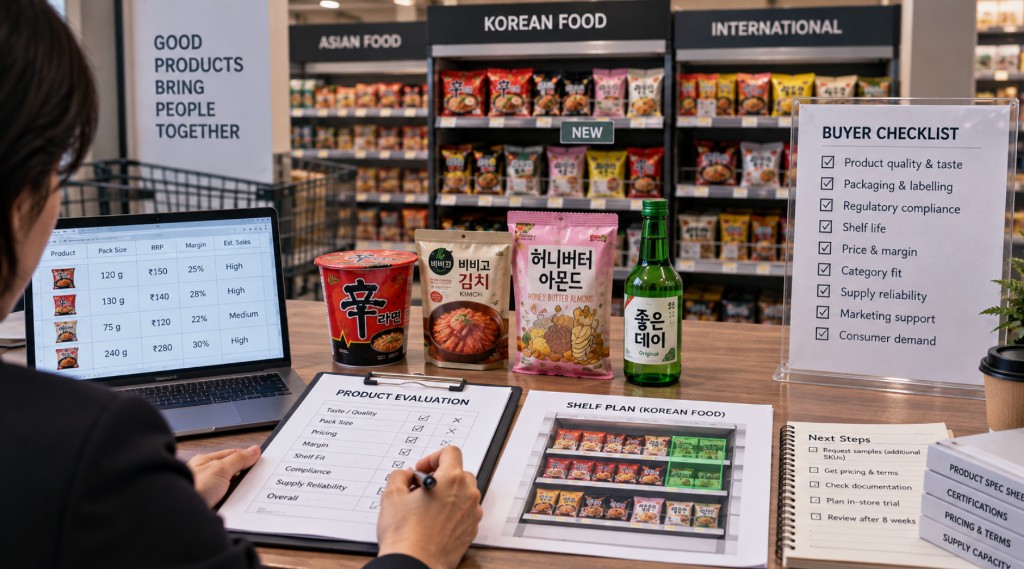
Retail buyers increasingly need clean product information
A wholesale importer may be able to purchase cartons with limited information.
Selling those cartons into organised retail is different.
Retail customers can ask for barcodes, carton configuration, ingredients, allergens, shelf life, storage requirements, certificates and product specifications before listing a product.
KCN’s current Korean food pages already surface buyer-facing information such as barcodes, carton packs, storage, shelf life and export-document readiness on individual products, while its wholesale offer includes mixed LCL and FCL supply.
That type of product data reduces work later because the importer does not have to reconstruct basic information after the retailer has already asked for it.
For a supermarket programme, information quality can become almost as important as product availability.
A product that is easy to buy but difficult to document can create unnecessary work for the distributor.
Authenticity and authorization are related but different questions
Importers should also avoid treating the words authentic and authorized as interchangeable.
An authentic product is a genuine product made under the relevant brand.
Authorization concerns the commercial relationship under which that product is being supplied or distributed.
The precise significance of authorization can vary by brand, territory and contract. A manufacturer may appoint particular distributors for certain markets while genuine goods can also circulate through other legitimate channels.
For a wholesale buyer, the useful question is not to make assumptions from terminology.
Ask what relationship the supplier has with the manufacturer or brand where that matters to your business.
If territorial distribution rights, exclusivity or brand approval are commercially important, those points should be confirmed directly and documented appropriately.
A website logo alone should not be treated as proof of a legal distribution right.
The buyer needs confidence in the order, not access to the supplier’s entire network
Due diligence does not mean the importer needs every contract, manufacturer price or internal sourcing relationship belonging to its exporter.
Some information is commercially sensitive.
GS1 itself recognises that traceability systems contain both information suitable for external sharing and internal data that companies may reasonably keep restricted.
The buyer needs enough information to evaluate its own transaction.
That usually means knowing what product is being supplied, who manufactured it where relevant, the commercial entity invoicing the shipment, the available shelf-life window, applicable supporting documentation and the identity of the goods when they arrive.
The exporter does not need to hand over its sourcing playbook for the buyer to perform sensible due diligence.
That distinction protects both sides.
A good B2B supply relationship provides the buyer with enough visibility to purchase confidently while allowing the exporter to keep legitimate commercial relationships and pricing structures confidential.
What matters most is whether the supply chain remains accountable
Authentic Korean food wholesale is ultimately less about marketing language and more about accountability.
The buyer should be able to identify the product it ordered.
The shipment documents should describe the goods that actually moved.
The shelf-life position should be understood before dispatch.
Relevant certificates should belong to the correct products or manufacturers.
Batch or lot information should be available where the transaction or downstream customer requires it.
And when something changes, the supplier should be able to explain what changed.
KCN currently positions its B2B export model around direct manufacturer and brand relationships, verified authenticity, batch checks, carton and MOQ data, mixed-container supply and export documentation from Korea.
For the importer, that is the useful standard to look for in any supplier relationship.
The goal is not simply to prove that a packet of Korean food is genuine.
It is to know that the product can move from Korea into the buyer’s commercial supply chain with enough information behind it to remain sellable, traceable and supportable after the first carton arrives.