
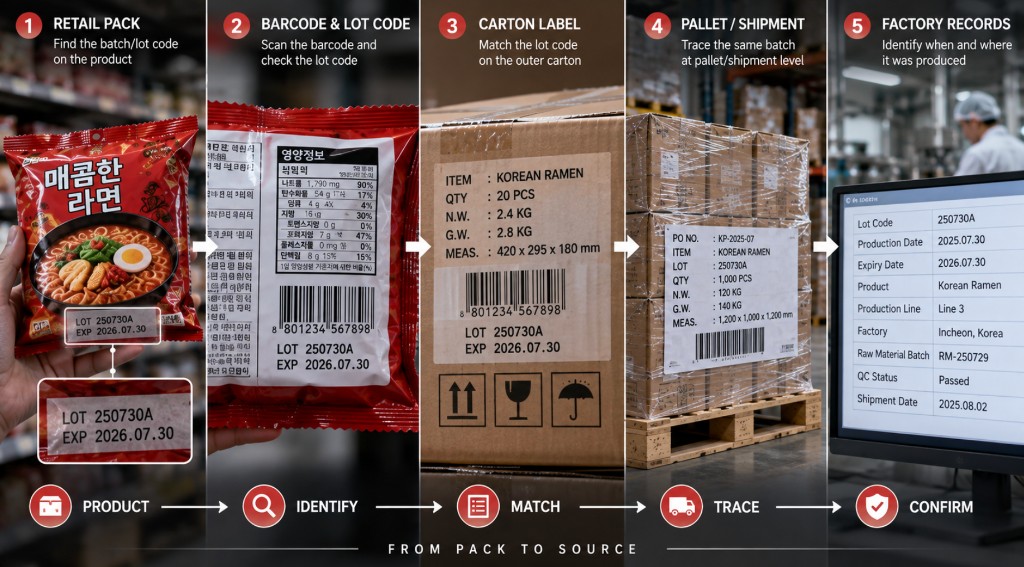
This is where traceability becomes useful. The barcode normally helps identify what the product is, while the batch or lot information helps distinguish one production group of that product from another. GS1’s traceability standards distinguish product identification from batch-level identification for exactly this reason. The same GTIN may continue identifying a product across many production runs, while the lot or batch number allows specific groups of production to be separated when necessary.
For an importer, the value of this information is practical rather than theoretical. If a manufacturer later identifies an issue involving one production batch, the importer should ideally be able to determine whether that batch entered its inventory. If different batches arrive with different expiry dates, the warehouse should be able to manage them separately. If a retailer asks which batch it received, the distributor should have a reasonable way of answering without inspecting every carton in the warehouse.
The same SKU can exist under several batches
Imagine an importer purchases the same Korean drink in January, April and July. The brand, flavour, pack size and barcode remain unchanged throughout the year, but the actual stock comes from three different production runs. January inventory may have been manufactured in December, April stock may have been produced in March and the July shipment may contain another production batch entirely. The product identity has not changed, so the barcode can remain the same, but the physical history of those three groups of stock is different.
This distinction becomes important when an importer buys ready stock. A supplier might have sixty cartons available from one batch and another forty cartons from a newer batch. Both groups are the same commercial SKU, yet their remaining shelf life may differ significantly. If the importer purchases all one hundred cartons without checking the dates, it may assume it has one uniform stock position when it actually has two.
That does not necessarily make the order unsuitable. A fast-moving distributor may comfortably sell both batches. The useful point is visibility. If sixty cartons have ten months remaining and forty have seven months remaining, the buyer can decide whether that shelf-life mix works for its customers before shipment rather than discovering it after the products arrive.
For organised retail, this can become even more relevant because supermarkets may have their own shelf-life acceptance policies. The importer may be able to allocate fresher stock to a customer that requires a longer remaining window while moving the older batch through faster channels. Batch visibility gives the business more control over how inventory is distributed.
Batch information becomes valuable when something goes wrong
Traceability often feels unnecessary while everything is running normally. Its value appears when somebody needs to investigate a problem.
Suppose a manufacturer discovers a packaging defect affecting one production run of a Korean snack. If the importer knows which batch entered its warehouse, it may be able to isolate only the affected inventory. Without that information, the company may need to inspect or temporarily hold all stock of the product until the issue is understood.
The same applies to less serious situations. A retailer may report unusual packaging on several cartons. A customer may complain about the taste of a product. A warehouse team may notice that certain pouches are sealing differently. If the affected cartons all belong to one lot, that information immediately gives the importer and manufacturer a useful starting point for investigation.
This is why batch information should remain connected to the actual stock rather than becoming paperwork that disappears after customs clearance. The importer does not need an elaborate system for every small shipment. It simply needs enough information to establish which batch arrived in which shipment and, where commercially necessary, where that stock subsequently went.
A distributor handling large retail programmes may manage this through warehouse software. A smaller wholesaler may use simpler inventory records. The level of technology can differ considerably, but the basic principle is the same: if somebody asks whether a particular batch entered the business, the importer should have a realistic way to answer.
Lot numbers and expiry dates are not the same thing
Buyers sometimes use expiry dates as a substitute for batch identification because the date is easier to recognise. The two pieces of information can be related, but they do different jobs.
The expiry or best-before date tells the buyer about the product’s time window. The lot or batch code identifies a production grouping determined by the manufacturer. Two production batches can sometimes carry the same expiry date, while one manufacturer’s lot coding system may contain information that is not readable as a normal calendar date at all.
The importer should therefore avoid inventing its own batch identity from the expiry date. If lot-level traceability matters to the business or downstream customer, the actual manufacturer lot information should be retained.
Expiry management still remains extremely important. If the same SKU arrives under three batches with different dates, the warehouse should generally understand which stock needs to move first. For food distribution, this is why FEFO, or first-expired-first-out, can be more useful than simply moving whichever carton entered the warehouse first. The oldest arriving carton is not necessarily the carton with the shortest remaining life.
Batch information and expiry information therefore work together. One tells the business which production group it is handling, while the other helps determine how urgently that inventory needs to move.
Mixed Korean food shipments make traceability more important
A single-brand order can be relatively simple. A mixed Korean food shipment may contain dozens of brands and hundreds of SKUs sourced from many manufacturers. Each manufacturer operates its own production schedule, and products can arrive at the consolidation warehouse under different batches and dates.
That complexity does not mean the importer needs a giant traceability exercise before every shipment. It means product information should stay attached to the correct SKU as the order moves through consolidation.
Consider a mixed shipment containing sixty Korean products. Most of the products arrive from one batch each, but five products arrive from two batches because the supplier did not have enough inventory from a single production run. If those batches have similar dates, the commercial impact may be negligible. If the shelf-life difference is substantial, the importer may want to know before loading.
The consolidation stage is the easiest point to identify these differences because the goods are still in Korea and corrective options remain available. The buyer may accept the stock, ask for replacement quantities, reduce the affected line or move it to another shipment. Once the container has reached the destination market, each of those solutions becomes more expensive.
A multi-brand exporter therefore adds value by keeping product identity, dates and relevant batch information sufficiently organised during consolidation rather than treating a mixed container as one anonymous block of cartons.
Traceability does not require exposing the supplier network
Professional due diligence should not be confused with asking the exporter to reveal every commercial relationship behind the transaction. An importer can have sufficient product traceability without receiving the exporter’s manufacturer pricing, confidential contracts, internal supplier contacts or complete sourcing structure.
The buyer needs information relevant to its own goods. It should know what product it purchased, the manufacturer where relevant, the batch or lot information when required, the applicable dates and the shipment through which the stock arrived. That is enough to support many normal traceability requirements without exposing commercially sensitive information that does not belong to the buyer’s transaction.
This balance matters particularly for a multi-brand exporter. The exporter may have spent years establishing relationships across manufacturers and brands. That network is part of its commercial value. Buyers need confidence in the products being supplied, but they do not need the exporter’s entire sourcing playbook to obtain that confidence.
Good traceability provides accountability around the product while preserving reasonable commercial confidentiality around the supply network.
Retail scale changes how useful the information becomes
The importance of traceability usually grows with distribution scale. A small shop that receives five cartons and sells them within two weeks has limited inventory exposure. A distributor that receives 2,000 cartons and supplies several hundred stores has a different problem.
Once products spread across multiple warehouses and customers, knowing what went where becomes more valuable. If only one batch is affected by a manufacturer notice, the distributor does not want to recall every unit of the product unnecessarily. Better information allows the response to be narrower.
The same principle applies to retailer receiving. Some organised retailers may request batch and expiry information as part of their normal product-handling procedures, while others operate more simply. Requirements differ by customer and country, so the importer should communicate any special data expectations before shipment.
The Korean supplier does not need to anticipate the internal warehouse system of every supermarket in every country. What it should be able to do is provide reliable product information when the buyer’s commercial programme requires it.
That is a more practical standard than producing huge quantities of documentation for every initial enquiry.
Packaging changes create another reason to keep product records clean
Korean food brands regularly update artwork and packaging. Sometimes the change is cosmetic. In other cases the manufacturer changes net weight, ingredients, carton quantity or barcode. During the transition period, both old and new packaging may legitimately exist in the market.
For an importer, this can create confusion if product records are weak. Retailers may see two different package designs and assume one is incorrect. Warehouse staff may receive a different carton configuration from the previous shipment. A salesperson may send an old product image to a customer even though the current stock carries the new design.
Batch and shipment records help the importer understand when different versions entered its inventory. They do not replace proper SKU identification, especially where a significant product change requires a different GTIN or updated commercial record, but they make the transition easier to manage.
This is particularly useful for repeat business. The importer does not need to rediscover months later that the manufacturer changed something. The change becomes part of the history of the product and its shipments.
The right amount of traceability depends on the business
It is possible to turn traceability into a technical project far larger than the commercial problem requires. Not every importer needs serial-level information, sophisticated scanning systems or massive databases.
A business handling standard shelf-stable snacks may need a relatively simple level of visibility. Another company supplying major supermarket chains or handling products with greater food-safety sensitivity may need much stronger controls.
The useful question is what information the importer needs to protect the product, meet customer requirements and respond if an issue occurs.
At a practical minimum, serious wholesale buyers should be able to maintain a clear connection between the product, relevant batch or lot information where available, expiry information and the shipment in which the stock arrived. As the business grows, those records can become more sophisticated.
The technology should follow the commercial need rather than becoming the objective itself.
Traceability is valuable because it preserves certainty after the shipment
A batch number does not reduce freight cost or improve the flavour of the food. Most customers will never notice it. Its value is that it preserves information after the product has moved away from the Korean manufacturer.
Several months after shipment, the importer may need to determine which production batch is sitting in its warehouse, whether a manufacturer notice applies to its stock, which batch was supplied to a particular retailer or why two groups of the same product have different expiry dates.
Without traceability, those questions become guesswork.
With reasonable batch and shipment records, they become manageable business questions.
For a Korean food exporter such as KCN, the objective is not to overload every buyer with technical traceability data. It is to keep enough control around identifiable products, batches, dates and shipments that serious importers and retail distributors can receive the information they need when the transaction requires it.
The buyer should be able to purchase Korean food without learning the exporter’s entire internal supply chain.
It should still know what arrived in the carton.