
That distinction becomes important once an enquiry moves beyond browsing. An importer may need to submit products to a supermarket, confirm ingredient information with its compliance team, calculate carton quantities, review storage requirements or check whether the product being quoted is the same SKU that was sampled earlier.
A good specification sheet does not need to become a hundred-page technical file. It needs to remove ambiguity around the product.
For a Korean snack, beverage, sauce or noodle product, the buyer should be able to identify the exact item, understand what is inside it, know how it is packed and obtain enough information to determine what additional checks are required for the destination market.
The specification sheet is therefore part commercial document, part product reference.
It should help the importer avoid a surprisingly expensive mistake: approving one product and receiving something slightly different.
The specification should identify one exact SKU
The first job of a product specification is identification.
A brand name alone is not enough.
A Korean beverage brand may produce six flavours in three bottle sizes. A ramen brand may have packet noodles, cups and multipacks with nearly identical names. A snack may exist in 60 g, 90 g and 120 g formats.
The specification should therefore correspond to one identifiable product.
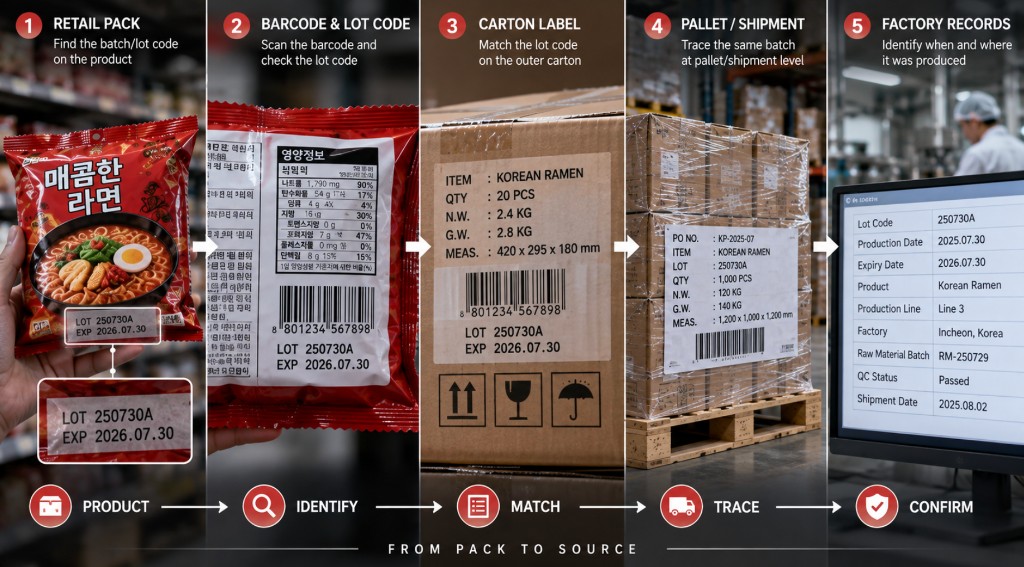
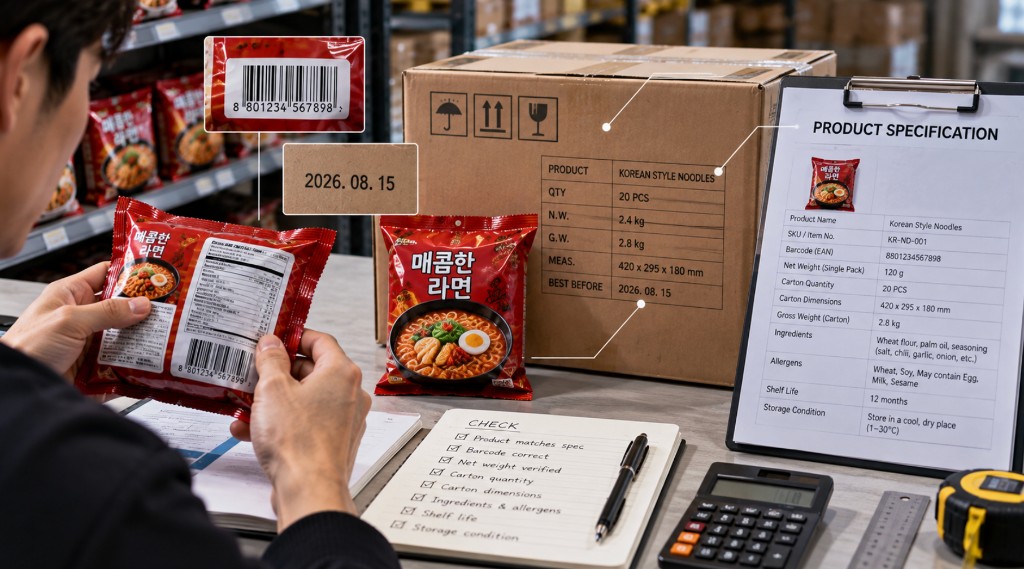
Useful identifying information can include the exact product name, flavour or variant, net quantity, barcode or GTIN where applicable, manufacturer and product or internal SKU reference.
This allows the importer to connect several documents to the same item.
The sample should match the specification.
The quotation should match the specification.
The carton configuration should match the specification.
The product eventually shipped should match the same product.
If the importer sampled a 120 g product but later receives a quotation for a 100 g version, the difference should be visible before the purchase order is confirmed.
This sounds basic, but errors become easier when a mixed order contains fifty or one hundred products with similar names.
A specification sheet gives each SKU a fixed identity around which the rest of the transaction can be organised.
Ingredients, allergens and nutrition need to describe the actual product
For food products, the ingredient and allergen sections are among the most useful parts of the specification.
MFDS describes Korean food labelling requirements as including information such as product name, ingredients, net contents, business identity, date information, nutrition information and storage or safety instructions. Korean rules also contain specific allergen-labelling requirements.
For an overseas importer, however, the Korean label should not automatically be treated as proof that the destination country’s requirements have been satisfied.
Different countries can classify allergens differently, require different nutrition formats or impose additional labelling requirements.
The specification gives the importer the underlying information from which those destination checks can begin.
Suppose a Korean sauce contains soy, wheat and shellfish-derived ingredients.
That information may affect more than the consumer label.
It can affect whether the product is appropriate for a particular retailer, whether additional documentation is required and how the importer prepares its destination-market label.
The ingredient information should also be current.
If the manufacturer changes the recipe but an old specification continues circulating, the importer can end up submitting information to customers that no longer matches the physical product.
For products being supplied repeatedly, version control therefore matters more than collecting a specification once and forgetting about it.
Shelf life means more than one number
A specification may say that a product has twelve months of shelf life.
That is useful information.
It does not tell the importer how much shelf life the stock being offered today actually has.
The specification describes the product’s normal shelf-life structure. The commercial order still needs a separate discussion about production date, expiry or best-before information and expected remaining shelf life at dispatch.
Both pieces are useful.
The specification may confirm that the product normally has twelve months from manufacture.
The exporter may then confirm that the batch available for the current order is expected to leave Korea with nine months remaining.
Those are different facts.
Storage conditions belong beside shelf life. A product intended for ambient dry storage is operationally different from one that requires refrigeration or frozen handling.
Even within shelf-stable Korean food, the manufacturer may specify storage away from direct sunlight, high temperatures or moisture.
That information matters when the buyer is planning transportation and warehousing.
A product can have a long theoretical shelf life and still be handled badly.
The specification should therefore tell the importer what storage conditions the manufacturer intends for the product, while the actual quotation or pre-shipment review tells the buyer what dates apply to the specific stock.
Packaging data affects the economics of the order
A strong specification sheet should explain how the product is physically packed.
The buyer needs to know the retail unit and the carton.
If one retail pouch weighs 80 g and a carton contains twenty units, that carton represents 1,600 g of retail product before considering packaging weight.
The importer also needs carton dimensions and gross weight when available because those numbers affect logistics.
This becomes particularly important with mixed Korean food shipments.
A snack may be inexpensive per carton but take up considerable volume.
A compact sauce may cost more but use container space much more efficiently.
Without carton dimensions and weight, the buyer cannot accurately understand how a large mixed order will behave physically.
The data also matters after arrival.
A distributor receiving 500 cartons needs warehouse planning.
A supermarket distribution centre may require accurate case quantities.
If a carton changes from twenty-four units to twenty units, the change affects purchasing, warehouse receiving and unit economics.
This is why packaging information should not be treated as decorative catalogue data.
It is part of the commercial product.
Manufacturer and certificate information should connect to the same product
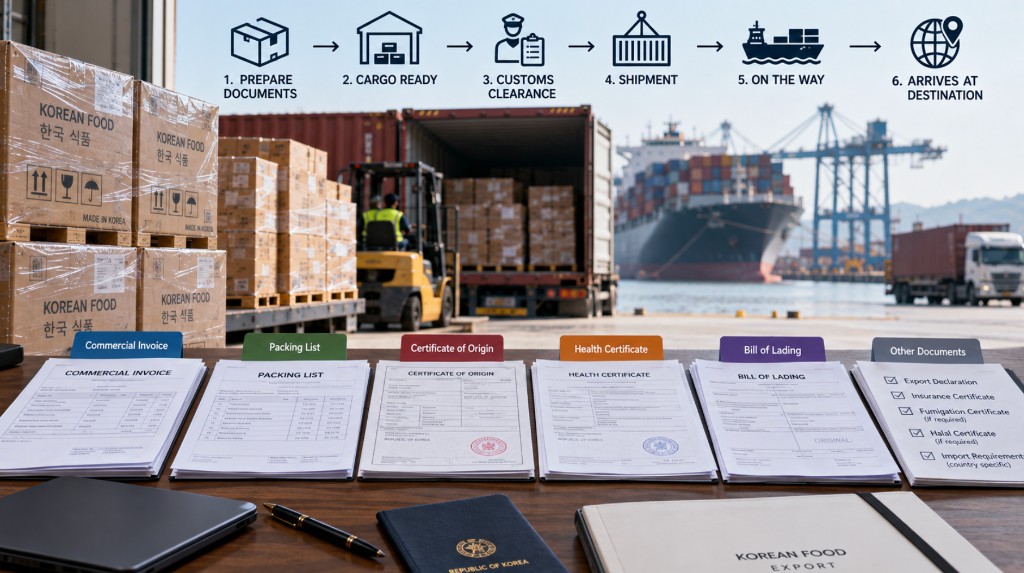
An importer may receive a HACCP certificate, Halal certificate, ISO certificate or other supporting document separately from the product specification.
The important question is whether that document actually applies to the product or manufacturing facility being discussed.
A specification sheet can help by clearly identifying the manufacturer and production location where appropriate.
That gives the buyer something against which supporting documents can be checked.
The specification itself should not be treated as a substitute for certificates.
Likewise, a certificate should not be treated as proof of every claim made about every SKU in a supplier’s catalogue.
Scope matters.
If a buyer requires a particular certification, it should confirm that requirement against the exact product and relevant documentation before placing the order.
For KCN’s type of multi-brand model, this becomes particularly important because one mixed shipment can contain products from many Korean manufacturers.
The documents need to remain connected to the correct products.
A specification sheet is not the same as destination approval
This is one of the most important distinctions for an importer.
A manufacturer can provide accurate Korean product information and the product can still require additional work before being sold in another country.
MFDS’s Korean labelling framework covers Korean requirements, including product identity, ingredients, date information, net contents and nutrition information. MFDS also notes that its English regulatory translations are provided for international convenience and that the official Korean text governs enforcement.
An importer therefore should not take a Korean specification and assume the product is automatically compliant everywhere else.
The destination authority may require a different nutrition format.
The local language may be different.
Allergen requirements may differ.
The importing company may need to appear on the label.
Some products can require registration, permits or certificates depending on the destination and product category.
The specification sheet gives the importer product facts.
The destination compliance process decides what has to be done with those facts.
Keeping those roles separate avoids two common mistakes: expecting the Korean manufacturer to know every regulation in every importing country, and assuming that documents prepared for Korea automatically satisfy the importing market.
Specifications should be controlled when the product changes
Food products change.
A manufacturer may update artwork while leaving the recipe unchanged.
Another may reduce the package from 100 g to 90 g.
A barcode may change.
Ingredients can change.
Carton configuration can change.
The importer therefore benefits from knowing which version of the specification it is using.
This does not require complicated document management for every small order.
A document date, revision number or other clear indication of the current version can prevent confusion.
Imagine an importer sends a product specification to a supermarket in January.
In March, the manufacturer changes the pack size and ingredient declaration.
The importer places another order in June using the old file.
Now the retailer’s system, importer’s file and physical product can disagree.
The earlier the change is communicated, the easier the correction becomes.
For recurring wholesale business, current product information is considerably more valuable than a large folder of old PDFs.
A serious buyer does not need every technical document immediately
It is possible to overcomplicate the process.
A buyer asking for an initial price on thirty Korean snacks does not necessarily need laboratory reports, manufacturing flow charts and every supporting certificate before it knows whether the products even fit its market.
The level of documentation should increase as the commercial opportunity becomes more serious.
At the catalogue stage, the buyer may need basic product identity, pack size, carton quantity and price.
During evaluation, it may need ingredients, allergens, nutrition, shelf life, storage and manufacturer information.
Before a supermarket listing or commercial purchase, the buyer may request the additional supporting documents relevant to the destination and customer.
This staged approach keeps wholesale sourcing practical.
The buyer receives enough information to make the next decision without forcing every initial enquiry into a full regulatory review.
For an exporter, it also means product data needs to be organised well enough that serious buyers can move from enquiry to due diligence without starting the information search again.
The best specification sheet makes the next question easier
A product specification cannot answer everything.
It should answer the questions that belong to the product itself.
What exactly is it?
Who manufactures it?
What is inside it?
How much does the retail unit contain?
How is it packed?
How should it be stored?
What is its normal shelf life?
What information is available for the buyer to review?
Once those points are clear, the importer can make the decisions that belong to its own market: whether the price works, whether the product can be imported, whether the retailer will accept it and how much should be ordered.
For KCN, this is where structured product information becomes valuable.
A buyer sourcing across Korean snacks, beverages, noodles, seaweed and other categories should not have to guess whether two similar-looking products are actually the same SKU.
The purpose of the specification is not to bury the buyer in paperwork.
It is to give the buyer enough certainty about the product that the commercial conversation can move forward.