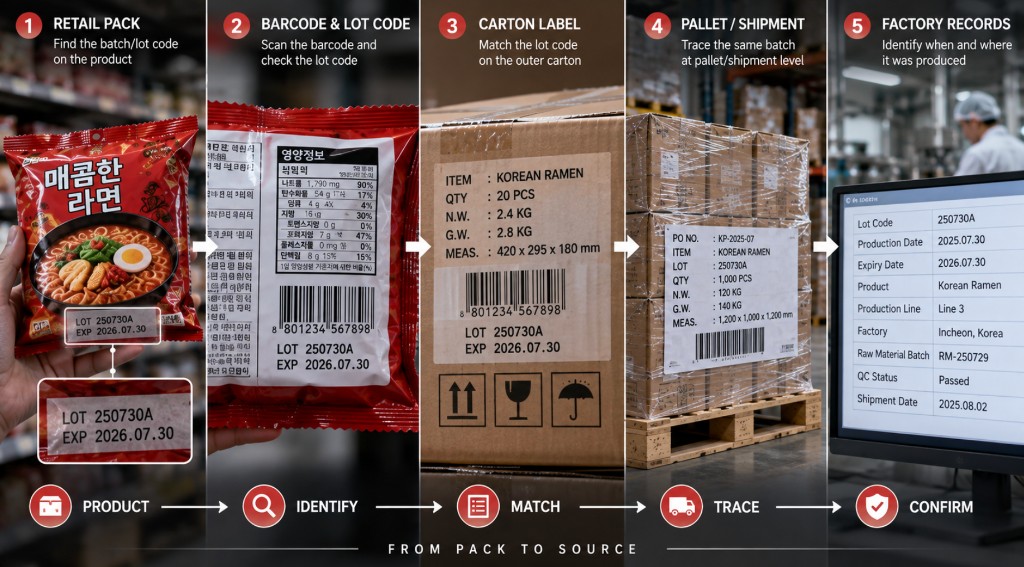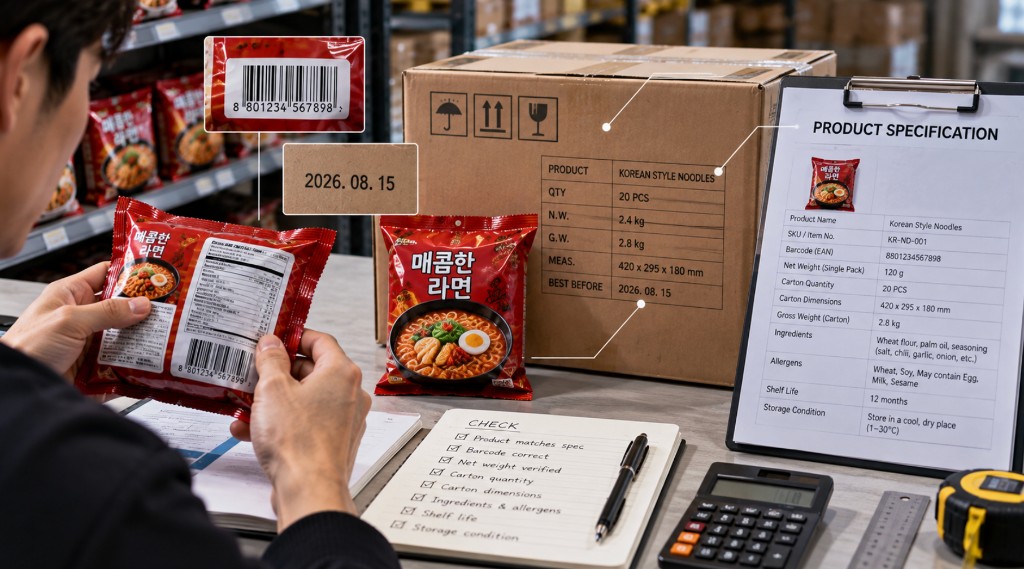

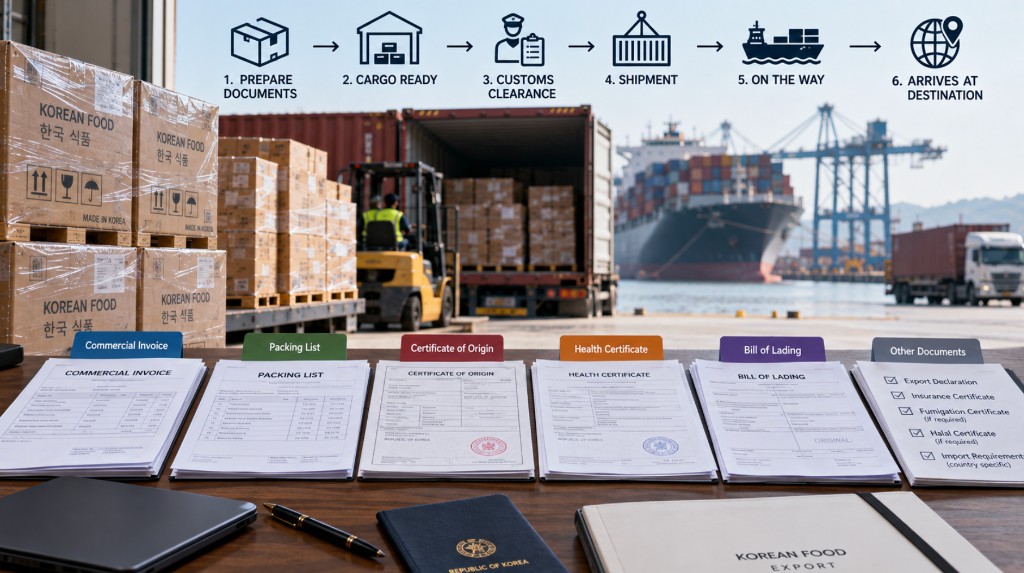
The cartons may be packed, the container booking may be confirmed and the products may have enough shelf life, but the shipment can still be delayed if the commercial or regulatory documents are incomplete. For an importer, documentation should therefore be reviewed while the order is being prepared, not after the cargo has reached the port.
There is also no single document pack that applies to every food shipment leaving South Korea. The documents required for a shipment depend on the product, destination country, trade agreement, customs rules and any food-specific requirements imposed by the importing country. Korea’s Ministry of Food and Drug Safety maintains separate export-certificate information and country-specific health-certificate formats, which is a useful reminder that food documentation changes according to the destination and product involved.
The importer therefore needs to understand what each document is supposed to prove and whether it will actually be accepted for the intended shipment.
Start with the commercial invoice
The commercial invoice is one of the basic documents in an international shipment. It identifies the seller and buyer, describes the goods and records the commercial value of the transaction.
For food imports, the description should be clear enough for the importer, freight forwarder and customs broker to understand what is being shipped. A vague description such as “food products” is much less useful than a description showing the product name, quantity, unit value and total value.
The invoice should also be checked against the purchase order before shipment. Product descriptions, quantities, prices, currency and the agreed Incoterm should match what the buyer believes it has purchased.
Small inconsistencies can create unnecessary questions later. If the purchase order refers to one product name, the carton uses another description and the invoice uses a third, the importer may have to explain that all three refer to the same product.
For a shipment containing dozens of Korean food SKUs, consistency becomes even more important.
The commercial invoice may also play a role in origin certification under certain Korean free trade agreements. Korea Customs explains that, depending on the applicable FTA, origin declarations may be made on invoices or other commercial documents rather than through one universal certificate format.
This is why an invoice should not be treated as something generated at the last minute after loading.
The packing list should describe the physical shipment
The commercial invoice explains the transaction. The packing list explains how the goods are physically packed.
For an importer receiving a mixed Korean food shipment, the packing list is particularly useful because the shipment may contain many products, carton quantities and pallet configurations.
A good packing list should allow the receiving team to understand what is actually inside the shipment.
Depending on the transaction, this can include product descriptions, carton quantities, gross and net weights, package numbers, pallet information and total shipment weight.
The packing list should agree with the commercial invoice.
If the invoice says 500 cartons and the packing list accounts for 492, that difference should be resolved before the cargo leaves Korea.
The same applies when the shipment changes during consolidation. Perhaps one manufacturer could not deliver ten cartons before the loading date, or another SKU was removed because its shelf life did not meet the buyer’s requirement.
If the physical shipment changes, the final documents should change with it.
The buyer should therefore avoid approving documents too early while the order is still moving.
A certificate of origin is not simply a statement that the goods came from Korea
Certificates of origin are one of the more misunderstood parts of international purchasing.
An importer may ask a Korean supplier:
“Can you provide a Korean Certificate of Origin?”
That question is incomplete.
The more useful question is:
Which certificate or origin declaration is required for this product under the trade arrangement being used?
Origin becomes especially important when an importer wants to claim a preferential tariff rate under a free trade agreement.
Korea Customs publishes different certificate-of-origin procedures for different FTAs. Some arrangements use authority-issued certificates, some permit self-issued origin declarations, and some allow the declaration to appear on an invoice or another commercial document.
The requirements can therefore vary by destination.
An importer should establish the applicable trade agreement, the HS classification of the product and the relevant rule of origin before assuming that a Korean supplier can provide a document that automatically reduces duty.
This point becomes particularly important for products that are packed or exported from Korea but contain imported ingredients or are manufactured under more complicated supply arrangements.
“Korean supplier” and “Korean preferential origin” are not necessarily the same question.
The goods must satisfy the origin requirements of the applicable agreement if preferential treatment is being claimed.
Korea Customs also notes that applications for authority-issued certificates can involve supporting material such as an export declaration, invoice or export contract and origin-related documents.
For the importer, the practical lesson is to discuss origin before the shipment, especially when the expected import duty calculation depends on it.
HS classification should be settled early
The HS code affects customs classification and may affect duty rates, trade-agreement treatment and certain regulatory requirements.
A Korean supplier may provide an HS code based on its own export records. That can be useful, but the importer should still confirm classification according to the rules applied in the destination country.
The same product can sometimes create classification questions depending on ingredients, preparation method, packaging or composition.
For example, a beverage containing milk may not necessarily fall under the same classification as a fruit drink. A sauce containing particular ingredients may be treated differently from another sauce that appears similar on a supermarket shelf.
The commercial team should therefore avoid choosing an HS code simply because it appears on an old invoice.
If there is uncertainty, the importer’s customs broker or another qualified local adviser should review it before the order is shipped.
This matters because landed-cost calculations are often built using the expected duty rate. An incorrect HS classification can make the expected margin inaccurate before the product even arrives.
Health and sanitary certificates depend on the destination and product
Food shipments can involve health or sanitary certificates, but importers should be careful with generic requests such as:
“Please provide health certificate.”
South Korea’s Ministry of Food and Drug Safety publishes export-related certificate information and maintains country-specific forms for certain products. As of August 2026, for example, MFDS lists specific health-certificate formats for exports of certain meat and animal products to Singapore, while other destination-specific certificates are maintained separately.
MFDS also updated its guidance on sanitary certification for exported foods in August 2026.
This illustrates an important point for importers: the phrase “health certificate” does not necessarily refer to one standard Korean document.
The required certificate may depend on the destination authority, product type and bilateral requirements.
Before asking the exporter to obtain a certificate, the buyer should confirm exactly what the destination authority expects.
Otherwise, both parties may spend time obtaining a document that does not satisfy the import requirement.
Product certificates should be checked separately from shipment documents
Food importers often receive documents showing HACCP, ISO, Halal or other certifications from a supplier or manufacturer.
These documents serve a different purpose from the commercial invoice, packing list or bill of lading.
A certificate may tell the buyer something about a facility, process or certification scope. It does not automatically prove that every SKU being shipped is covered.
Before relying on a certification for a commercial or regulatory requirement, the importer should check the name of the certificate holder, the facility covered, validity period and scope.
For Halal certification in particular, the buyer may also need to establish whether the certifying body is accepted in the destination market.
A logo on a catalogue is useful for identifying what should be investigated. It should not be the end of the verification.
For important products, keep the actual certificate on file.
Ingredient and allergen information should be collected before labelling begins
One of the most common points of friction in international food trade appears when the commercial order is already confirmed but the importer still does not have complete ingredient or allergen information.
The original Korean retail package may not contain the information in the format or language required by the destination country.
An importer preparing compliant local labels may therefore need the full ingredient declaration, allergen information, nutrition data, net weight, manufacturing information, storage instructions and other product details.
This should be collected while the product is being approved.
Waiting until the goods are ready to ship creates unnecessary pressure. If the importer discovers that the local label needs information that the exporter has not yet obtained from the manufacturer, the shipment may have to wait.
A strong product-approval process therefore combines commercial evaluation and documentation review.
The buyer should know not only that the product tastes good and has an acceptable price, but also that the information required to import and label it is available.
The bill of lading should match the final shipment
For ocean freight, the bill of lading records important transportation information relating to the shipment. For air cargo, the corresponding transport document is generally the air waybill.
Importers should review the shipping instructions before the final transport document is issued.
The names of the shipper and consignee, ports, package quantities and other shipment details should be consistent with the commercial arrangement.
Errors discovered after documents have been issued can require amendments and may create delays or extra charges.
The more complicated the shipment, the more useful a simple final-document review becomes.
For a mixed Korean food container, the importer may be receiving goods sourced from several manufacturers but exported through one company. The commercial paperwork should clearly reflect the actual export transaction and physical cargo.
Do not confuse “available” with “acceptable”
This distinction catches many new importers.
A supplier may say:
“We can provide the document.”
That does not always answer the real question.
The importer needs to know whether the document is in the form required by the destination authority or the customs treatment being claimed.
A certificate of origin may be available, but not in the required form for the relevant FTA.
A health certificate may be available, but not for that destination or product category.
A Halal certificate may exist, but the certifying organisation may not be accepted by the importing market.
A laboratory report may exist, but it may relate to another production batch.
An ISO certificate may belong to the manufacturer, but the buyer may be purchasing a product produced at another plant.
Document verification is therefore about scope and applicability, not just possession.
Product data should agree across the document set
A food shipment produces several versions of the same basic product information.
The product name may appear on the purchase order, commercial invoice, packing list, certificate of origin, export declaration, transport document and local import filing.
The quantities and weights may appear in several of those documents as well.
The more inconsistencies that appear, the more explanation may be required during clearance.
Before shipment, compare the final documents together rather than reviewing each one separately.
If the invoice says 24 bottles per carton but the packing list uses 20, investigate it.
If the invoice uses one net weight and the packaging artwork uses another, investigate it.
If the product description on the certificate differs substantially from the customs declaration, investigate it.
The aim is not to make every document visually identical. Different documents have different functions. The underlying commercial facts, however, should agree.
Mixed shipments need more document discipline
A mixed Korean food shipment is more complicated than importing one product from one factory.
A single container might contain snacks from five manufacturers, beverages from four more, sauces, seaweed and ready meals sourced through a Korean exporter.
Each manufacturer may provide its product data at a different time. Some certificates may relate to individual factories. Shelf-life details may differ by batch. One late supplier can change the final carton count.
For this reason, importers should separate the product master data from the final shipping documents.
The product master can contain the stable information: barcode, product name, net weight, carton configuration, manufacturer, ingredients and relevant certification details.
The final shipment file then records what actually moved: quantity, batch, dates, carton count, weights and shipment-specific documents.
Keeping those two layers separate reduces confusion when products are reordered.
Review documents before the container is loaded
The worst time to discover a documentation problem is after the vessel has departed.
A simple pre-shipment review can prevent many avoidable problems.
The importer should have enough information to confirm what products are shipping, how many cartons are included, how they are classified, what shelf life remains and what documents are expected.
Where a certificate of origin is being used, the applicable origin procedure should already be understood. Where a sanitary or health certificate is required, the correct form should already be identified. Product-specific certificates relied upon by the buyer should already have been reviewed.
For large orders, it is also useful to assign responsibility.
The supplier or exporter may prepare certain Korean-side documents. The freight forwarder handles transport-related paperwork. The customs broker advises on destination clearance. The importer still needs to make sure those pieces fit together.
No single party automatically sees the entire transaction.
Build a document file for every imported SKU
Once a product becomes a regular line, the importer should not have to ask the same questions every month.
A basic product file can contain the approved product specification, ingredient information, packaging artwork, carton details, manufacturer details, certificates, classification notes and any destination-specific labelling information.
Shipment-specific documents such as invoices, packing lists, certificates of origin and transport documents can then be stored against individual shipments.
This becomes particularly useful when an importer handles hundreds of Korean products.
If a customs broker asks for information about a product imported six months earlier, the answer should not depend on finding an old WhatsApp conversation with the supplier.
Good documentation becomes more valuable as the catalogue grows.
What the importer should know before shipment
Before Korean food leaves the origin warehouse, the importer should understand exactly what is being shipped, how it has been classified, what documents will accompany it and whether those documents satisfy the intended import procedure.
The commercial invoice and packing list should correspond to the final cargo. The importer should understand the origin documentation if preferential duty treatment is being claimed. Any required sanitary or health certification should be identified for the actual destination and product. Product certifications should be checked for scope and validity, and the information needed for local labelling should already be available.
The paperwork is not separate from the purchasing process. It is part of the product.
A carton that costs the right amount, has good shelf life and arrives on time can still become an expensive problem if the importer cannot clear or legally sell it.
For that reason, an experienced importer asks about documentation while deciding what to buy, not after deciding what to ship.