
That can work for a straightforward shipment. Korean food imports are often less straightforward.
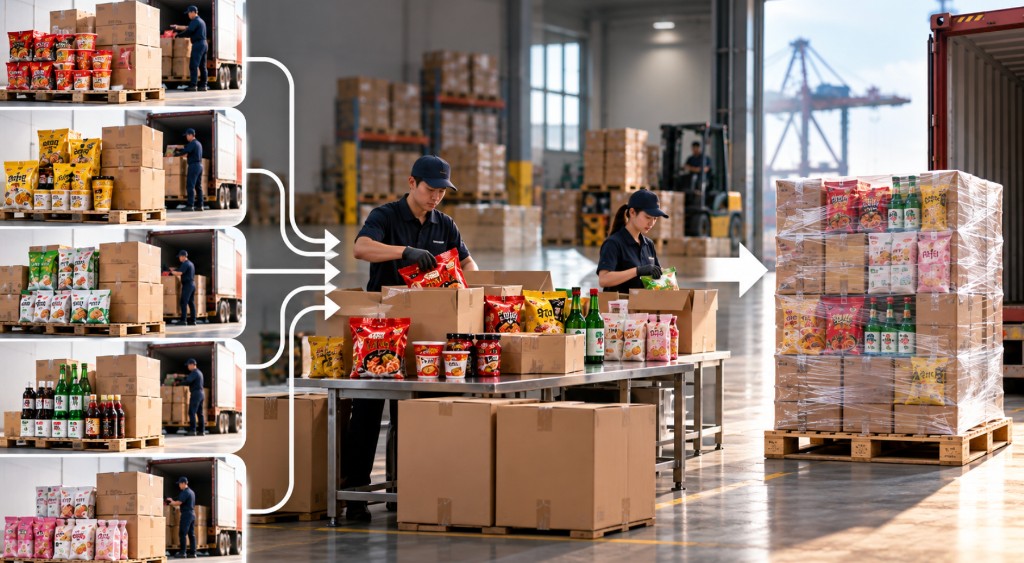
A typical order may contain beverages, snacks, seaweed, sauces, confectionery and ready-to-eat products from several manufacturers. The products may have different carton sizes, different shelf lives and very different sales speeds. Some may already be proven sellers. Others may be entering the market for the first time.
The decision between FCL and LCL therefore affects more than freight. It changes how much inventory the importer must carry, how often cargo is handled, how easily products from several suppliers can be consolidated, how much shelf life is consumed during the process and how much capital is tied up in each shipment.
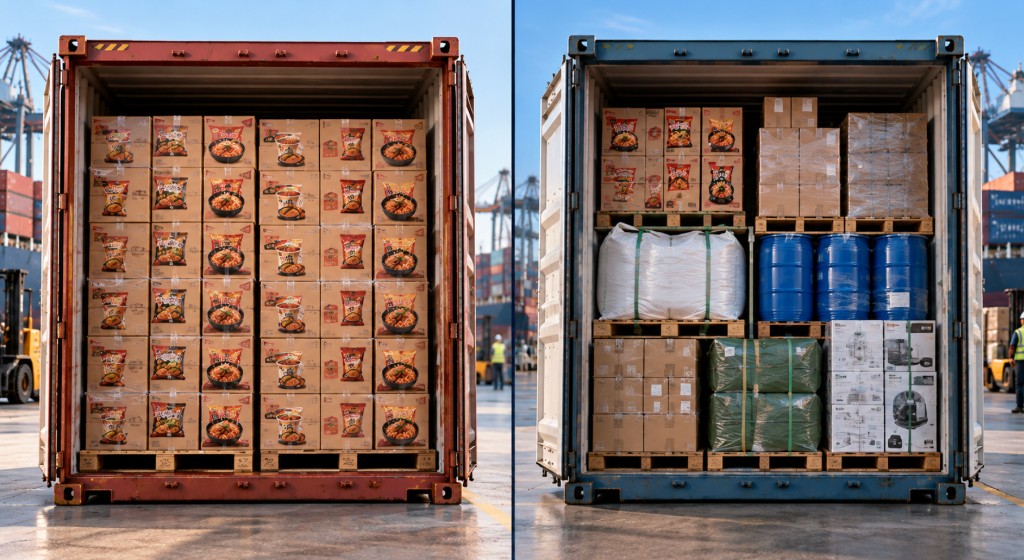
LCL, or Less than Container Load, means cargo from several shippers shares one container. FCL, or Full Container Load, means one shipper has the container for its shipment. LCL is generally priced according to the space or chargeable measurement used by the cargo, while FCL is priced at container level. Maersk describes LCL as a shared-container option where the shipper pays for the space used, while FCL becomes more economical when cargo occupies most of the container.
The important part for an importer is working out when the additional inventory required to justify FCL starts costing more than the freight saving.
LCL allows the importer to buy less inventory
For a new Korean food importer, LCL has an obvious advantage: the business does not need enough product to fill a container.
Suppose an importer wants to test twenty Korean food products. Ordering enough of every product to fill a 20-foot or 40-foot container may require far more inventory than the market can absorb. LCL allows the importer to purchase smaller quantities and pay for only part of a container.
That can be useful when sales history is limited.
An importer might bring ten cartons of one product, twenty of another and forty of a product with stronger expected demand. The assortment can be wider without forcing the buyer to hold several months of stock for every SKU.
This flexibility has financial value.
Every additional carton represents working capital. It also occupies warehouse space and consumes shelf life while waiting to sell.
A freight calculation that ignores those costs can make FCL appear cheaper than it really is.
FCL becomes attractive as shipment volume increases
LCL does not remain economical forever.
As the shipment becomes larger, the total LCL freight and handling cost rises. Eventually the importer reaches a point where booking an entire container can make more sense.
There is no universal CBM number at which every importer should switch. Freight rates change by trade lane, carrier, season, origin, destination and service. Cargo weight also matters.
Carrier guidance reflects this. Maersk notes that smaller shipments tend to favour LCL, while cargo occupying most of a container tends to favour FCL. DHL similarly notes that LCL pricing depends heavily on weight and measurement and that the cheaper option must be assessed using the actual shipment.
This means the decision should be based on quotations for the same shipment rather than an internet rule such as “switch to FCL at X CBM.”
Ask the forwarder to quote both.
Then compare the complete cost.
LCL freight is not just the ocean rate
One reason LCL quotations can surprise importers is that the main ocean freight rate is only part of the invoice.
LCL cargo has to be received at a container freight station, grouped with other cargo, loaded into a shared container and then separated again at destination. There may therefore be origin and destination handling charges associated with the cargo’s weight or measurement.
DHL explains that LCL invoices often contain local origin and destination charges as well as loading, unloading and handling costs.
This becomes important when comparing a quotation such as:
LCL freight: USD 85 per CBM
against:
FCL: USD 2,000 per container
At first glance, the calculation looks easy.
Ten CBM × USD 85 gives USD 850.
LCL appears much cheaper.
But the importer has not yet compared documentation fees, consolidation charges, CFS handling, destination deconsolidation, delivery arrangements and any other applicable local costs.
The comparison should therefore be made using the estimated door-to-door or warehouse-to-warehouse cost under the same Incoterm and routing wherever possible.
Food importers should calculate freight at SKU level
A mixed food shipment can create another problem.
The forwarder may provide one freight cost for the entire cargo, but the importer sells individual products.
That freight cost eventually needs to be allocated back to the SKUs.
Consider two products.
One carton contains lightweight seaweed packets and occupies a relatively large amount of space.
Another carton contains glass beverage bottles and is much heavier but may use space differently.
If the importer simply divides freight equally by carton, the resulting landed costs can be misleading.
For many LCL shipments, cubic volume becomes particularly important because freight is commonly assessed using weight or measurement. DHL describes LCL charges using weight/measurement principles, with the charge based on whichever measure is applicable under the quotation.
The importer should therefore know carton dimensions as well as carton weight.
A product that looks inexpensive at the supplier’s warehouse can become unattractive if each carton occupies a disproportionate amount of container space.
This is especially relevant for low-value, bulky food products.
FCL can reduce the number of cargo-handling stages
LCL cargo normally passes through consolidation and deconsolidation points because products belonging to several shippers have to be combined into one container.
That means additional cargo-handling stages compared with a straightforward FCL movement.
This does not mean LCL cargo will necessarily be damaged. Professional freight operators handle LCL shipments every day. It does mean the importer should think carefully about outer-carton strength, palletisation and product fragility.
Glass bottles, thin retail boxes, cans, pouches and products packed in delicate display cartons may respond differently to repeated movement.
With FCL, the importer has greater control over how its cargo occupies the container. With LCL, the cargo shares space with shipments belonging to other companies.
The outer shipping carton therefore matters.
A product package designed to look attractive on a supermarket shelf is not necessarily designed to survive several weeks of international freight and warehouse handling.
Shelf life changes the freight calculation
Shipping time has commercial value when the cargo is food.
Suppose an importer saves USD 500 by selecting a slower or more complicated shipment structure but loses another two weeks of useful selling time.
For products with eighteen months of shelf life, that may be irrelevant.
For products with six months remaining, it may matter a great deal.
LCL can require additional time for cargo consolidation at origin and deconsolidation at destination. DHL notes that LCL may involve longer transit time compared with other options because of the shared-container process.
An importer should therefore compare:
the freight saving,
the additional time,
and the value of the shelf life consumed during that time.
A cheaper freight option can become expensive if it pushes a product closer to retailer acceptance limits or forces the distributor to discount stock sooner.
Consolidation can determine whether LCL or FCL works
Korean food shipments are frequently sourced from more than one manufacturer.
An importer may purchase beverages from one supplier, snacks from another, sauces from a third and seaweed from several others. The goods then need to arrive at a common location before export.
The difficulty is that manufacturers do not always finish at the same time.
Suppose four suppliers are ready on the 5th of the month, but another important manufacturer will not deliver until the 18th.
The importer now has several choices.
The shipment can wait for the last supplier.
The late products can be removed.
The goods can be split into two shipments.
Or the late products can move with the next order.
With LCL, splitting smaller volumes may be financially manageable. With FCL, losing a significant portion of the planned cargo may leave expensive unused container space.
This is why a full-container strategy works better when purchasing and production schedules are reasonably predictable.
Container utilisation begins before the container reaches the warehouse.
It starts when purchase orders are placed.
Do not fill a container simply because space is available
This is probably the most expensive mistake hidden inside the FCL calculation.
An importer receives an FCL quotation and discovers that the existing order fills only 70% of the container.
The immediate instinct is to fill the remaining 30%.
From a logistics perspective, this appears sensible. The container cost is largely fixed, so more products reduce freight cost per unit.
The problem is that the additional products have to be sold.
Suppose the importer adds another 400 cartons only because the container has space. If those cartons represent four months of extra inventory for slow-moving SKUs, the freight saving may be smaller than the financing, storage, markdown and expiry costs created by the additional stock.
The better calculation asks whether there are products the business already expects to reorder soon.
If a fast-moving beverage would otherwise require another shipment next month, adding more of that product may make excellent sense.
Adding a new flavour nobody has tested just to occupy two cubic metres is a different decision.
Empty container space has a visible cost.
Excess inventory has a less visible cost.
Both should be measured.
Look at inventory turnover before switching to FCL
An importer approaching FCL volume should examine how quickly the stock is turning.
Imagine an LCL shipment currently carries 12 CBM and represents six weeks of expected sales.
The business is considering moving to a 20-foot container containing almost twice as much product because the freight cost per unit would fall.
If the larger order increases inventory from six weeks to four months, the freight calculation should include the consequences of holding that stock.
There is more money tied up in inventory.
More warehouse space is required.
More products are exposed to changes in demand.
The importer has less flexibility to replace weak SKUs with stronger ones.
And more shelf life is consumed while products sit in storage.
FCL becomes particularly attractive when the importer has enough reliable sales volume to consume the larger quantity without dramatically increasing inventory days.
That is different from merely having enough money to fill the container.
Product mix affects container economics
Not every Korean food category uses container space in the same way.
Beverages are often relatively heavy.
Snacks may consume substantial cubic volume relative to their value.
Seaweed can be very light but bulky.
Sauces and canned foods may create high weight concentrations.
The importer therefore needs to consider both payload and physical space.
A container can reach a practical limitation because it is full by volume or because the weight becomes a concern before every cubic metre is used.
For a mixed food importer, carton dimensions and gross weights should be maintained as part of the product master data.
This allows the purchasing team to estimate how proposed quantities will behave before the final order is sent to suppliers.
It also makes it easier to test different product mixes.
Instead of asking how many cartons fit into a container, the importer can ask which combination of cartons produces the best balance of sales demand, shelf life and logistics cost.
LCL can be useful for replenishment even after the importer uses FCL
Importers sometimes treat LCL and FCL as stages.
A small company begins with LCL.
It grows.
Then it “graduates” to FCL.
After that, every shipment is expected to be a full container.
Real purchasing does not need to work that way.
A distributor may use FCL for planned core inventory and still use LCL to replenish a product that unexpectedly sells out.
LCL can also be useful when launching a new category alongside an established FCL programme.
For example, an importer may already bring full containers of Korean snacks and beverages but want to test a smaller group of frozen, functional or premium products without changing the main purchasing plan.
The shipping method should follow the inventory requirement.
The business does not receive a prize for using only one mode.
Compare the two options using the same order
The cleanest comparison is to create one proposed purchase order and price it under both shipping methods.
Assume the order occupies 14 CBM.
Request:
an LCL quotation for the full 14 CBM,
and an FCL quotation using the appropriate container size.
Then calculate the total logistics cost under each scenario.
After that, calculate the freight contribution per sellable unit.
Suppose LCL produces a total logistics cost of USD 2,600.
FCL costs USD 2,300.
FCL saves USD 300.
If the 14 CBM order already fits comfortably inside the chosen container, the decision may be straightforward.
But suppose the purchasing team proposes increasing the order to 22 CBM merely to “make the FCL worthwhile.”
That additional 8 CBM needs a separate commercial justification.
The question is no longer whether FCL is cheaper than LCL.
The question has become whether the business should buy another 8 CBM of food.
Those are different decisions.
There is no single FCL-versus-LCL crossover point
Importers often search for a number such as:
“At what CBM should I use FCL?”
It would be convenient if there were one.
There is not.
Maersk describes LCL as particularly suitable for smaller loads and gives examples around lower CBM or pallet volumes, while DHL notes that LCL can remain competitive at larger volumes depending on the trade lane and cargo. The underlying message from both is that the actual quotation and cargo characteristics matter.
The crossover point moves with freight rates.
If FCL rates fall, the point moves lower.
If LCL rates are competitive on a particular route, it can move higher.
Destination charges can change the result.
Heavy cargo can change the result.
Non-stackable cargo can change the result.
Seasonal freight conditions can change the result again.
An importer should therefore recheck the comparison periodically instead of turning one old freight quotation into a permanent company rule.
The better option is the one that produces the healthier inventory
For Korean food importers, the final decision should combine freight economics with inventory economics.
LCL usually gives the buyer more flexibility to purchase smaller quantities and test more products. That flexibility comes with shared-container handling and a different charge structure.
FCL can reduce freight cost per unit when volumes become large enough and gives the importer a dedicated container. The danger is using the attractive container rate as a reason to buy inventory that the market did not ask for.
A good freight decision therefore looks beyond the shipping invoice.
How much capital will be tied up?
How many months of inventory will arrive?
How much shelf life will remain?
How quickly do the products sell?
How many suppliers have to be coordinated?
How much unused container capacity exists?
Would filling that capacity reduce total cost, or simply increase stock?
Once those questions are included, the FCL-versus-LCL decision becomes much clearer.
The cheapest container is not necessarily the cheapest shipment. The cheapest shipment is the one that gets the required inventory into the market at a sensible landed cost without creating unnecessary stock behind it.