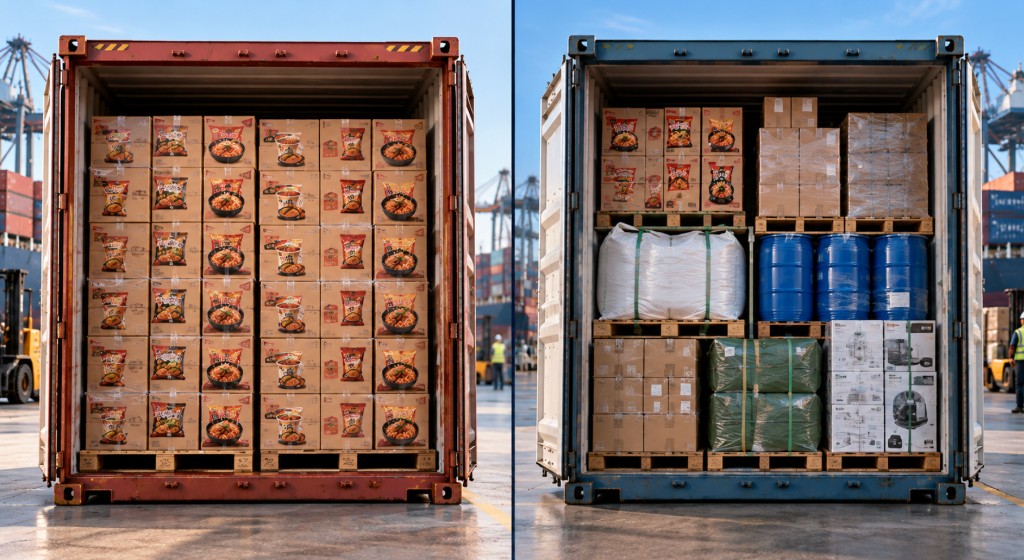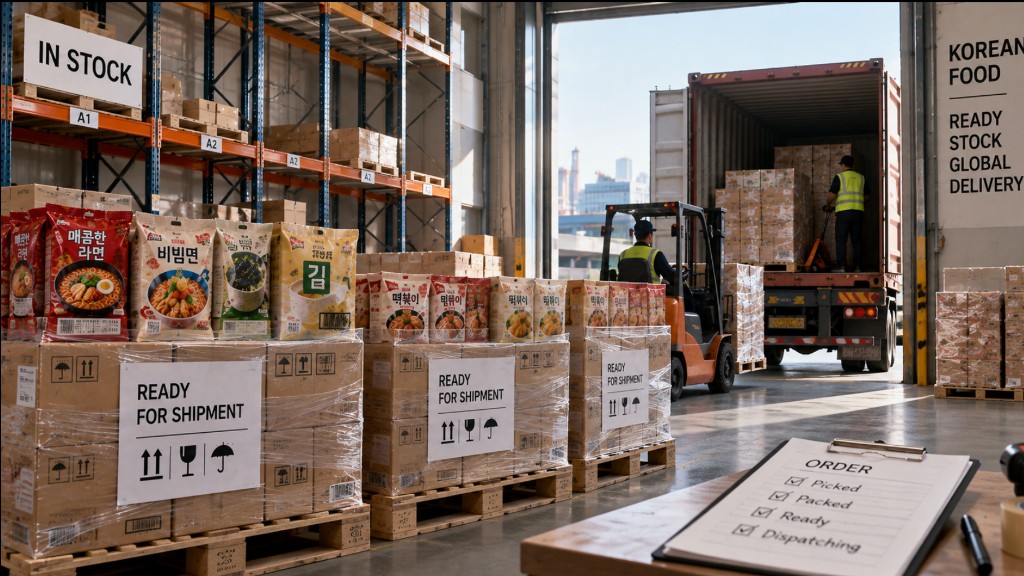

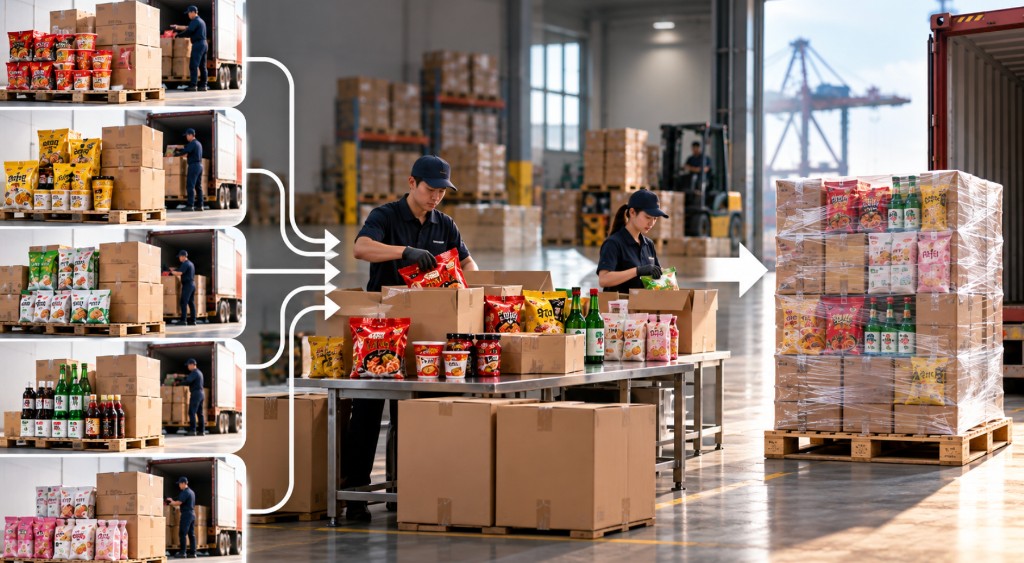
That process is consolidation. In logistics terms, consolidation means bringing smaller cargo lots together at a central point and moving them as one larger shipment. Maersk describes consolidation as combining smaller LTL or LCL shipments at a central origin point before transporting them together. For a Korean food importer, the practical version is usually simpler to understand: several suppliers deliver their cartons to one warehouse, the quantities and condition are checked, the products are organised into the final shipment and the cargo then moves to the destination under the agreed logistics structure.
The important part happens before the container is loaded. If twenty Korean suppliers are involved, the importer is really managing twenty small inbound movements before managing one international outbound movement. The quality of that coordination can affect shelf life, freight cost, final carton quantities and whether the vessel booking is met at all.
The consolidation warehouse becomes the control point
The consolidation warehouse is where the separate purchase orders begin to turn into one shipment. Each supplier is normally given a delivery location and a deadline. The warehouse receives the cartons, records what actually arrived and holds the goods until the rest of the suppliers have delivered.
This sounds straightforward until the shipment contains dozens of SKUs. One supplier may deliver the full order. Another may be short by five cartons. A third may send a replacement flavour without clearly notifying the buyer. A manufacturer may deliver cartons with different expiry dates from those originally discussed. Another supplier may simply miss the planned delivery day.
If the importer discovers these differences only after loading, correcting them becomes difficult. The consolidation stage should therefore include a reconciliation between the purchase order and the cargo physically received.
Suppose the importer ordered 100 cartons from Supplier A, 60 from Supplier B and 40 from Supplier C. The warehouse actually receives 100, 56 and 40. The final invoice and packing list should reflect the shipment that exists, not the quantity everybody originally hoped would arrive.
The same principle applies at SKU level. If Supplier B was supposed to deliver twenty cartons each of three products but sends twenty, sixteen and twenty, the shortage should be visible before final shipping documents are prepared.
This is also a good point to record carton condition. A crushed outer carton may not mean the retail units are damaged, but loading visibly weak cartons into an international shipment without checking them is unnecessary risk.
Timing is harder than the physical loading
The container may take only a few hours to load. Getting all the suppliers ready at approximately the same time can take weeks.
Consider an importer buying from eight Korean manufacturers. Six suppliers have stock ready immediately. Supplier Seven needs ten days. Supplier Eight is waiting for fresh production and expects to finish in three weeks.
The buyer now has a decision. The six ready suppliers can deliver early and wait in the consolidation warehouse. The entire shipment can be delayed for Supplier Eight. The late product can be removed. Or the order can be divided between shipments.
None of those options is automatically correct.
Waiting may be sensible if Supplier Eight contains important fast-moving products and the warehouse cost is modest. It may be a poor decision if the waiting time consumes valuable shelf life on products already sitting in the warehouse.
This is why a consolidated order needs a realistic cargo-ready plan before vessel booking. Each supplier should provide an expected ready date, and the buyer should identify which supplier is likely to control the final loading date.
The last supplier can effectively determine the schedule for the entire shipment.
If one factory delivers three weeks later than everybody else, then the other cargo may spend three weeks waiting. That time should be included in shelf-life calculations just as seriously as ocean transit.
A product with eight months remaining when it enters the warehouse does not still have eight months remaining after waiting twenty days for another supplier.
Consolidation can reduce MOQs, but it does not erase them
One of the main reasons importers use a consolidator or exporter is the ability to combine smaller purchases.
A buyer may want only ten cartons of a snack, twenty cartons of seaweed and thirty cartons of a drink. None of those quantities is large enough to justify an individual international shipment, but together with products from several other manufacturers they may form a useful mixed load.
LCL services use the same basic logistics principle at another level. Small shipments from different shippers can be consolidated into a shared container, allowing the customer to move only the volume it needs rather than booking an entire container. Maersk notes that LCL allows smaller volumes to be combined with other cargo and can help businesses test products or avoid excessive inventory.
For a Korean food buyer, there can therefore be two types of consolidation happening at once. The importer may first consolidate purchases from several Korean manufacturers into one cargo lot. If that cargo is still too small for an FCL booking, the forwarder can then move it as LCL alongside cargo belonging to other shippers.
The commercial advantage is flexibility. The buyer can spread purchasing capital across more products without buying excessive quantities of each one.
The manufacturer MOQ still exists, however.
If the ramen factory requires twenty cartons per flavour, the consolidation warehouse cannot turn that into five cartons. Consolidation solves the shipment problem, not the manufacturer’s production or selling minimum.
This distinction is useful when planning a mixed Korean catalogue. The importer should know whether the limiting factor is factory MOQ, exporter MOQ or freight economics. They are different problems and may need different solutions.
The importer needs one master view of the order
Once several suppliers are involved, individual supplier spreadsheets are not enough. The buyer needs a master order showing what is expected across the entire shipment.
At minimum, the importer should be able to see the supplier, SKU, product description, ordered cartons, units per carton, carton dimensions, gross weight, expected CBM, expected ready date, shelf life and actual cartons received.
That file changes during consolidation.
Suppose the draft shipment contains 1,000 cartons occupying an estimated 24 CBM. After receiving the products, actual carton dimensions or quantities may push the volume to 26 CBM. One product may be removed and another increased. Several cartons may arrive with unacceptable dates and need replacement.
The final shipping plan should be based on the actual cargo, not the first version of the purchasing spreadsheet.
For an importer using FCL, this becomes especially important as the container approaches its physical or weight limits. If there is spare space, the buyer may have time to increase a fast-moving product. If the shipment is larger than expected, some cartons may need to move to the next shipment.
The master file also makes supplier performance visible. If the same manufacturer repeatedly ships short quantities or misses consolidation deadlines, the buyer can see the pattern across multiple orders instead of treating each incident as an isolated problem.
Shelf life needs to be checked when the goods arrive
The supplier may confirm acceptable shelf life when the purchase order is placed, but the consolidation warehouse provides a chance to verify what has actually been delivered.
For food products, this is one of the most valuable checks in the process.
Imagine an importer agreed that products should ship with at least nine months remaining. Supplier A delivers stock with eleven months remaining. Supplier B delivers eight months. Supplier C sends two batches, one with ten months and another with six.
If this is identified before loading, the buyer still has options. Supplier B may replace its stock. Supplier C’s older batch can be rejected or reduced. The importer can decide to accept the product if sales are strong enough.
Once the cargo has reached the destination, all of those solutions become harder.
This does not mean every consolidation warehouse will automatically perform detailed expiry inspection. The importer needs to specify what information or checking is expected. If batch and expiry visibility matter, that requirement should be communicated before receiving begins.
For mixed food containers, a final pre-shipment report showing production or expiry information by SKU can be extremely useful. It gives the buyer one last chance to identify the products that carry more expiry risk than the rest of the container.
Documents have to follow the final cargo
A consolidated shipment can create confusion when purchase orders and final shipping documents are treated as the same thing.
They are not.
The purchase orders describe what the importer intended to buy. The final commercial invoice and packing list should describe what is actually being shipped under the relevant transaction.
If goods are missing, substituted or removed during consolidation, the shipment documents need to reflect those changes.
The exact document structure depends on the commercial arrangement. If one Korean exporter purchases products from several manufacturers and resells them to the overseas buyer, that exporter may issue the commercial invoice covering the consolidated transaction. If the buyer purchases directly from multiple suppliers and a freight company merely consolidates the physical cargo, the documentation structure can be different.
The importer should understand this before loading.
Otherwise, the logistics team can end up with one physical container and several document sets that do not fit neatly with the intended import procedure.
Certificates also need to remain connected to the right products. A HACCP certificate from one factory should not accidentally be treated as evidence for products made by another. The same applies to Halal certificates, product specifications and other supporting documentation.
Consolidation combines the cargo. It does not combine the identity of the manufacturers.
Local transport can quietly become a large cost
Buying directly from many factories can produce attractive product prices, but every supplier still needs to move its goods to the consolidation point.
If the factories are located across different parts of South Korea, domestic collection can become a meaningful part of the shipment cost.
One supplier may include delivery to the warehouse. Another may quote EXW and expect the buyer to arrange collection. A third may offer free domestic delivery only above a certain order value.
These differences should be captured before the buyer decides that direct purchasing is cheaper than using an exporter.
Suppose direct factory sourcing saves USD 1,200 across the products but creates USD 900 of additional collections, handling and coordination. The real saving is now much smaller.
If it also creates longer waiting times or requires larger MOQs, the direct option may no longer be clearly better.
Consolidation costs should therefore be included in landed-cost analysis. The warehouse receiving fee, storage, pallet handling, local collections and final container loading are part of getting the goods from the Korean suppliers into the international supply chain.
Ignoring them makes the factory price look artificially attractive.
Consolidation works best when the shipment has a cut-off
Without a cut-off date, a mixed shipment can remain permanently unfinished.
One supplier is always promising delivery tomorrow. Another product is expected next week. A salesperson asks whether three additional SKUs can still be added.
At some point the buyer has to freeze the shipment.
The cut-off should allow enough time for the warehouse to reconcile the cargo, resolve discrepancies, prepare the final load plan and meet the carrier’s schedule.
Cargo arriving after the cut-off can move with the next shipment unless there is a strong reason to delay the entire order.
This discipline matters because delaying a container for a small product can affect every other product inside it.
Suppose 980 cartons are ready and twenty cartons from one new supplier are late. Delaying the shipment by ten days for those twenty cartons means the other 980 cartons also wait ten days.
The buyer should compare the importance of the late cargo with the cost of delaying everything else.
Sometimes the right decision is simply to leave it behind.
The best consolidated shipment is not the one with the most suppliers
It is easy to turn consolidation into a catalogue-building exercise. If a warehouse can accept products from many factories, the importer may keep adding suppliers because the operational structure allows it.
That can create a different problem.
Every supplier adds another payment, delivery schedule, product file, set of certificates and possible discrepancy. Every new SKU creates another inventory line at destination.
Consolidation is most useful when it allows the buyer to purchase the right quantities from the suppliers it actually needs.
If twenty suppliers produce a commercially strong container, the complexity may be justified. If forty suppliers are being combined only because the importer wants a huge catalogue, the business may be creating administrative work and dead stock at the same time.
The test is what happens after arrival.
If the products sell and the importer can build the next order more accurately, consolidation is doing its job. If the warehouse ends up with hundreds of small lines that never reach reorder level, the problem is no longer logistics.
The purpose of consolidation is to make fragmented purchasing manageable.
It should allow an importer to buy across Korean manufacturers without turning every product into a separate international shipment, while still keeping control over quantity, dates, documents and cost.
When those controls are in place, a mixed shipment can behave like one organised purchase even though it began as orders placed with many different suppliers.