
This is especially true when an order contains products from several Korean manufacturers. One brand may update its wholesale price while another remains unchanged. A product may be available from ready stock today but require a new production run next month. Freight conditions can move, carton quantities can change and a different batch may have a different shelf-life position. A quotation therefore represents a commercial situation at a point in time rather than a permanent global price for the product.
For a buyer, the important thing is not to expect every line to remain unchanged indefinitely. The more useful question is whether the quotation clearly states what is being offered, in what quantity, under which commercial terms and for how long that offer can reasonably be relied upon.
Stock availability can change the price
Ready stock and fresh production can produce different commercial results.
A Korean exporter may have access to stock that is already available in a manufacturer’s warehouse. If the required quantity is small and the stock is available, the buyer may receive a competitive quotation with a short lead time.
The next time the buyer asks for the same product, that batch may already have been sold. The manufacturer may need to produce again, and the minimum quantity or commercial terms can change.
The opposite can happen as well. A product that previously required production may later become available from existing stock, making smaller quantities possible.
This is one reason buyers should avoid assuming that a previous MOQ or price automatically applies to every future order.
Availability should be reconfirmed when the buyer is ready to proceed.
Shelf life also needs to be considered alongside price. Older ready stock can sometimes be commercially different from fresher stock. A buyer should compare the price with the remaining shelf life rather than looking at the price alone.
A slightly cheaper product is not necessarily a better purchase if it leaves the importer with much less time to sell the inventory.
Quantity still matters
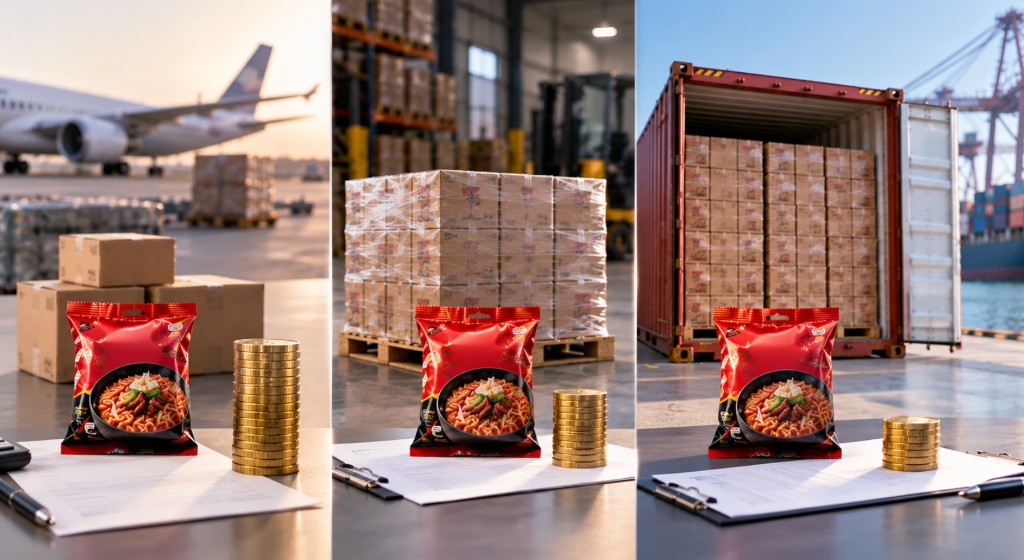
Wholesale pricing is connected to quantity because manufacturers and exporters incur different costs depending on the size of the order.
A buyer asking for ten cartons may not receive the same unit price as a buyer ordering five hundred cartons.
The difference is not always dramatic, and larger quantities do not automatically guarantee a better overall business decision. The buyer still needs to consider how quickly the stock can be sold.
For mixed Korean food orders, quantity becomes more complicated because the total shipment can be large while individual SKU quantities remain small.
An importer may purchase 1,000 cartons overall but only ten cartons of a particular snack. The manufacturer of that snack still sees a ten-carton requirement.
This is why a large mixed order does not necessarily produce factory-volume pricing on every product.
The best quotation usually comes when the buyer provides a realistic quantity rather than asking for the “lowest possible price” without giving any indication of volume.
If the expected quantity changes substantially, the quotation may need to be recalculated.
Manufacturer prices can change independently
A Korean exporter working across many brands does not control every manufacturer’s wholesale price.
Manufacturers can revise their prices because their own production costs, packaging costs or commercial policies change. One company may update prices at the beginning of a quarter while another may keep the same pricing for much longer.
This means a mixed catalogue does not necessarily move together.
Twenty products may remain unchanged while three increase and two decrease.
A buyer looking at a large quotation should therefore treat each product as its own commercial line rather than assuming that one percentage adjustment applies across the entire order.
The same applies when pack sizes or carton configurations change.
If a manufacturer moves a snack from 80 g to 75 g, changes the number of units inside a carton or introduces new packaging, the product may need to be quoted again even if the brand and flavour look almost identical.
Exact SKU identification helps prevent these problems.
Freight can change the final economics without changing the product price
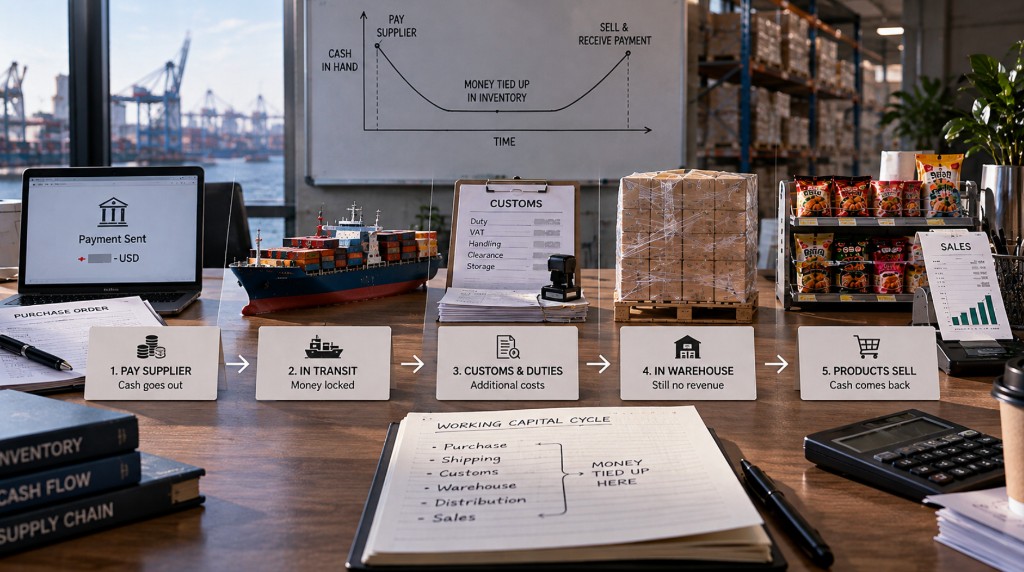
A supplier can keep the product price exactly the same while the importer’s final cost changes because transportation has changed.
This matters most when buyers compare quotations issued at different times or under different shipping arrangements.
A product quoted at the Korean side of the transaction may remain unchanged, while ocean freight or destination handling moves separately.
For mixed shipments, the final CBM also affects how freight is distributed across the products.
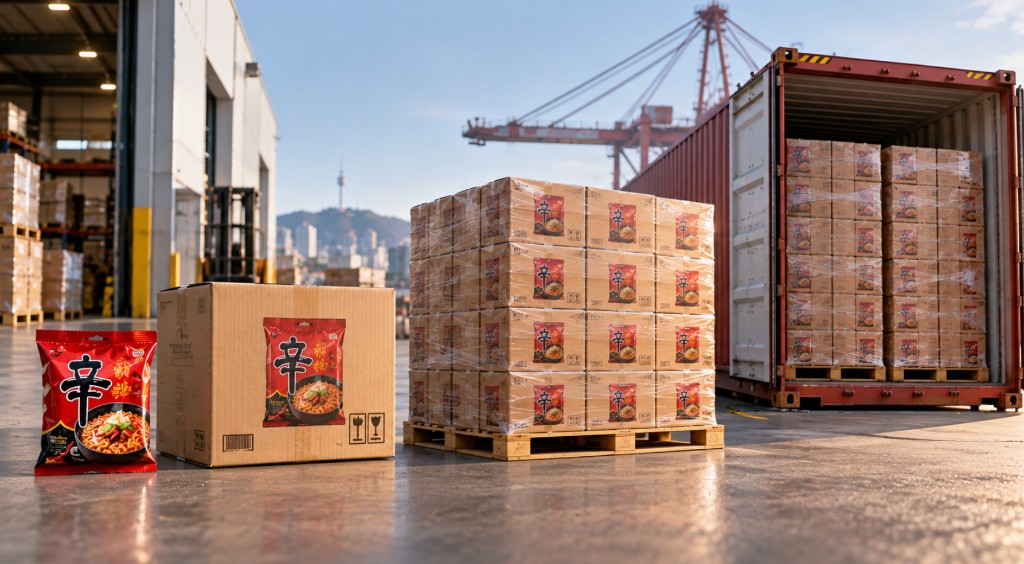
Suppose an early quotation is based on an estimated 18 CBM shipment. After the buyer adds more products, the final shipment becomes 25 CBM and the shipping method changes.
The product prices may not have changed at all, but the shipment economics have.
This is why a product quotation and a final landed-cost calculation should not be confused.
The Korean supplier or exporter can quote the goods according to the agreed commercial basis. The importer still needs to consider freight, destination charges, duty and other applicable import costs when deciding whether the product works in its market.
Currency can affect international quotations
International food transactions are often quoted in currencies such as US dollars even when the manufacturers and buyers operate in different local currencies.
Changes between currencies can therefore affect quotations over time.
An exporter may receive manufacturer pricing in Korean won and sell internationally in US dollars. The overseas buyer may then convert the dollar price into another currency before calculating its own landed cost.
There can be several currency relationships inside one transaction.
For a small short-term movement, the effect may be limited. Over a longer quotation period or a large order, the difference can become more noticeable.
This is another reason wholesale quotations normally have a practical validity period rather than remaining open indefinitely.
The buyer does not need to monitor foreign-exchange markets every day. It simply needs to understand that a quotation issued several months ago may need to be refreshed before the purchase order is placed.
Destination requirements can change what is included
Two buyers requesting the same Korean product may not receive an identical commercial arrangement if the destination requirements are different.
One country may require additional documentation. Another buyer may need specific certification for its retailer. Packaging or labelling requirements may differ. A product may require additional preparation before shipment to one market but not another.
Those requirements can affect time and cost.
The importer should therefore tell the exporter the destination country early in the quotation process.
A price prepared without knowing the destination may be useful as a product reference, but it should not automatically be treated as the final commercial offer.
This is particularly important for food because regulatory requirements depend on both the destination and the type of product.
The buyer is responsible for confirming the requirements of its importing market, while the Korean exporter can confirm which Korean-side documents and product information are available.
Resolving that early avoids spending time negotiating a product that later turns out to need a different commercial or documentation structure.
A quotation should be refreshed before a real order is placed
A buyer may use an old quotation while planning a market entry, comparing products or presenting ranges internally. That is perfectly reasonable.
Before placing the actual purchase order, however, important commercial details should be reconfirmed.
The exporter needs to check current product availability, price, MOQ and expected shelf life. The buyer may also have changed quantities or added and removed products since the original quotation.
For a mixed shipment, this final review becomes even more useful because dozens of product lines may have changed independently.
A quote containing eighty products does not necessarily become invalid because the price of four products changed. The exporter can update the affected lines and rebuild the commercial order around the buyer’s current requirements.
The objective is to reach a final quotation that reflects what can actually be supplied at the time the buyer is ready to proceed.
The lowest quotation is not always the lowest-cost shipment
Buyers naturally compare suppliers on price.
That comparison becomes much more useful when the commercial basis is the same.
A product quoted at USD 20 from one supplier and USD 21 from another does not tell the full story if the first quotation requires a much larger MOQ, has substantially less remaining shelf life or covers a different delivery point.
The buyer should understand what is included before deciding that one quotation is cheaper.
This does not require a complicated procurement model for every small order.
It requires comparing like with like.
The exact SKU should match. The pack size and carton configuration should match. The quantity should be comparable. The commercial term should be clear. Shelf-life expectations should be understood.
Once those points are aligned, price becomes much more meaningful.
Wholesale Korean food purchasing works better when the buyer treats the quotation as a commercial offer rather than a static catalogue price.
Products, quantities and market requirements change.
A good quotation changes with them.
For buyers working with KCN, the most useful approach is to send the current product list, destination and approximate quantity when requesting an updated quotation. That allows the order to be priced around the products and stock actually available rather than relying on an old price sheet that may no longer reflect the shipment being planned.