
Before Toomba existed as a retail SKU, Korean consumers had been modifying Shin Ramyun with ingredients associated with a creamy pasta-style dish. Nongshim’s 2024 launch announcement describes the recipe with milk, cheese, shrimp and bacon added to Shin Ramyun. The company said the consumer-created “Shin Toomba” recipe had circulated for years before it was turned into a packaged product.
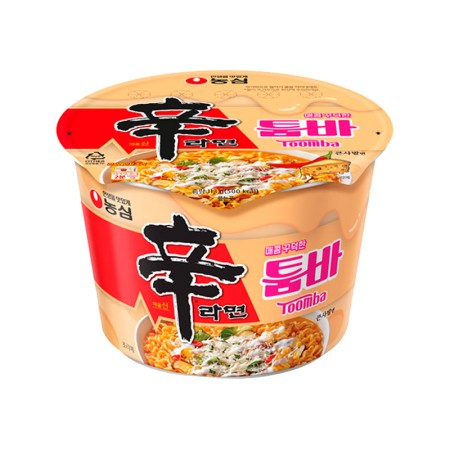
That origin story matters because the retail product behaves differently from ordinary soup ramen. Shin Ramen Toomba Big Bowl 113g is a sauce-style noodle. It is prepared with a smaller quantity of water, then finished with a second seasoning to create a thicker coating rather than a full bowl of broth.
Nongshim launched the Big Bowl in September 2024. The current Korean product page lists 113g, 500 kcal and six months shelf life from manufacture. KCN lists the exact SKU as Nongshim Shin Ramen Toomba Big Bowl 113g, Korean name 농심 신라면 툼바 큰사발면 113g, barcode 8801043017022, with 16 bowls per carton. The food inside those 16 units totals 1.808 kg net weight, excluding packaging.
Its preparation tells you what the product really is
The microwave method uses 220 ml of boiling water, considerably less than the 400 ml used for the standard Shin Big Cup. The spicy pre-seasoning goes in first, the bowl is microwaved for two minutes at 1,000W or two minutes forty seconds at 700W, and the creamy finishing powder is mixed in afterward.
The non-microwave method is even more revealing. The noodles are covered with boiling water, left for around three minutes, then the water is drained through openings in the lid before the seasonings are mixed through the noodles.
That is the technical reason an importer should not label Toomba as if it were simply another Shin soup cup. The water volume, drain step and final mixing are central to the finished product. If the preparation directions are mistranslated, the consumer can easily end up with the wrong texture.
Nongshim turned an existing modification into a standardized SKU
Nongshim’s launch announcement said the company wanted to reproduce the spicy-creamy balance of the consumer-made recipe. This is one of the few KCN catalogue products where the product story can be told without reaching for vague trend language: the manufacturer itself documented the recipe lineage and the date it commercialized it.
The timing is also useful. The Toomba Big Bowl arrived in 2024, decades after the original Shin Ramyun and long after the 1997 standard cups. A retailer can therefore position it as a newer branch of the Shin family rather than another size of the core product.
That distinction can matter in ordering. A buyer may keep standard Shin as a high-replenishment base SKU and test Toomba in a smaller quantity until local reorder behavior becomes clear.
The formulation creates different ingredient questions
Nongshim describes the product around a creamy element added to Shin’s spicy profile. The original consumer recipe cited milk and cheese, but an importer should not turn that recipe story into an ingredient declaration for the packaged product. Only the exact current specification for barcode 8801043017022 should be used for allergen and labeling work.
The product’s commercial concept tells the importer to pay particular attention to milk-related allergens and any flavor components used to reproduce the creamy profile. The destination-market ingredient file needs to answer those questions directly.
The same goes for halal or other certification. Do not infer status from the Shin brand. Request certification for this exact SKU if the customer or country requires it.
The bowl uses space and has a six-month clock
Sixteen units at 113g produce 1.808 kg of declared food net weight per carton. That number is useful only as a floor for freight calculations. The bowl, lid, sachets and outer carton add weight; the rigid packaging adds substantial volume. Current carton dimensions and gross weight should come from KCN or the supplier.
The six-month shelf life makes opening quantity important. A 2024 line extension may not have the same local sales history as core Shin. Importers should avoid using the brand’s overall reputation as a substitute for SKU-level demand. The first order should reflect real retailer commitments and the age of the batch being offered.
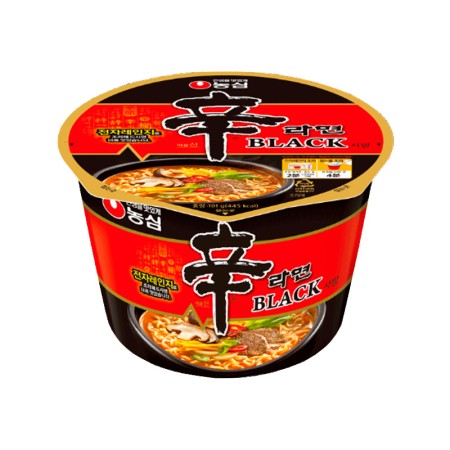
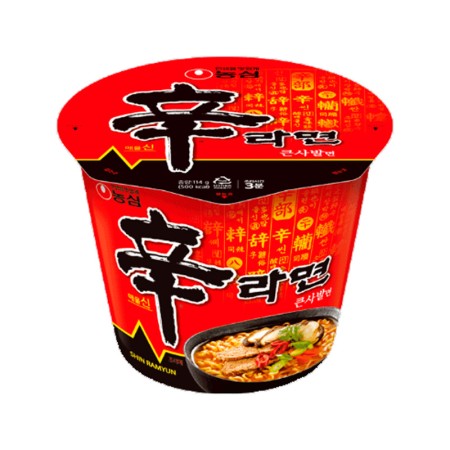
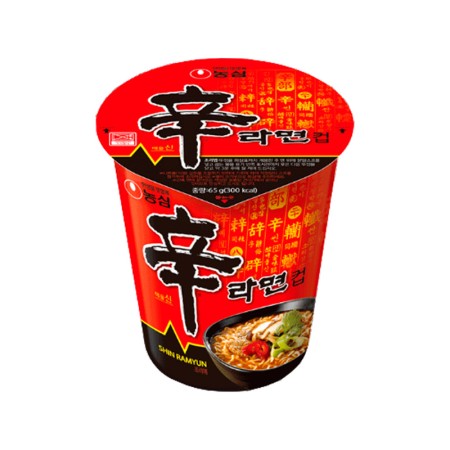
This product also makes a mixed-Shin range more interesting. KCN can quote standard Shin, Shin Black, Toomba and other variants together. A supermarket can then choose products that occupy genuinely different positions instead of adding several cups that tell the same story.
For KCN’s current catalogue, the Toomba reference is 113g, barcode 8801043017022, 16 bowls per carton.