
Nongshim launched Shin Ramyun Black in 2011 as a richer offshoot of the Shin line. The company’s current Korean product material describes the Black broth around beef and pork bone stock, with meat, shiitake mushroom and egg among the substantial garnish components. That is a material product difference from the standard Shin line and a much better basis for retail positioning than calling it “premium” repeatedly.
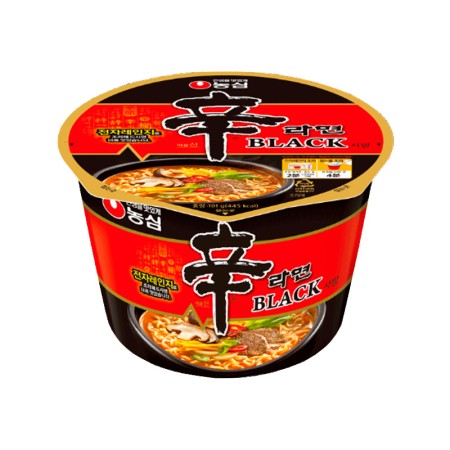
The KCN SKU is Nongshim Shin Ramen Black Cup 101g, Korean name 농심 신라면 블랙 컵 101g, barcode 8801043041447. KCN lists 16 cups per carton. At 101g each, the declared food weight inside a carton is 1.616 kg, excluding the bowl and all shipping packaging.
Nongshim lists the Korean bowl at 101g, 445 kcal and six months of shelf life from manufacture. Its preparation system is more elaborate than the 65g red cup. The current instructions use 330 ml of boiling water. For microwave preparation, the lid is fully removed, the pre-seasoning is added, and the bowl is heated for two minutes at 1,000W or two minutes forty seconds at 700W. A post-seasoning powder is added after heating. Without a microwave, the product can be prepared with hot water and a roughly four-minute stand before the finishing seasoning is mixed in.
That second seasoning stage is part of the product design. An importer preparing translated instructions cannot simply write “add boiling water and wait three minutes” because that describes a different Shin cup.
Shin Black has an unusual commercial history
The Black line is also one of those products whose international story fed back into the Korean market. Nongshim’s 2012 annual report says exports of Shin Ramyun Black began in September 2011 and describes strong overseas distribution in markets including the United States, China and Japan. The company later leaned into Black as a differentiated Shin product rather than a simple packaging variant.
For a modern buyer, the historical sales figures are less important than the lesson: Shin Black was designed to occupy another tier of the ramen range. The formula, garnish and preparation are different enough that a retailer can place standard Shin and Shin Black next to each other without pretending they are interchangeable.
That said, the importer still has to make the local price architecture work. A richer formula usually has to support a higher landed cost and shelf price. The gap between Black and standard Shin should make sense after freight, duty, tax and retailer margin are added.
The garnish and broth change compliance questions too
The ingredient complexity deserves attention. Nongshim’s Korean product description references beef and pork bone stock and a garnish that includes meat, mushroom and egg. Those are not details to copy casually into every country-specific article. They tell the importer where to look.
Some destinations apply additional scrutiny to animal-derived ingredients or flavorings. Others may have labeling, halal, veterinary or compositional questions depending on the exact formula and origin documentation. The importer should obtain the exact export-batch specification and confirm destination rules before assuming that the product follows the same regulatory path as a simpler vegetable-seasoned noodle.
The same caution applies to halal claims. Do not infer certification from another Shin product, from a factory, or from a different market pack. If a buyer needs halal documentation for barcode 8801043041447, that exact document should be requested.
The 101g bowl is engineered for two preparation methods
The microwave option is commercially useful because it changes where the product can be consumed. Offices, dormitories, convenience environments and workplaces with microwave access can treat the bowl differently from a product that only needs hot water.
That flexibility needs to survive translation. The local label should clearly preserve water quantity, microwave wattage and the finishing-powder step. Incorrect preparation directions create a poor product experience even when every customs document is correct.
The bowl format also introduces the same freight-density problem seen elsewhere in cup noodles. Sixteen bowls contain only 1.616 kg of food net weight. The shipping carton will weigh more and occupy much more space. Carton dimensions and gross weight should be requested from KCN before comparing this SKU with packet Shin Black or standard Shin.
A Black Cup order should be built around its place in the range
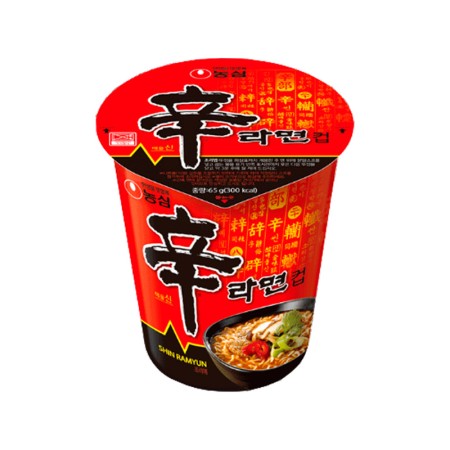
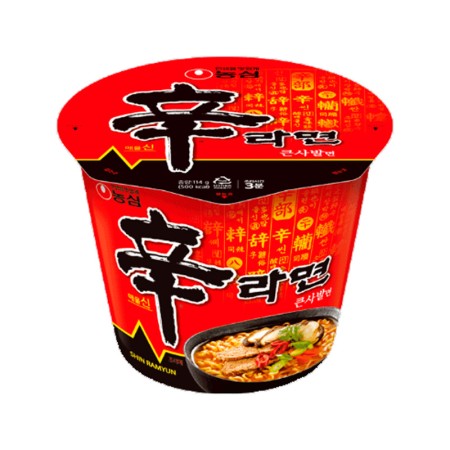
KCN carries the standard 65g Shin Cup, 114g Big Cup, Shin Black Cup and several later Shin extensions. That gives an importer choices, but it also creates a risk of SKU clutter.
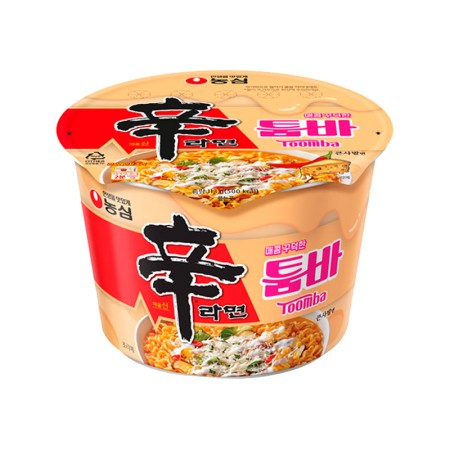
Black is easiest to justify when it has a clear shelf role. Standard Shin can anchor the line. Black can occupy the richer, more elaborate product position. Toomba can serve a sauce-style creamy extension. The Red can satisfy a different heat proposition. A retailer does not need every one of them to tell that story.
For KCN’s current catalogue, the Black Cup reference is 101g, barcode 8801043041447, 16 pieces per carton. The import file should then add current shelf life, exact ingredient and allergen documentation, current carton dimensions, gross weight and any destination-specific product certificates.