
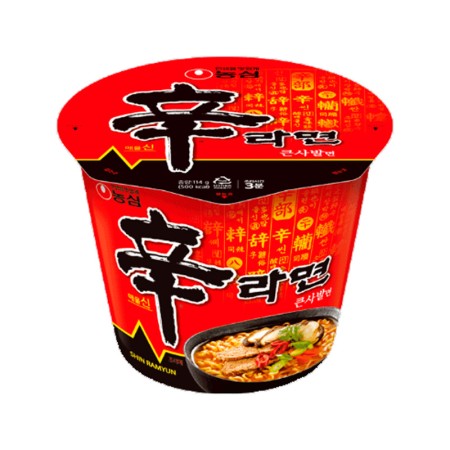
For an importer, the 114g cup has a clearer commercial story than “bigger Shin.” It is almost the weight of the original 120g packet while keeping the convenience of a self-contained cup. Nongshim lists it at 114g, 490 kcal, six months shelf life from manufacture, with a simple hot-water method using 400 ml of boiling water and about three minutes of standing time.
KCN’s catalogue lists Nongshim Shin Ramen Big Cup 114g, Korean name 농심 신라면 큰사발 114g, barcode 8801043015981, with 16 cups per carton. Sixteen retail units at 114g equal 1.824 kg of declared food net weight per carton, excluding the cups and shipping materials.
The piece count is lower than the 65g cup’s 30-per-carton configuration, but the food weight inside a case is surprisingly close: 1.824 kg for the Big Cup versus 1.95 kg for the small cup. The carton cube is the number that will show how efficiently each version actually travels. That information needs to come from the current shipping pack.
It occupies a different place between packet ramen and cup ramen
The original Shin packet is 120g. The Big Cup is 114g. In net food weight, they are very close. Their preparation formats are completely different.
A packet is a cooking product. The Korean Shin packet is prepared in boiling water in a pot. The Big Cup asks the customer to add soup powder and 400 ml of boiling water directly to the container and wait. That distinction can influence where the product sells. A supermarket shopper buying pantry stock may prefer packets. A customer shopping for an office, dormitory, convenience store or quick meal may value the bowl format more.
For a trade buyer, the comparison should therefore be made by occasion and landed price, rather than grams alone.
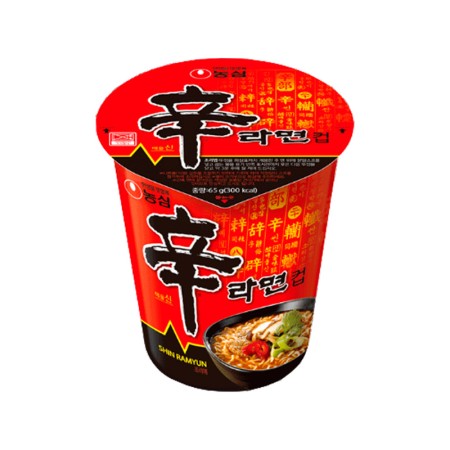
The Big Cup also sits almost twice the retail net weight of the 65g Shin Cup. An importer who lists both should give the retailer a clear reason for both sizes to be present. If the final shelf prices end up too close, the small cup can look poor value. If they are too far apart, the Big Cup may be difficult to move. The right spread depends on local freight, taxes and retailer margin, not on the Korean recommended retail structure.
The same fried-noodle technology has different logistics consequences
Like the standard cup, the Big Cup uses fried noodles. Nongshim’s process explanation applies here as well: the noodles are cooked and fried in hot oil to remove moisture, with Nongshim managing its fried noodle moisture below 7%. That low moisture supports shelf stability and rapid rehydration.
The rigid cup is the trade-off. A 114g bowl needs physical space. On a pallet or LCL load, it cannot be compressed like packet ramen. Sixteen large cups may therefore occupy a disproportionate amount of cube compared with their 1.824 kg of food.
This is where buyers should stop using retail weight as a proxy for freight. Ask KCN for the current carton dimensions and gross weight. For LCL, calculate the carton’s cubic meters. For container planning, look at how many cartons fit a pallet and how the bowl cartons stack with the rest of the order.
Six months from manufacture is a real procurement constraint
The Big Cup has the same six-month shelf life Nongshim publishes for the 65g cup and packet Shin. Buyers should treat that as a countdown from manufacture. A stock lot that is already eight weeks old when ordered leaves a very different commercial window from freshly produced goods.
This becomes important if the importer is adding the Big Cup alongside the 65g cup. Two sizes can split sales. A large first order of both may leave the slower size aging in the warehouse.
A better approach is to use the buyer’s retail network to decide the opening mix. Convenience-led accounts may favor one format; supermarkets may accept both. Order depth should follow the actual placement plan.
The Big Cup gives KCN a useful range-building conversation
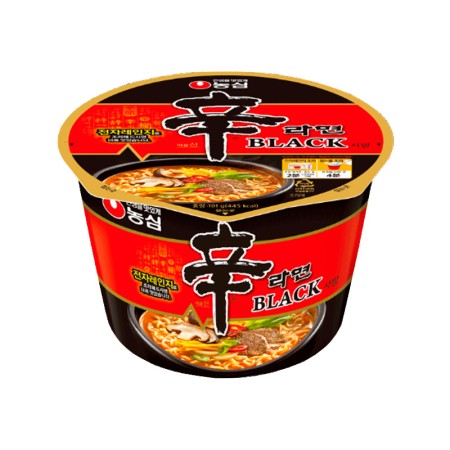
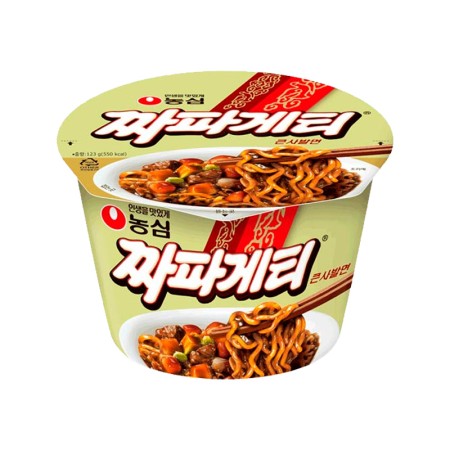
KCN lists the 114g Big Cup beside the 65g cup, the 101g Shin Black Cup, The Red 117g and Toomba 113g. An importer looking at the Big Cup can therefore compare formats close in size but very different in product proposition.
The decision should not be “take one carton of everything.” A useful range might be standard Shin Big Cup plus one differentiated variant. Another retailer may prefer standard 65g cup and Shin Black. A third may only need the packet format.
That is the level at which the sourcing conversation becomes commercial rather than catalog-driven.
For the current KCN catalogue, the Big Cup reference is 114g, barcode 8801043015981, 16 pieces per carton. Before the purchase order is fixed, confirm current batch age, shipping-carton dimensions, gross weight, destination label requirements and the rest of the Korean products being consolidated.