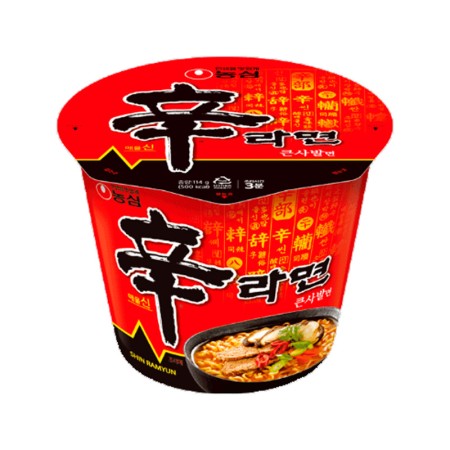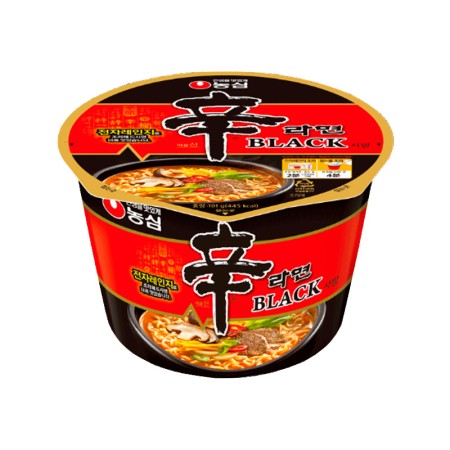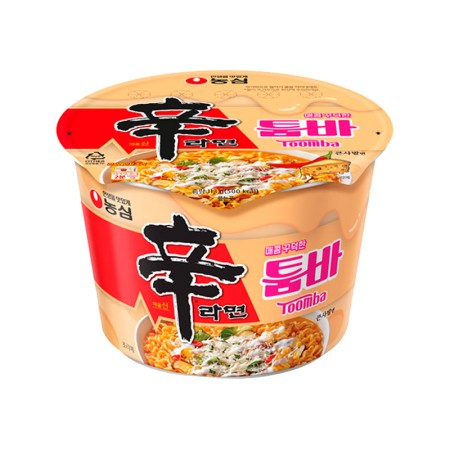

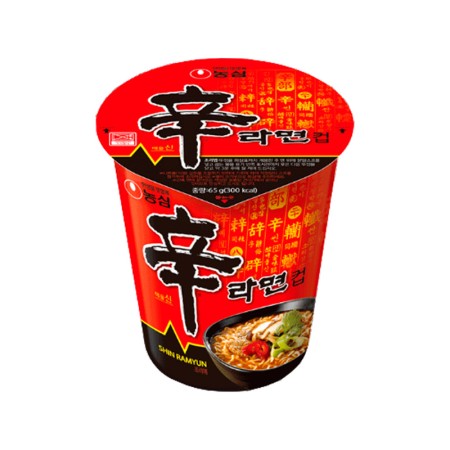
The familiar red cup can make an overseas buyer feel as though most of the work has already been done. Shin Ramyun is established, the product is compact, and a 65g cup looks simpler to import than a chilled meal or a glass beverage. Yet the commercial details are where this SKU becomes interesting. The Korean cup has its own weight, barcode, carton count, preparation method and shelf-life clock. Other markets carry Shin cups in different pack sizes, so an importer who copies data from an American or European listing can end up building a label or purchase file around the wrong product.
The product KCN lists is Nongshim Shin Ramen Cup 65g, Korean name 농심 신라면 컵 65g, barcode 8801043015714. KCN’s catalogue places it under Instant Noodles & Ramyun / Cup & Bowl Noodles and lists 30 cups per carton. That means one carton contains 1.95 kg of declared product net weight before the cup, lid, soup sachet packaging and outer carton are counted. Thirty pieces is a carton configuration, not automatically the MOQ.
The cup belongs to a product line that started much earlier. Nongshim launched the original packet Shin Ramyun in October 1986. The Korean 65g cup followed in August 1997, more than ten years later. That timeline explains the role of the cup better than any marketing adjective can. The original product came first; the cup translated the same Shin identity into a faster single-serve format.
Nongshim currently lists the Korean cup at 65g, 300 kcal and six months of shelf life from manufacture. Preparation is deliberately simple: add the powdered soup to the cup, fill with boiling water to the marked line, close the lid and wait roughly three minutes. This matters to a supermarket or convenience buyer because the cup serves a different occasion from the 120g packet. The packet asks for a pot and several minutes of cooking. The cup is built around immediate preparation in its own container.
The noodle itself is an engineered shelf-stable product
Nongshim classifies Shin Cup as a fried-noodle product. Its own technical explanation of this noodle type is useful for importers because it shows how the product is made shelf stable. The noodles are cooked, then fried in oil heated to as much as about 150°C. The frying stage removes moisture. Nongshim states that fried noodles can be taken below the 10% moisture level at which microorganisms can readily proliferate, and that its own fried noodles are managed below 7% moisture.
That gives the importer a more precise picture of the SKU. The cup does not contain a fresh noodle sitting in a preserved soup. It contains a low-moisture fried noodle block, dry soup seasoning and dried garnish that are rehydrated immediately before consumption. The product’s shelf life depends heavily on that low-moisture system and on the integrity of the sealed packaging.
This is also why moisture damage, punctured packaging and bad warehousing matter. A cup can have months left on the printed date and still be commercially compromised if the barrier packaging has been damaged or the carton has been stored in poor conditions.
The six-month shelf life is shorter than many importers assume
Six months from manufacture is workable, but it is not generous enough to ignore procurement timing. An importer does not receive six fresh months at the destination port. Some of that time may already have elapsed before the product is allocated. More disappears during domestic pickup in Korea, consolidation, vessel scheduling, ocean transit, customs clearance, inland delivery and the retailer’s warehouse intake process.
A supermarket chain may also impose its own minimum remaining shelf-life rule. A product can be legally saleable while still being rejected by a customer because too much of the commercial window has already gone.
For this SKU, the quotation stage should include a batch question. Ask for the current manufacturing date or remaining shelf life before confirming volume. The right quantity depends partly on how quickly the importer can place the goods after arrival.
A 65g cup is light; the carton is not “cheap freight” by definition
The retail weight can be misleading. Cup noodles have poor packing density compared with flat packet noodles because the rigid cup occupies space and must protect the noodle block. Freight can therefore become volume-driven, especially on LCL shipments.
KCN’s catalogue gives the buyer the piece count: 30 cups per carton. It does not give a current shipping-carton dimension or gross carton weight in the data used for this article, so those should be requested rather than guessed. The 1.95 kg calculation is only the sum of the declared food weights, 65g × 30. It is not the shipping weight.
This distinction matters when comparing the cup with the 120g packet or with a larger cup. The smallest retail unit is not necessarily the most freight-efficient unit. A buyer planning a mixed Korean-food shipment should compare carton cube, not only product kilograms.
The Korean 65g SKU should be treated as its own product
Search for Shin Cup online and several market versions appear. That is useful for consumers and dangerous for compliance work. A U.S. Shin cup, for example, may have a different net weight and a different local ingredient or nutrition panel. Those foreign-market listings should not be copied into an import file for barcode 8801043015714.
The Korean-market pack should be the starting point for destination labeling. The importer needs the exact ingredient declaration, allergen statement, nutrition information, origin details, date marking and preparation instructions for the batch being exported. If the destination permits supplementary stickers, the sticker should be built from those exact documents.
The same principle applies to customs classification. Instant noodles usually fall within the prepared-pasta/noodle area of tariff schedules, but the precise HS classification, import duty and local food controls should be confirmed for the destination country. A tariff code used by another importer in another country is not evidence that the same code applies everywhere.
The 65g cup is one point inside a much larger Shin range
KCN’s catalogue is useful here because it shows the neighboring products rather than presenting Shin Cup as an isolated item. Alongside the 65g cup, KCN lists Shin Ramen Non-Frying Cup Noodle 77g, Shin Ramen Big Cup 114g, Shin Ramen Black Cup 101g, Shin Ramen The Red Big Cup 117g and Shin Ramen Toomba Big Bowl 113g.
Those are not five interchangeable red cups. The 65g SKU is the compact single-serve product. The 114g Big Cup is substantially larger. Shin Black changes the formula and price tier. Toomba is a sauce-style product built from a newer offshoot of the Shin line. A retailer may need two of these products, not all of them.
This is where KCN can add value beyond forwarding a price. A buyer can send the intended destination, channel and product list and build a small Shin assortment around actual shelf roles. That is a stronger sourcing exercise than asking for “Shin Cup price” with no context.
For the current KCN catalogue, the key reference points are 65g, barcode 8801043015714, 30 cups per carton. The next useful questions are current batch date, carton dimensions, gross shipping weight, current availability and the other Korean products that will travel in the same order.