
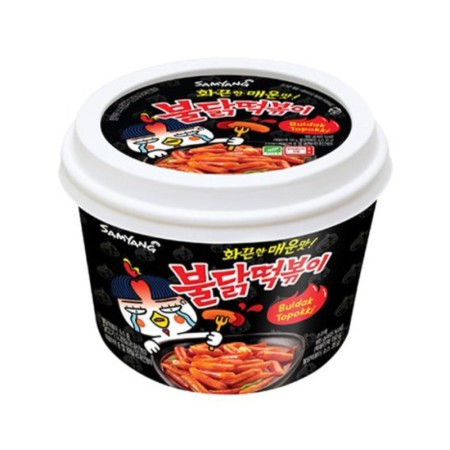
Samyang launched the product in October 2018. The official Korean product page lists 185g, 445 kcal and an eight-month shelf life. More importantly, the manufacturer separates the food types into rice cake and a sterilized sauce. The rice cakes are produced by Youngpoong, while Samyang Foods manufactures the Buldak sauce.
That production split is the kind of detail that matters in export work. An importer dealing with destination registrations, factory information or supporting certificates may need to know that the components are not all manufactured by one plant.
KCN lists SAMYANG BULDAK TTEOKBOKKI ORIGINAL 185g, barcode 8801073310926, with 16 units per carton. That gives the carton 2.96 kg of declared product net weight before cups, spoons and outer packaging.
The package contains multiple food components
Samyang’s official specification lists packaging materials separately for the container, rice cakes, sauce, lid and spoon. The container, rice-cake pouch and sauce use polyethylene on the relevant inner/contact layer, while the lid and spoon are polypropylene.
This matters because tteokbokki is not a single dry block with powder seasoning. It is a kit containing rice cakes and sauce, assembled into a convenience-meal format.
The shelf-life mechanism is therefore different from fried instant noodles. You should not copy the six-month fried-noodle explanation into this article. The manufacturer gives the tteokbokki an eight-month shelf life, and the sauce is identified as a sterilized product.
That product engineering is exactly the kind of technicality a buyer should see before the article starts discussing freight.
Rice cake changes the import questions
The importer needs the exact ingredient and product specification for both the rice cake and sauce. Depending on the destination, rice products, sauces, preservatives, animal-derived flavorings or other components may be treated differently from ordinary instant noodles.
The product should also be checked for storage requirements. KCN’s classification places it alongside instant noodle products, but category placement in a sales catalogue is not a storage specification. The actual manufacturer documents and retail pack control the handling requirement.
Preparation instructions matter more here because an overseas consumer may never have cooked packaged tteokbokki. A poor translation can produce a product that looks wrong even when the formula is fine. The local label should preserve the exact water quantity, heating method and sequence shown on the current pack.
The Buldak name gives the product a bridge into another category
This is the commercial story of the SKU. A buyer may already know Buldak as noodles, then use the same flavor family to introduce Korean rice cakes.
That can make the product useful in a Korean-food range because it expands the category without asking the retailer to introduce a completely unrelated name.
At the same time, tteokbokki should not automatically receive the same opening quantity as Buldak ramen. The format, retail price and customer familiarity are different. An importer may need a smaller first order while the retailer learns the category.
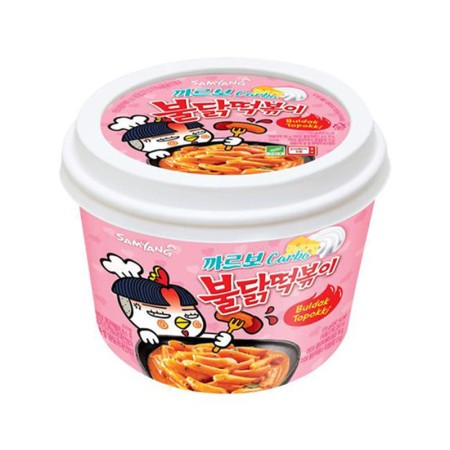
KCN also carries Carbonara and Rose Buldak tteokbokki. Those variants give the buyer room to build a small tteokbokki set, but the Original 185g product is the clearest starting point.
For the KCN catalogue, the reference is 185g, barcode 8801073310926, 16 units per carton.