
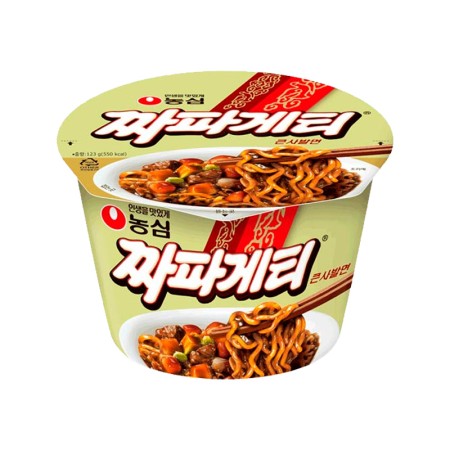
Nongshim launched the original Chapaghetti in March 1984 as an instant product built around jajang-style noodles. The 123g Big Cup followed on 10 April 1992. The cup therefore predates Shin Cup by more than five years and belongs to an older strand of Korean convenience noodles that was built around dry sauce-style eating rather than spicy soup.
Nongshim’s current Korean product page lists Chapaghetti Big Cup at 123g, 550 kcal and six months shelf life from manufacture. The company also classifies it as a fried-noodle product. KCN lists Nongshim Chapaghetti Big Cup 123g, Korean name 농심 짜파게티 큰사발 123g, barcode 8801043016049, with 16 bowls per carton. Sixteen units contain 1.968 kg of declared food net weight.
For a buyer who already carries Shin, the product creates category breadth rather than another heat level. Chapaghetti’s role is built around black-bean-style sauce noodles. That difference should be visible in the product story, shelf placement and search strategy.
Chapaghetti belongs to a different instant-noodle eating format
The original Chapaghetti line is associated with a thick jajang-style sauce rather than soup. That changes what the cup has to accomplish. The noodle and seasoning need to rehydrate into something that can be mixed and eaten as a coated noodle dish.
Nongshim’s own current brand page describes the Big Cup as part of the Chapaghetti family and lists the same six-month shelf life used across many of its fried-noodle products. The fried-noodle production explanation is the same basic technology: cooked noodles are fried at high temperature to drive out moisture and produce a rapidly rehydratable shelf-stable noodle block.
The commercial result is a pantry-stable product that can deliver a different Korean noodle experience without a chilled sauce pouch or frozen logistics.
The cup’s age is part of the story
A 1992 launch date is useful because it shows that Chapaghetti Big Cup was not created as a response to the recent international attention around Korean noodles. It had already existed for decades before the current K-food export boom.
That history gives an importer something concrete to say to a retail buyer: this is a long-running Korean cup format built from a brand launched in 1984. It does not require inflated claims about global popularity or cultural importance.
The timeline also explains the family structure. Nongshim currently sells multiple Chapaghetti formats, including the 140g packet, a 70g cup format and newer extensions such as The Black. KCN’s catalogue likewise contains several Chapaghetti products. A buyer can decide whether the 123g Big Cup should be the main cup listing or sit beside a smaller version.
The 123g bowl is heavy for a cup noodle, but freight is still about cube
At 123g, this is one of the larger cup products in the initial KCN blog list. Sixteen units equal 1.968 kg of declared food weight. The current shipping-carton gross weight will be higher, and the cup shape will make the cube much larger than a similarly weighted packet-noodle carton.
That makes it worth comparing against both the 70g Chapaghetti cup and the 140g packet if the buyer is deciding which format to import. The Big Cup may offer the most substantial single-serve experience, but the packet can be more efficient in freight and the smaller cup can reach another retail price point.
The correct answer depends on the destination and retail channel.
The label should explain the product, not turn it into a history lesson
Outside Korea, “Chapaghetti” does not automatically tell a buyer what is in the cup. The local description should make the black-bean-style noodle format understandable. That can be done in a short product description without inventing claims about authenticity or copying restaurant terminology that does not match the packaged food.
The exact current ingredient list and allergen declaration should be used for destination compliance. The product family and flavor style suggest areas to review, but they do not replace the specification. If the destination needs local-language cooking directions, those should follow the current pack exactly.
Carton count also needs to stay separate from MOQ. KCN lists 16 units per carton for barcode 8801043016049. That is the physical case configuration. Commercial minimum order should only be stated when KCN has confirmed it.
A Chapaghetti Big Cup enquiry can also expand naturally into a broader Nongshim noodle order. Standard Shin gives a soup product; Chapaghetti gives a sauce-style jajang product; other cup and bowl formats add further variety. That creates real assortment logic instead of stacking five spicy cups next to each other.