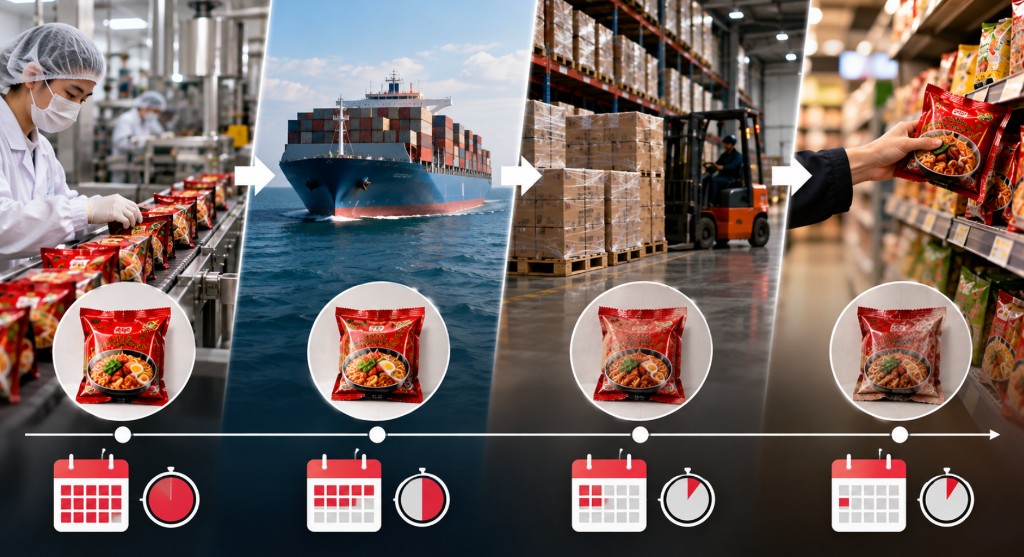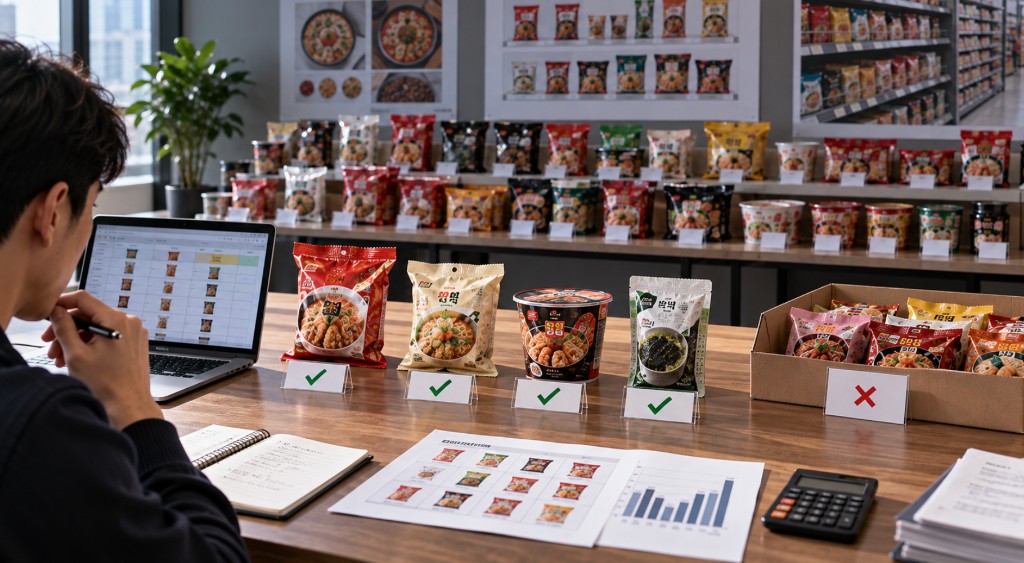

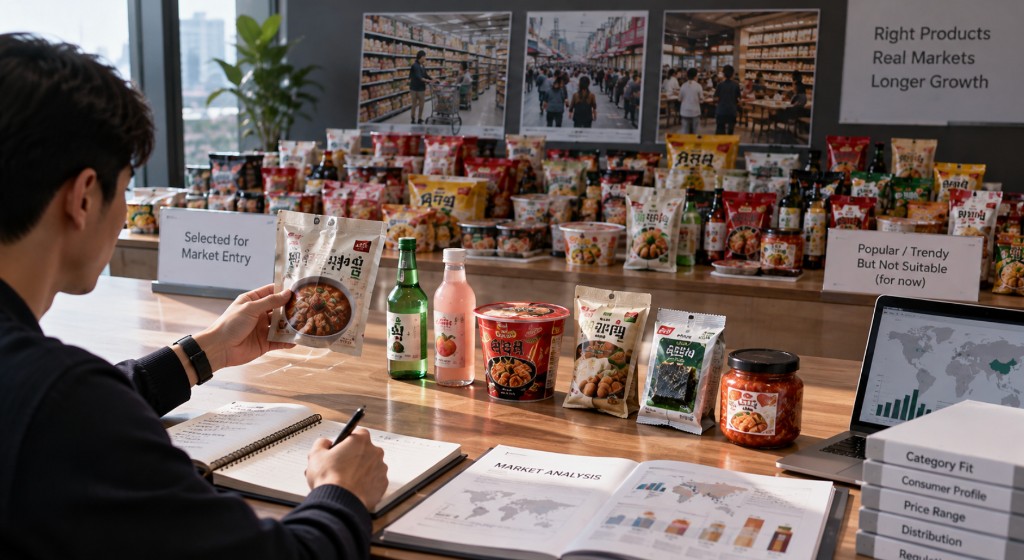
This is where many new import programmes become too dependent on trends. A product appears repeatedly on social media, a particular flavour becomes popular for a few months, or a retailer asks whether the importer can supply the latest Korean snack seen online. Those signals can be useful, but they should not become the entire purchasing strategy. By the time an overseas importer finds the supplier, negotiates the order, consolidates the goods, ships the container and distributes the product, the original trend may already be weakening.
A better range contains products that can continue selling after the first wave of curiosity disappears. Trends can help bring customers into the category, but the products that build the business are usually the ones people buy again.
Start with the customer you are actually supplying
The same Korean product can perform very differently depending on where and how it is sold. A premium supermarket, Asian grocery store, convenience store, online retailer and wholesale distributor do not need the same assortment.
A buyer supplying convenience stores may care heavily about unit price, impulse purchasing, small package size and fast rotation. A premium supermarket may accept a higher selling price if the packaging, brand and product proposition justify it. An Asian grocery retailer may have customers who already understand Korean products and are willing to buy larger packs or more specialised ingredients.
The importer should therefore begin with the customer channel rather than the Korean catalogue.
Suppose the importer is supplying supermarkets where most snack purchases fall below a particular retail price. A Korean snack may look excellent at USD 1.20 ex-factory, but after freight, duty, distributor margin and retailer margin, the final shelf price could become too high for the category. Another product with less impressive packaging but better carton efficiency and a lower landed cost may perform much better.
This is why product selection needs to begin with an approximate acceptable retail price. The importer can then work backwards to determine what landed cost is commercially possible.
If the final market can realistically support a retail price of USD 2.50, the product selection process should reflect that limit before the buyer becomes attached to a particular brand.
Build the range around products people can reorder
A strong product range normally needs several different roles. Some products bring attention to the catalogue. Others generate frequent repeat purchases. Some provide good margins, while a smaller number can be used to test new categories or consumer interest.
The mistake is allowing the experimental part of the catalogue to become larger than the repeatable part.
Consider two Korean snacks. Product A is visually unusual and receives a lot of social-media attention. Customers frequently buy it once to try it. Product B looks more ordinary but people who like it buy it every few weeks.
Product A may produce a strong first shipment.
Product B may produce a business.
This does not mean the importer should avoid unusual products. A catalogue without anything new can become boring, particularly in a category where discovery is part of the appeal. The purchasing quantity should simply reflect the difference between curiosity and established consumption.
For a new product, the buyer may begin with a limited number of cartons and watch what happens after the first sale. The useful question is not only how quickly the first stock disappears, but whether retailers reorder it and whether consumers buy it again.
A first order can be driven by novelty. A second and third order begin to show whether the product has a place in the market.
Price needs to be considered after freight, not before it
Products should not be shortlisted using Korean supplier prices alone. A low-priced product can become expensive once shipping is included, particularly when it occupies a large amount of space relative to its value.
Lightweight snacks are a common example. A carton may weigh very little while occupying considerable CBM because of the retail packaging. The factory price looks attractive, but the freight cost per retail unit can be significant.
Beverages create a different problem. They may use container space efficiently but carry substantial weight. The cost of handling and transport can therefore behave differently.
When comparing products for a new market, it helps to calculate an estimated landed cost early rather than waiting until the final purchase order is complete. This does not need to be exact at the product-discovery stage. Even a rough estimate can remove products that will never work commercially.
Suppose Product A leaves Korea at USD 0.70 per unit and is expected to land at USD 1.05. Product B leaves Korea at USD 0.80 but lands at USD 0.98 because its carton configuration is more efficient. The product with the higher supplier price has become cheaper by the time it reaches the warehouse.
If this calculation is delayed until after supplier negotiations, the buyer can spend a lot of time developing products that were never commercially viable.
Shelf life should influence which products are used for testing
New products are uncertain by definition. That uncertainty becomes more dangerous when the product also has a short shelf life.
Suppose the importer wants to test two products. Both are expected to sell at roughly the same rate. One arrives with eleven months of remaining shelf life and the other with five months.
The second product gives the buyer much less time to learn.
If demand develops slowly, the first product can remain on sale while the importer adjusts distribution, pricing or promotion. The shorter-life product may require action before the market has produced enough information.
This is one reason longer-life products can be easier when first entering a market. They give the importer more room for mistakes.
Once demand becomes predictable, shorter-life products may be perfectly manageable because the buyer knows how much to order and when to replenish. The problem is combining uncertain demand, a large MOQ and limited shelf life in the first shipment.
The buyer should therefore look at shelf life as part of product-selection risk rather than treating it as something checked only after the products have been chosen.
A large catalogue is not the same as a strong catalogue
Korean manufacturers and exporters can provide enormous product catalogues. It is easy for an importer to believe that a larger assortment makes the business more competitive.
In practice, every additional SKU creates work.
The product needs purchasing data, pricing, images, descriptions, documentation, storage space and inventory tracking. The sales team has to understand it. Retailers may need samples or product information. If the SKU sells slowly, small amounts of capital remain trapped across many products.
An importer with 300 products can therefore have less useful inventory than one with 100 carefully selected products.
This is particularly important during the first few shipments. The buyer does not yet know which flavours, package sizes or categories will become core sellers. Bringing too many variations makes the sales data harder to interpret because demand is spread across similar products.
Suppose the importer wants to introduce Korean ramen. Bringing twenty flavours immediately may create impressive shelf presence, but it also divides the initial customer base across twenty SKUs. Starting with a smaller range of clearly different products can provide cleaner information. Once the stronger products become visible, the importer can expand around them.
The same applies to beverages, snacks, sauces and confectionery. Variety is useful when it helps the customer choose. Too much variety can turn into fragmented inventory.
New products should earn larger quantities over time
The first purchase quantity should reflect how much the importer knows about the product.
A product with confirmed retailer orders deserves more stock than a product selected from a catalogue two weeks earlier.
This sounds obvious, but supplier pricing can push buyers in the opposite direction. The supplier may offer a lower price at fifty cartons than at ten cartons. At one hundred cartons the price becomes even better.
The buyer now has to decide whether the saving is worth taking additional inventory risk.
Suppose the importer can buy twenty cartons at USD 25 each or fifty cartons at USD 23.50. The larger order saves USD 1.50 per carton. Across fifty cartons, that looks attractive.
The problem is that thirty additional cartons have been purchased to obtain the discount.
If the product sells quickly, the decision works well. If those cartons remain in storage for months, the discount has done very little for the business.
For a new market, it is often better to accept a slightly higher initial unit cost and buy information. Once the product has demonstrated demand, larger quantities can be negotiated with much more confidence.
The second or third order is where volume pricing becomes more meaningful because the importer has actual sales history.
Watch what retailers reorder, not only what they accept
A retailer agreeing to stock a product is useful, but it is not the same as consumer demand.
Retailers may accept new Korean products because the category is growing, because the packaging looks attractive or because they want to test something new. The stronger signal comes later.
Did the retailer reorder?
How quickly?
Was the reorder larger or smaller?
Did the retailer request the same product or ask to replace it?
This information should flow back into purchasing.
Suppose twenty retailers each accept one carton of a new drink. The importer sells twenty cartons quickly and might assume the product is successful. If only two retailers reorder after six weeks, the first shipment was largely pipeline filling rather than recurring demand.
Another product may initially enter only eight retailers but all eight reorder regularly. That product may deserve more inventory even though its first sales looked smaller.
Importers should therefore separate initial placement from repeat consumption when evaluating new products.
Be careful when one category is carrying the whole range
A new Korean food programme can sometimes develop around one successful category. Beverages may sell extremely well, while snacks, sauces and confectionery move slowly.
The temptation is to keep adding products to the weaker categories in the hope that one eventually performs.
Sometimes that works. Sometimes the market is telling the importer where the opportunity actually is.
If beverages consistently generate most of the sales and repeat orders, the business may be better served by building more depth around that category before forcing equal expansion elsewhere.
Category balance should not become an aesthetic goal.
The customer does not care whether the importer has exactly twenty products in every category. The customer cares whether the products offered are useful and priced correctly.
A strong portfolio can therefore be uneven.
One category may contain forty products because the demand supports it. Another may contain only eight.
The range should follow the market rather than the spreadsheet.
Trends are most useful as small experiments
Social media, Korean entertainment and online food culture can create sudden demand for specific products. Ignoring those signals completely would be a mistake. The problem comes when temporary attention is converted directly into large purchase orders.
A safer approach is to use trends for controlled experiments.
If a particular Korean drink suddenly receives attention, the importer can include a smaller quantity in the next mixed shipment, place it with selected retailers and observe the response. If the product sells and reorders continue, the quantity can increase.
If demand disappears, the loss is limited.
This also protects the buyer from timing problems. International trade moves more slowly than social media. A product can become popular and disappear from public attention within the time required to manufacture, ship and distribute a large order.
Products that depend entirely on a temporary online moment should therefore be bought differently from products with established consumption.
The purchasing quantity needs to reflect how long the demand is expected to survive.
The strongest products usually solve several problems at once
After a few shipment cycles, the products that deserve more space tend to become obvious.
They sell repeatedly.
Their landed cost leaves workable margins.
Their shelf life is manageable.
Their MOQ fits the reorder cycle.
Retailers are willing to reorder them.
The packaging survives international logistics.
The supplier can replenish them reliably.
A product does not have to be perfect in every area, but the stronger lines usually perform reasonably well across most of them.
That is why product selection improves when the importer stops asking whether a Korean product is “popular” and starts asking whether it works inside the distribution system.
The catalogue should be built around products the business can buy, ship, store, sell and reorder repeatedly.
A trend can introduce a product.
Repeat demand is what earns it a permanent place in the container.