
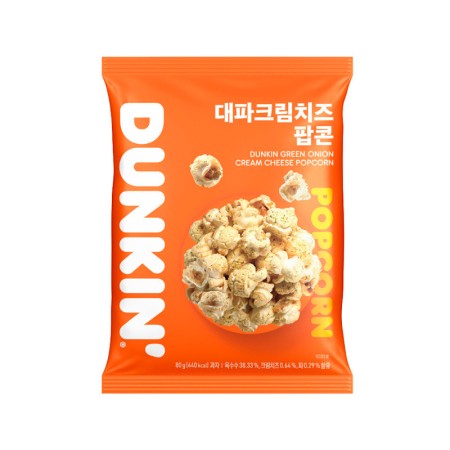
KCN lists the exact product as 던킨 대파크림치즈팝콘 80g, barcode 8809288634950, under Popcorn. The catalogue records room-temperature storage and 10 bags per carton. That means an entire commercial case contains only 800g of declared food net weight.
That is the freight story in one number.
Popcorn is extremely light for the space it occupies. A case with only 800g of food may take up much more cubic volume than a 3.6kg almond case or an 8.4kg porridge case. The importer therefore needs current carton dimensions before comparing products by freight cost.
The seasoning is also where the compliance work sits. “Green Onion Cream Cheese” strongly suggests dairy-related ingredients, but the actual milk, cheese powders, onion ingredients, flavorings and allergens need to come from the current label. A public product description is not enough to build an export declaration.
The pack is sold at room temperature according to KCN, which makes it easy to consolidate with other dry snacks. Physical stacking is still important. Popcorn bags require headspace and crush easily. They should not sit beneath beverage cartons or sauce cases.
KCN also lists a 15g Mini Green Onion Cream Cheese Popcorn with barcode 8809288635100 and 30 units per carton. That gives an importer a meaningful size decision. The 80g bag is a conventional retail snack. The 15g pack is closer to a trial or impulse format. A convenience chain may prefer one; a supermarket Korean-snack shelf may prefer the other.
The product story should stay anchored in that format and flavor connection. There is no need to write that green-onion cream cheese is “taking the world by storm.” The trade buyer needs to know that the SKU exists, how much it weighs, how many bags are in the case, what the flavor system implies for allergens and how inefficient popcorn can be in cubic freight.
For KCN, the reference is 80g, barcode 8809288634950, room-temperature storage, 10 bags per carton, 800g net food per case.