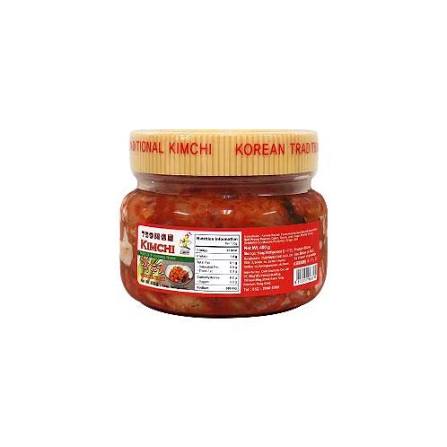

KCN lists barcode 8802257067926, tags the product Halal, Vegan / Vegetarian, and specifies refrigerated storage at 0–10°C. Twelve 400g packs contain 4.8 kg of declared food net weight.
Daekwang F&G’s own export catalogue identifies the corresponding Sukbakji-kimchi / cabbage & radish kimchi format at 400g, 12 units per case, case dimensions 430 × 310 × 105 mm, six months shelf life, and cold storage.
That makes the physical trade configuration effectively the same as Daekwang’s 400g sliced cabbage and cubed-radish products, which simplifies mixed-pallet planning.
The interesting part is the fermentation behavior. Napa cabbage and radish do not have the same density or water structure. Radish remains firmer and crunchier, while cabbage softens differently as fermentation progresses. A mixed product therefore gives the consumer two textures in the same pack, but it also means the producer has to balance brine, seasoning and fermentation across both vegetables.
Temperature control remains the decisive export variable. Kimchi continues to ferment after packing. A warmer cold chain accelerates acid development and gas production; a colder, stable chain slows it. The product may still be safe within its limits while changing noticeably in flavor and package pressure.
The Vegan / Vegetarian tag matters because conventional kimchi often uses fish sauce or salted seafood. The current ingredient specification should support the claim for barcode 8802257067926. KCN should not generalize the vegan status to all kimchi products.
The same applies to Halal certification. Daekwang has a documented certification history, but the importer should request the current certificate covering this exact SKU and production facility.
The six-month shelf life is not generous once chilled ocean freight, port clearance and retailer intake are included. Remaining shelf life should be quoted before the order is confirmed. This is especially important if the buyer is importing several kimchi variants that will compete for the same refrigerator shelf.
The 400g mixed format can be commercially useful because it gives customers cabbage and radish in one purchase. A retailer with limited refrigerated shelf space may prefer that to stocking separate 400g cabbage and radish SKUs. Another retailer may want all three. The decision should follow shelf capacity and sales data.
For KCN, the hard reference is 400g x 12, barcode 8802257067926, Halal, Vegan / Vegetarian, refrigerated 0–10°C, six-month manufacturer shelf life and 430 × 310 × 105 mm case dimensions.