
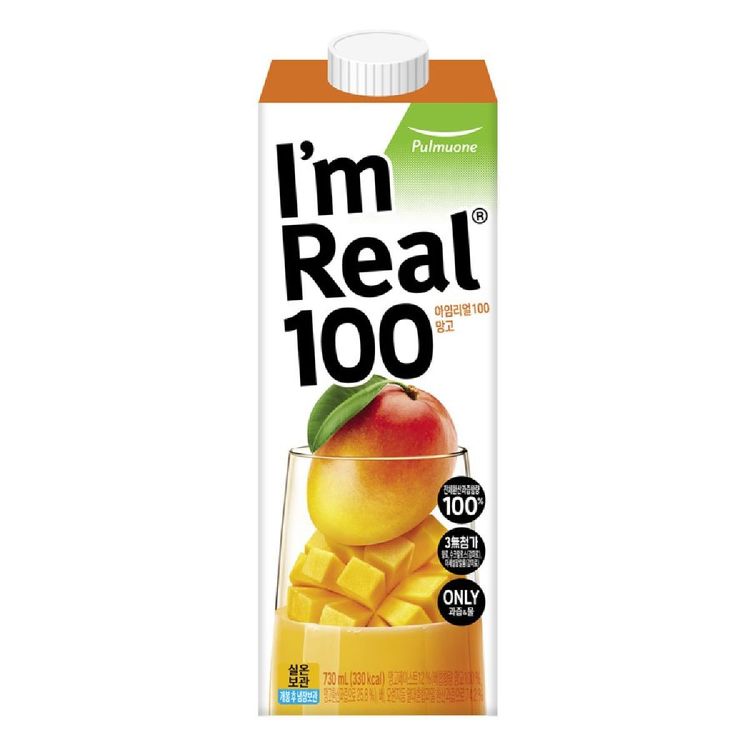
Pulmuone built the I'm Real name around refrigerated fruit and vegetable drinks, so an importer encountering the newer I'm Real 100 range can easily assume that the 730ml bottle belongs in a chilled chain. Pulmuone has since expanded the brand into shelf-stable products, and its 2026 corporate material describes I'm Real 100 as part of that ambient expansion. KCN lists PULMUONE I'M REAL 100 MANGO 730ml, Korean name 풀무원 아임리얼 100 망고 730ml, barcode 8801114174524, as a New Arrival. The KCN commercial sheet shows 8 units per carton.
Eight 730ml units represent 5.84 litres of nominal beverage volume per carton before bottle weight and outer packaging are added. That already tells the importer more than the retail pack photo does: this is a heavy case, and landed cost will be driven by liquid weight as much as by the Korean purchase price.
Pulmuone’s current shelf-stable strategy matters here because the brand used to be strongly associated with fresh refrigerated juice. In a 2026 newsroom update, the company said its shelf-stable food sales had grown sharply and identified I'm Real 100 as a flagship ambient beverage line. Pulmuone also said the line applies the additive-minimizing principles of the original I'm Real brand to products designed for room-temperature distribution. That makes the export route simpler than refrigerated juice, but KCN should still confirm the exact storage statement and shelf life for barcode 8801114174524 rather than borrowing a line-level claim from another I'm Real 100 SKU.
The “100” in the name also needs careful handling. An importer should obtain the exact Korean ingredient and juice-content declaration and use the manufacturer’s wording when preparing a destination label. It should not be rewritten as “fresh-pressed,” “not from concentrate” or “cold pressed” unless the technical specification explicitly says so. Fruit-content language is regulated differently across markets, and a brand name is not a substitute for the legal composition statement.
The 730ml size gives the product a household rather than single-serve role. KCN also carries Mango in a 840ml multipack made from six 140ml units, which is a fundamentally different retail proposition even though the flavor is the same. The 730ml SKU is one larger container. The 140ml format is portioned. An importer deciding between them should compare channel, shelf price, freight weight and how the retailer expects customers to use the product.
For freight planning, the current KCN sheet gives us the unit count but not a verified gross carton weight or carton dimensions. Those should be requested before building an LCL or container model. At minimum, the buyer knows that the beverage content itself is 5.84 litres per case. The final gross weight will be higher after the containers, closures and corrugated carton are included.
The strongest KCN page for this product should therefore lead with the format and supply-chain reality: 730ml ambient mango juice, barcode 8801114174524, 8 units per carton, 5.84 litres of beverage per case. From there, the buyer needs the exact juice-content wording, current shelf life, packaging format, case dimensions and gross weight.