
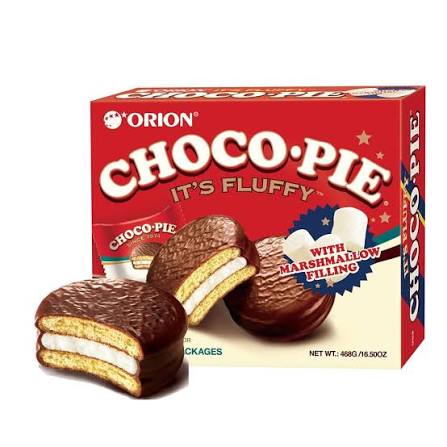
The current Korean retail box is 468g and contains 12 pieces. That makes each Choco Pie 39g. Orion lists 2,052 kcal for the 12-piece box, which works out to 171 kcal per piece, and gives the product a six-month shelf life. The current Korean allergen declaration includes wheat, egg, milk, soy, pork and beef.
Those last two animal-derived declarations are especially important for exporters. A buyer sourcing Choco Pie for a halal-sensitive market should not assume that the Korean domestic SKU is suitable because Choco Pie products sold in some other countries may have different formulations or certifications. Barcode 8801117534912 needs its own ingredient and certification review.
The 39g piece is the result of a documented product change
Orion launched Choco Pie in 1974. The company’s own 2024 corporate brochure records a meaningful reformulation in 2015: without raising the price, Orion increased the weight of each piece from 35g to 39g, increased the chocolate content by about 13%, and adjusted the texture.
That history matters because the present 468g box is mathematically tied to that 39g piece weight: 39g × 12 = 468g. The packaging is therefore not an arbitrary family-size number. It is the current twelve-piece expression of the product Orion has been refining for decades.
This is much more useful product storytelling than calling Choco Pie an “iconic snack.” The buyer can see exactly what changed and how the modern pack is constructed.
The product is a multi-layer food, and that affects handling
A Choco Pie combines cake layers, marshmallow filling and chocolate coating. Those components react differently to heat, pressure and age. The importer should therefore treat warehouse temperature and carton compression as real quality issues.
Chocolate can soften or bloom under poor temperature conditions. The cake can be crushed. The marshmallow structure can also make the finished piece more sensitive to deformation than a hard biscuit. None of this means refrigerated freight is required by default; it means ambient storage still needs to be sensible and the cartons should not be buried under heavy beverages or canned goods.
The six-month shelf life also makes the batch date worth checking. A twelve-piece box can be easy for a retailer to sell, but international transit, customs and distribution still consume part of the commercial window.
The allergen declaration tells an importer where not to make assumptions
Orion’s current Korean page explicitly lists pork and beef among the allergens or declared ingredients requiring notice. That is a detail an importer might never guess from a picture of chocolate-coated cake and marshmallow.
The export specification should therefore be reviewed before any halal, vegetarian or dietary statement is made. The buyer should also verify whether the destination-market version uses the same formulation as the Korean barcode in KCN’s catalogue.
A retailer may already know “Choco Pie” as a category, but multiple manufacturers and market-specific formulations exist. The barcode and producer matter.
KCN should fix the name before SEO creates a permanent typo
The KCN catalogue entry should read ORION CHOCO PIE 468g, not “CHOCHO PIE.” Product-name quality matters because the typo can leak into page titles, schema markup, invoices, feeds and search-engine indexes.
The exact KCN reference currently available is 468g, barcode 8801117534912, Orion, Cakes & Pies / Pies & Cakes. The carton count should be confirmed from KCN’s current commercial pack before publication if it is going to be stated on the page.